 Guide On Map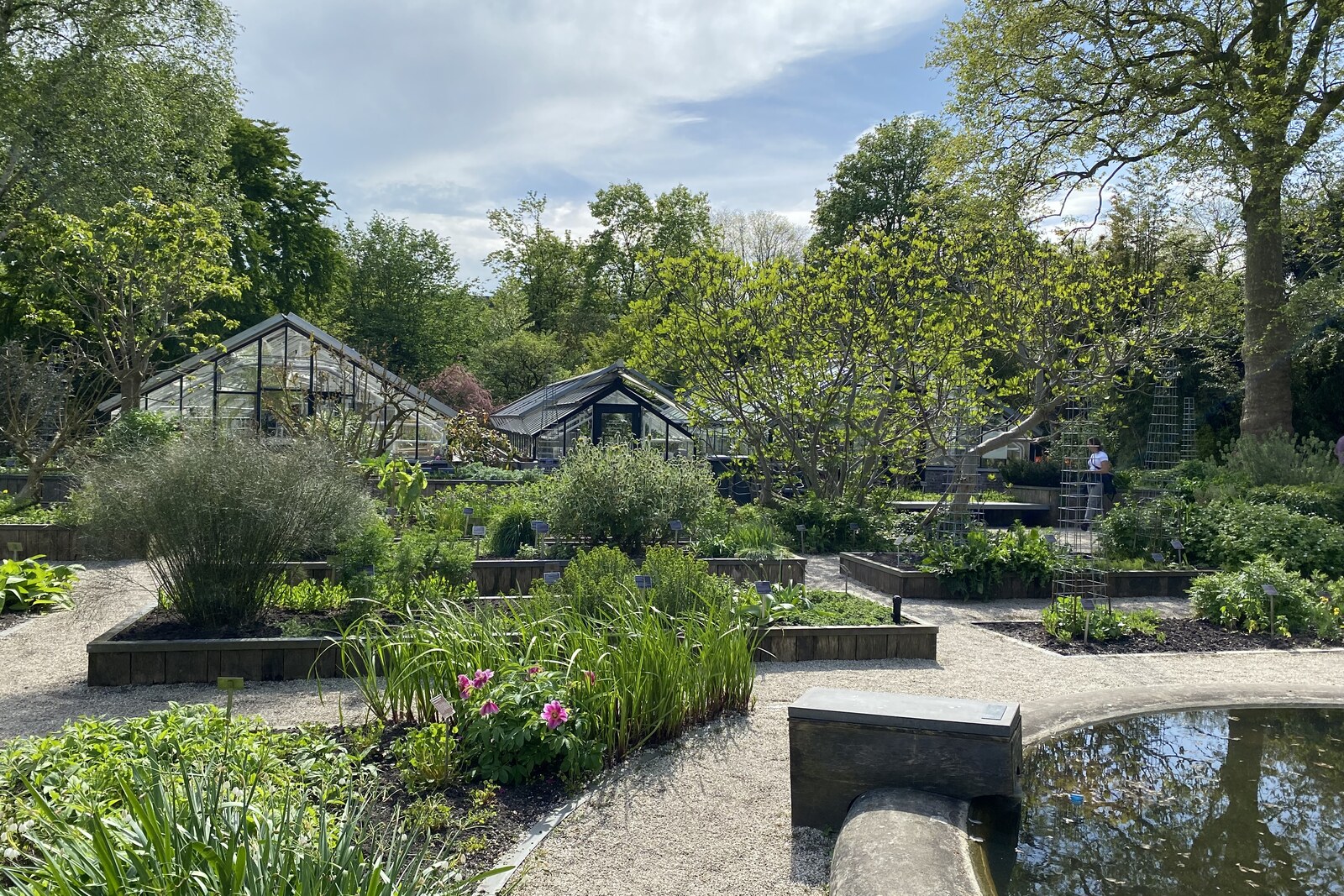
Look around first
What to notice
- The red-brick laboratory building
- The name Hortus Botanicus above the entrance
- The dates “1682” and “1912”
- The Palm Greenhouse
The story of the place
“Hortus Botanicus” means “botanical garden” in Latin. Amsterdam’s burgomasters founded it in sixteen thirty-eight for physicians and pharmacists: here, they learned to distinguish medicinal plants and took examinations. The garden was moved to its present site in sixteen eighty-two. Two centuries later, it became part of the University of Amsterdam, and plants here began to be grown for experiments in heredity.
One such experiment lasted thirteen years. Hugo de Vries, professor of botany and head of the university’s Botanical Institute, received a salary for teaching and research. He was interested in a question on which his scientific reputation depended: could new species arise at once, in a visible leap, or did changes always accumulate gradually?
In eighteen eighty-six, de Vries found an unusually variable evening primrose in an abandoned potato field near Hilversum. He moved its seeds to an experimental plot at Hortus Botanicus. He then grew generation after generation, selected plants with a new appearance, pollinated them with their own pollen, and sowed the offspring separately. About fifty thousand plants passed through these beds altogether.
In some descendants, the height, leaves, or arrangement of the buds changed suddenly. The new traits persisted in subsequent generations. De Vries called such leaps mutations and decided that he had caught the birth of new species right in a garden bed. In nineteen oh one, he began publishing the two-volume The Mutation Theory. The work made him one of the best-known biologists of his time, and the word “mutation” entered genetics.
In nineteen ten, Columbia University offered de Vries a position in New York. For Amsterdam, the professor’s departure would have meant the loss of the researcher through whom the city’s garden had gained international renown. City leaders agreed to build, to his specifications, a teaching building with laboratories and a new Palm Greenhouse. De Vries stayed and continued working here until his retirement in nineteen eighteen.
The plant he chose later let him down. Geneticists established that most abrupt changes in the evening primrose arose from rare rearrangements and duplications of entire chromosomes. This evening primrose turned out to be an exceptional case that could not explain the origin of species in general. De Vries’s theory lost its former significance, although the word he introduced remained and acquired a more precise meaning.
De Vries’s experimental greenhouse disappeared. The red-brick laboratory building beside the gate survived; in nineteen forty-eight, it was named after Hugo de Vries. Conservation organizations are now housed in the building, and above the entrance remain the name Hortus Botanicus and two dates—sixteen eighty-two and nineteen twelve.
Useful on site
Usually open daily 10:00–17:00, closed 25 December and 1 January; temporary closures due to weather or events are possible.
Checked: June 28, 2026. Check the official source before visiting.The garden requires a separate admission, and it is worth allowing more time for the greenhouses and historic sections than for an ordinary park. Some plants are seasonal, so do not search at all costs for a particular flower; read the labels and compare the living features.