 Guide On Map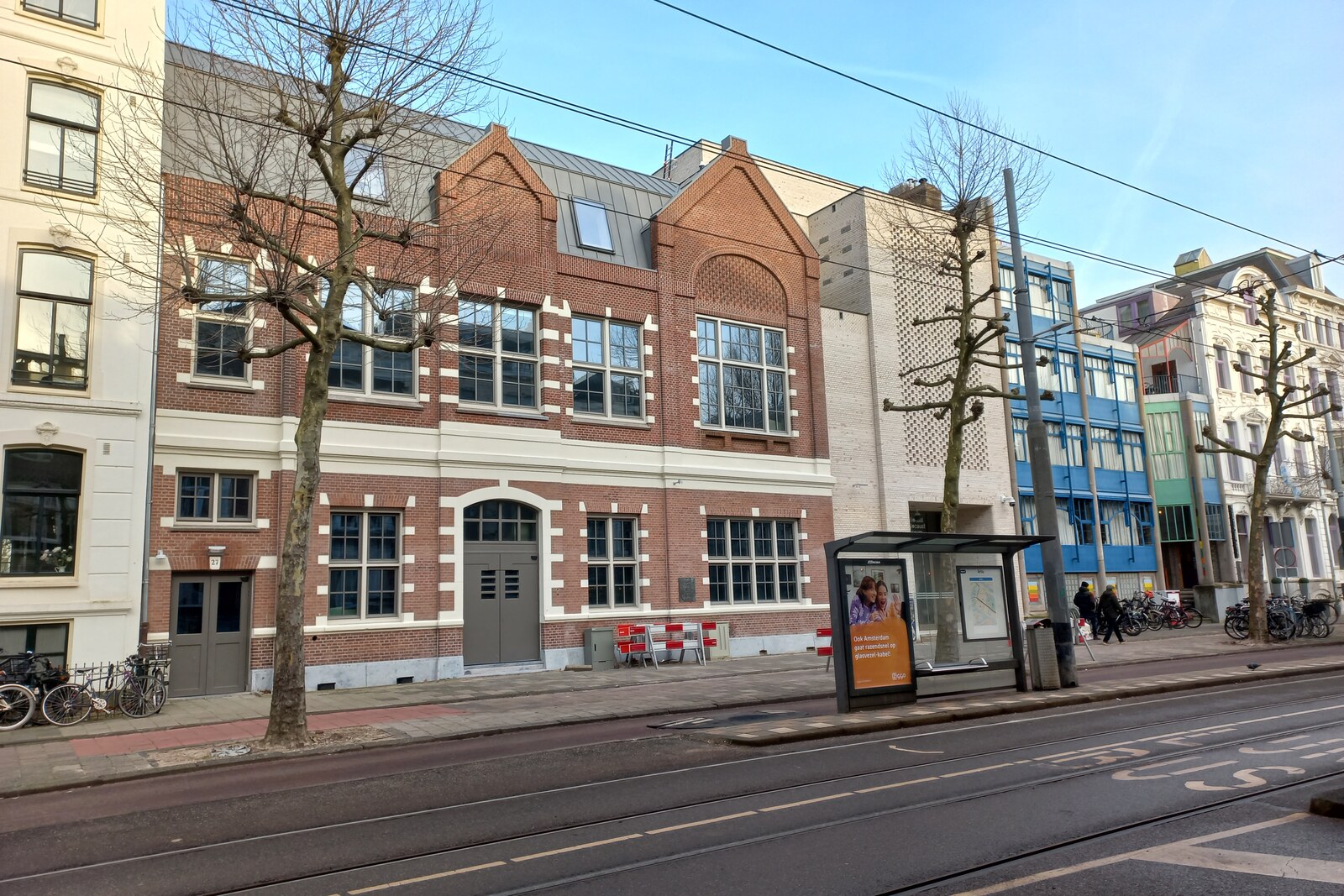
Look around first
What to notice
- Restored first classroom
- School corridor
- Door to the exit
- Fence line
The story of the place
The neighboring nursery was demolished in nineteen seventy-six, but its boundary was preserved at the former Christian teachers' seminary. The National Holocaust Museum now operates here, and its permanent exhibition tells of the persecution of Jews throughout the Netherlands. Inside, the first classroom and the passage to the exit have been restored, while the school corridor with its door and the line of the low fence preserve the memory of the vanished nursery plot.
In the spring of nineteen forty-three, Henriëtte Pimentel, a Jewish educator and head of the neighboring nursery, asked Johan van Hulst to allow her children to play in the school garden. Pimentel was looking for a route by which the children could be taken to people prepared to hide them. Van Hulst, the director of a Christian teachers' seminary, agreed. A month later, he gave up one of the classrooms for daytime sleep.
By then, the German occupiers were holding Jewish families in the Hollandsche Schouwburg across the street, awaiting deportation to the camps. Younger children were separated from their parents and placed in a nursery on the plot next to the school. Pimentel had run it since nineteen twenty-six; now, together with nursery and theater staff, she removed from the registration cards the names of children for whom the resistance had found hiding places. Before an escape, consent was sought from the parents locked up across the street.
The nursery's and seminary's gardens were separated by a hedge and a low fence. Playtime and daytime sleep made it possible to move children to the school side without further explanation. There they were hidden in a classroom. The school caretaker admitted those who came for a child, checked the street, and gave a signal when it was possible to leave through the front door. Small children were carried out in bags, baskets, and sacks; older ones were led out by escorts. Sometimes they waited for a tram: for a few moments, the carriage concealed what was happening from the guards opposite.
Van Hulst was risking the school, which he had just kept from closing. After state funding was withdrawn, he persuaded the pupils' parents to pay for its operations and the church council to guarantee the teachers' salaries. The director said almost nothing about the hidden children, either to his colleagues or to his own wife.
During state examinations, the inspector Gezina van der Molen heard a baby crying at the school. Her task was to monitor the examinations, and a single report would have been enough to expose the hiding place. Van der Molen was already involved in the resistance. She did not report van Hulst; instead, she enlisted her assistants and began taking children from the seminary herself.
Through the nursery and several routes connected to it, about six hundred children were taken out and hidden; many passed through this school. Henriëtte Pimentel was deported and killed in Auschwitz on September seventeenth, nineteen forty-three. Johan van Hulst survived the war and continued to run the seminary.
The National Holocaust Museum is now housed in the seminary building. Its full permanent exhibition opened here in March two thousand twenty-four and tells of the persecution of Jews throughout the Netherlands. The architects restored the first classroom, the passage to the exit, and the boundary between the former schoolyard and the nursery. The garden is named after Henriëtte Pimentel. The nursery building itself was demolished in nineteen seventy-six; the museum retains the fence line and the school corridor with the door through which the children were led away.
Useful on site
Usually open daily 10:00–17:00; closures or reduced hours occur on Jewish holidays and certain dates. The exhibition is recommended for ages 10 and up.
Checked: June 28, 2026. Check the official source before visiting.The exhibition requires time and emotional focus; it is best to plan your entry in advance and not schedule another intensive museum visit immediately afterward. Take breaks, and do not photograph visitors during moments of personal experience.