 Guide On Map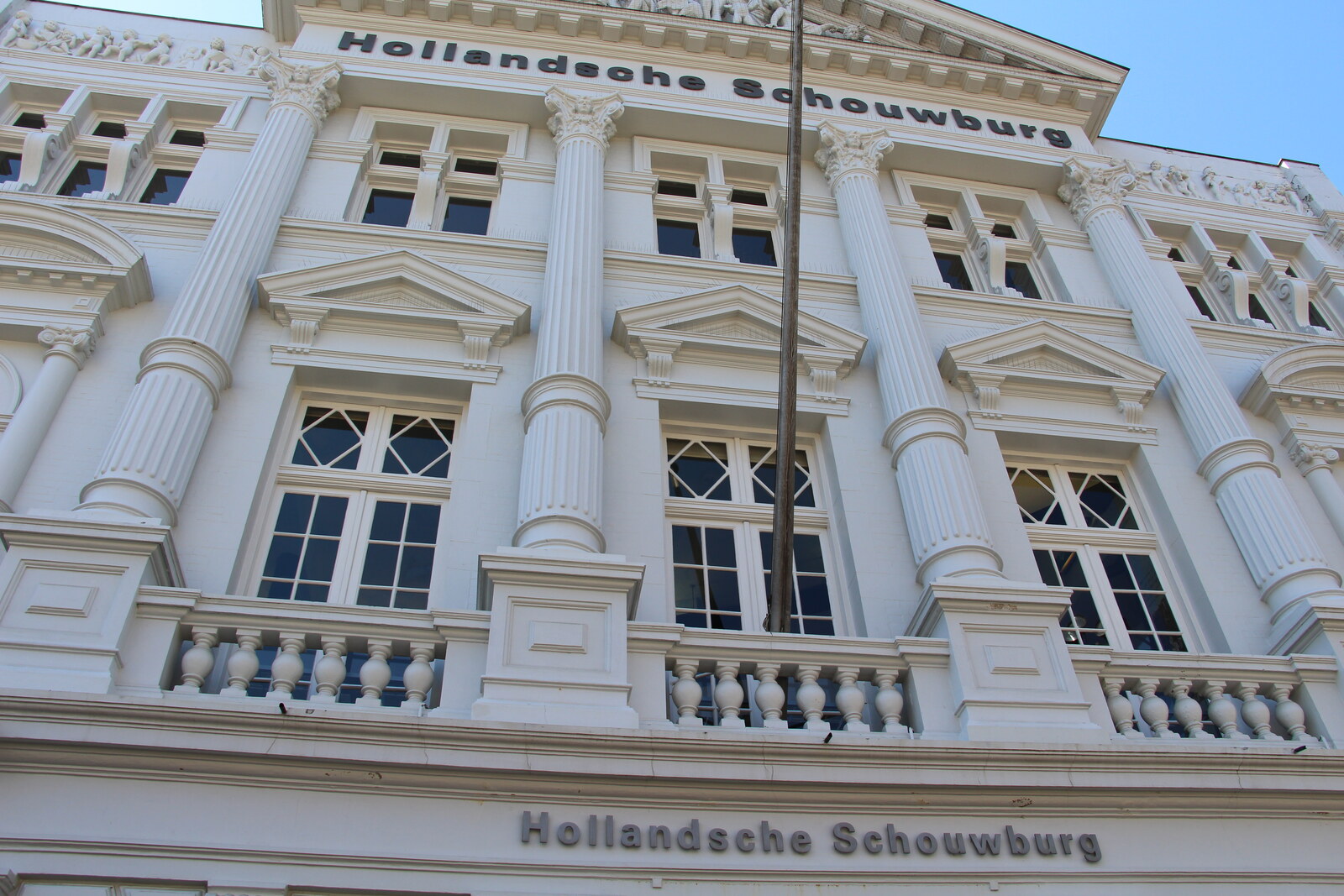
Look around first
What to notice
- The inscription “Hollandsche Schouwburg”
- The open memorial courtyard
- The eternal flame
- Fragments of the stage tower walls
The story of the place
Behind the façade bearing the inscription “Hollandsche Schouwburg,” there is no longer an auditorium. In its place is an open memorial courtyard. The name was retained from a popular Amsterdam theater that opened at the end of the nineteenth century.
During the occupation, Jews were forbidden to attend other theaters, while this one was renamed the Jewish Theater: only Jewish performers could appear here, and only before a Jewish audience. In the summer of nineteen forty-two, even this last theatrical function disappeared. Having decided against setting up a collection point in the Portuguese Synagogue, the Germans chose the building in Plantage: its large enclosed hall stood near the Jewish Quarter. People who had been detained or summoned by notice were brought here, registered, held for several days, and then sent to the transit camps of Westerbork and Vught. Tens of thousands of people passed through the former theater.
Fourteen-year-old Emilia Meijer was brought here alone. The daughter of a Jewish doctor, she had been in hiding with her mother, but their shelter was discovered. The women were separated, and Emilia found herself in the registration queue. She hoped to wait for her mother and did not yet understand that the name entered on her card would tie her to one of the nearest transports.
Walter Süskind, head of the theater's Jewish staff, controlled the queue. The Germans assigned him to keep order, receive people, and prepare transports. Süskind himself was a Jew who had lost his job twice because of his background: first in Germany, then in the occupied Netherlands. His wife and young daughter lived in Amsterdam. His fluent German and his position allowed him to speak with the guards and move around the building, but they did not remove his family from among those being persecuted.
Süskind used access to the lists against those who had ordered him to compile them. His staff removed registration cards, altered information, and helped individual prisoners disappear. Seeing Emilia without her parents, he pulled her out of the queue and told her not to let the registrars see her again.
Medical assistant Maurice Hirschel undertook to hide the girl inside the collection point itself. For five weeks, Emilia moved from one part of the hall to another. When a transport to Vught was being prepared, she stayed among people who were still listed for Westerbork; when a group for Westerbork was called, she changed sides. Most prisoners remained here for three or four nights. Emilia lived through several such changes: some people left on a transport, and the seats were filled again by people brought in after raids.
The hiding place stopped working when the Germans ordered the theater to be completely cleared for a major cleaning. Hirschel hid Emilia under the roof and told her not to come out until the building was empty. Deep in the night, he returned for her. The guard post at the entrance was empty, and the girl left through the main exit onto Plantage. Before liberation, she moved through several underground addresses, and after the war she reunited with her father. Emilia's mother was murdered in Sobibor. Hirschel himself went underground and survived the occupation. Süskind was deported with his family: his wife, daughter, and mother were murdered in Auschwitz, while he died during a death march in early nineteen forty-five.
After the war, the owners began renting out the theater again—now under the name “Piccadilly”—for weddings, parties, and meetings. A public committee decided to buy the building and put an end to entertainment at this address. Of the required three hundred thousand guilders, two hundred thousand were raised through donations. The final third was contributed anonymously by entrepreneur and philanthropist Bernard van Leer. In nineteen forty-seven, the foundation created by the committee transferred the theater to the city on two conditions: there would be no more entertainment here, and a room of mourning with an eternal flame would be created.
After years of disputes, city leaders established the memorial, which opened in nineteen sixty-two. The dilapidated auditorium was dismantled, while the façade and fragments of the stage tower walls were preserved. The present courtyard lies between them: this is the very space once occupied by the seats among which Emilia Meijer spent five weeks moving from one group doomed for transport to another.
Useful on site
Usually open daily 10:00–17:00, free admission; there may be exceptions on Jewish holidays and certain dates. Groups of 8 or more must register in advance.
Checked: June 28, 2026. Check the official source before visiting.This is a place of quiet, not an ordinary tourist stop. Do not block the entrance, silence your phone, and leave yourself a few minutes without audio; explore the accessible parts of the memorial according to the rules posted on site.