 Guide On Map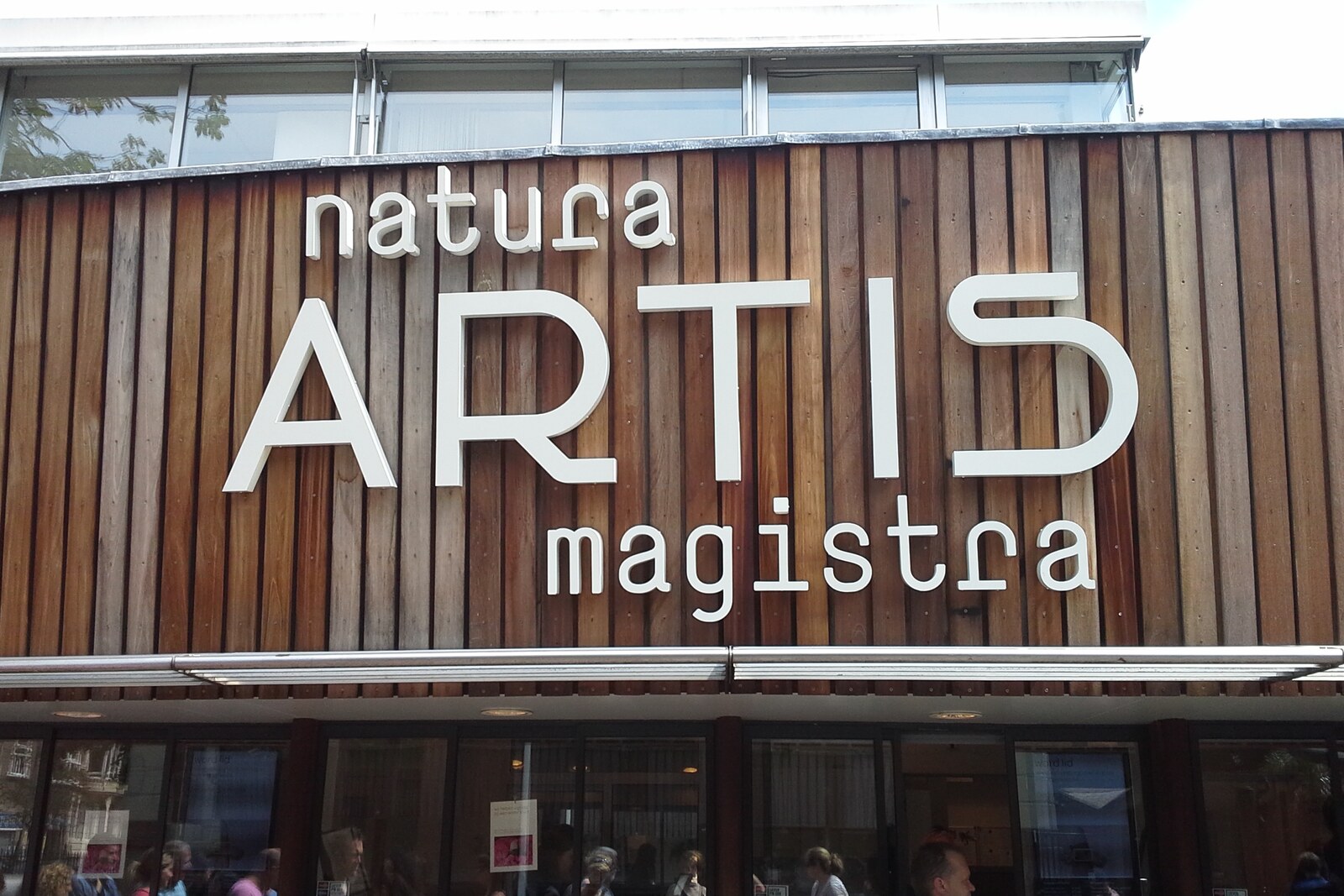
Look around first
What to notice
- The inscription “Natura Artis Magistra”
- An island surrounded by water
- The concrete rock
The story of the place
Beyond the gates of ARTIS begins an urban zoo with enclosures, service rooms, and islands for animals. Among them stands a concrete rock on an island surrounded by water on all sides. It replaced the former monkey rock, and red pandas and Asian small-clawed otters now live here.
Above the entrance stand three words: “Natura Artis Magistra”—“Nature instructs art and science.” In eighteen thirty-eight, three Amsterdam residents chose this motto for a zoological society where they intended to display live animals and study natural history. The long name was soon shortened to its middle word—ARTIS. This is how the Netherlands’ oldest zoo still in operation came into being.
In September nineteen forty-one, a different inscription was put up on the fence around ARTIS: “Jews are not allowed to enter.” German soldiers, meanwhile, were free to visit the zoo. They walked between the cages even during raids in the neighboring Jewish Quarter.
Director Armand Sunier wanted to preserve the animals and protect the staff. He knew that keepers were hiding people in service rooms, but he did not demand names or make lists. Hiding places were arranged in the hayloft above the predators, behind the enclosures, in the nighttime quarters of the polar bears, and inside the monkey rock. During the day, those in hiding mingled with visitors or helped care for the animals. When German soldiers entered ARTIS, staff at the gates warned the keepers.
During one of the raids, several Jewish young men ran along Plantage Doklaan, beside the rear of the zoo. Van Schalkwijk, the monkey keeper, let them in through a service door of the monkey house. By the start of the occupation, he had worked here for more than thirty years and knew every door and partition in his section.
The monkey rock was surrounded by water. Van Schalkwijk laid a plank across it, led the young men onto the island, and hid them inside the hollow rock, beside the monkeys. He then removed the plank. German soldiers entered the zoo, but did not search for people on the island surrounded by water. The young men were not discovered during that raid.
Researchers estimate that between two hundred and three hundred people hid at ARTIS during the years of occupation: Jews, resistance members, and young employees whom the authorities intended to send to Germany for forced labor. Some stayed overnight; others remained for months or years. Not a single person was arrested inside the zoo.
The old monkey rock has not survived. In nineteen sixty-six, another one, made of concrete, was built in its place. In two thousand twenty-five, staff turned it into a green island for red pandas and Asian small-clawed otters. Water still surrounds the island, but the hollow where Van Schalkwijk hid the fugitives no longer exists.
Useful on site
Usually open daily 09:00–18:00; holiday hours are shorter. The Aquarium has reopened after restoration; check individual pavilions separately.
Checked: June 28, 2026. Check the official source before visiting.ARTIS is a major visit in its own right, with a separate entrance, not a single exhibit at the exit. If you are short on energy, choose a few areas in advance and do not try to cover the entire zoo; keep your distance, do not feed the animals, and do not use flash where it is prohibited.