 Guide On Map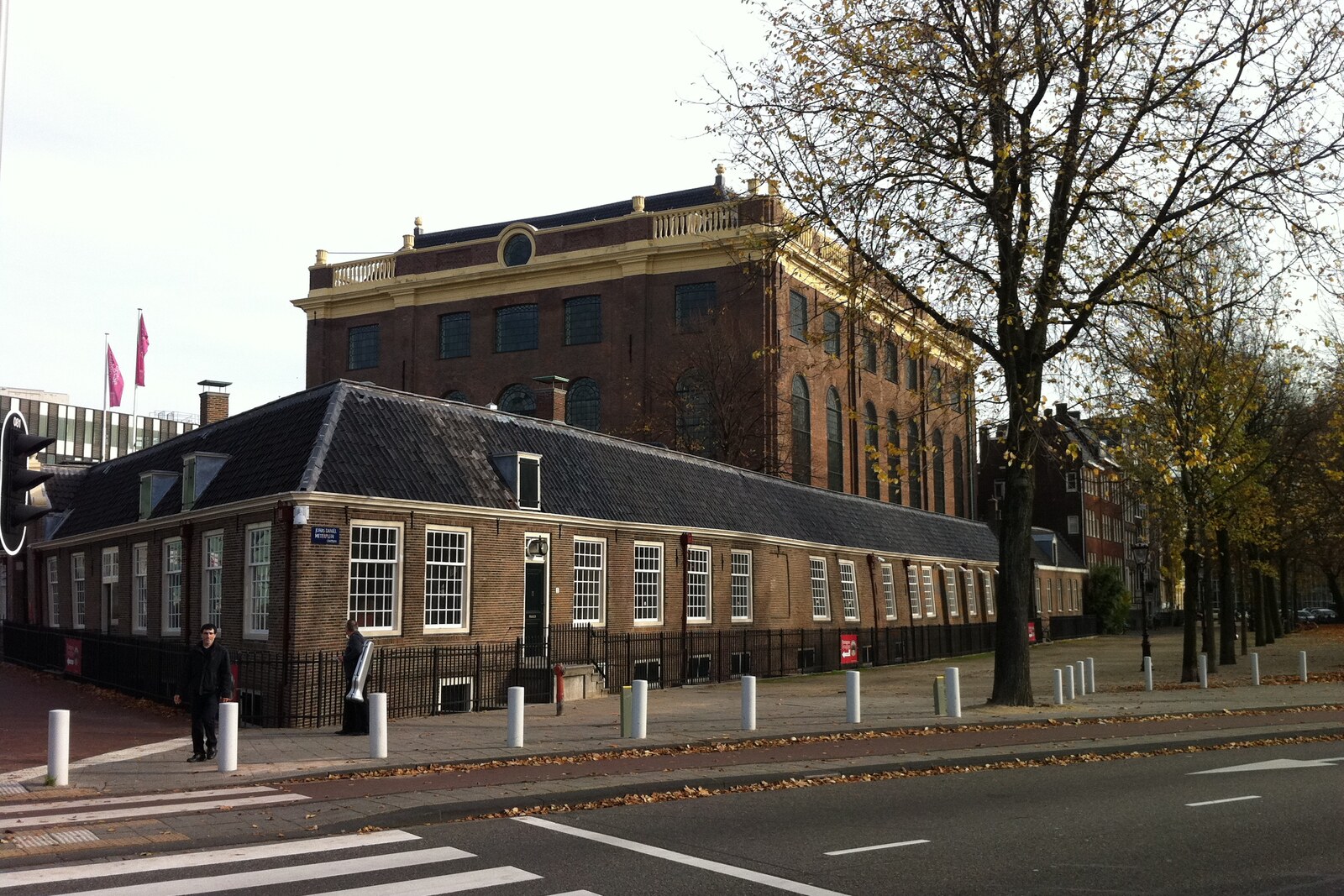
Look around first
What to notice
- Windows of the prayer hall
- Brass chandeliers
- Candles
- Ark with Torah scrolls
The story of the place
Light in this tall hall still comes from candles in heavy chandeliers: there is no electric lighting here. It was built in sixteen seventy-five by the Sephardic community, whose former prayer rooms had already become too small. Families whose ancestors had endured expulsions and forced conversions in Spain and Portugal were able to practice Judaism openly again in Amsterdam. Galleries run along the walls, and seventy-two windows fill the hall with daylight.
In nineteen forty-two, sixteen-year-old Leo Palache met Ferdinand aus der Fünten here, the head of the Central Office for Jewish Emigration. The harmless name concealed an institution that organized deportations. Aus der Fünten was looking for a hall where hundreds of Amsterdam Jews could be brought together and locked up before being sent to the camps. The enormous Portuguese Synagogue stood in the middle of the Jewish Quarter, with trams passing nearby—the building seemed suitable.
It was called Portuguese after the community that built this complex in sixteen seventy-five. They were Sephardim, descendants of the Jews of Spain and Portugal. After expulsions and forced conversions, many of their ancestors had lived as Christians; in Amsterdam, the families were able to return openly to Judaism. People whose relatives had once fled from Spain to Portugal were also called Portuguese here. When the former prayer rooms became too cramped, the community’s leaders received permission from four burgomasters and built a large prayer hall with seventy-two windows.
Leo was the son of Yehuda Lion Palache, a professor of Semitic languages and the head of this community. From the beginning of the occupation, he served in a volunteer fire watch: no fewer than forty Jewish men kept watch in the complex, fearing air raids and arson. According to a family account that has been preserved, during the inspection Leo explained to aus der Fünten that there was no electricity in the synagogue and that the huge windows could not be quickly covered for the mandatory blackout. Turning this hall into a guarded assembly point proved difficult. The Germans rejected the synagogue and chose the Hollandsche Schouwburg, which had almost no windows.
The watches continued. When the community was denied access to the building, the firefighters hid ceremonial objects and a copy of the list of congregants in the void between the vault of the prayer hall and the attic. On February second, nineteen forty-four, the last Jewish guards were arrested. Leo passed through Westerbork and Buchenwald and lived to see liberation; his relatives were sent to Auschwitz and killed.
After the arrests, non-Jewish municipal firefighters took over the guard duty. They remained here during the Hungry Winter, when wooden stairs, doors, and benches were torn out of empty houses and other synagogues for fuel. This hall retained its galleries, furniture, brass chandeliers, and Torah scrolls in the ark.
On May ninth, nineteen forty-five, hundreds of Jews who had survived the occupation came here. At the first large public service after liberation, the rescued scrolls were taken from the ark to the platform where the Torah is read. Leo Palache later returned to the community, took part in its leadership, and raised funds to repair the synagogue.
Services are still held here. There is still no electric lighting: about one thousand candles are lit in the chandeliers. The seventy-two windows that the sixteen-year-old firefighter used to explain the hall’s unsuitability as a deportation point remain in their places.
Useful on site
Usually open Sunday–Friday from 11:00; closed on Saturdays. Closing time changes by season, and holidays and services may restrict access.
Checked: June 28, 2026. Check the official source before visiting.The main details are inside, so a separate visit is needed for the full stop. The candles are not lit constantly, and the lack of heating is genuinely noticeable in cold weather; dress accordingly and observe the rules of an active religious space.