 Guide On Map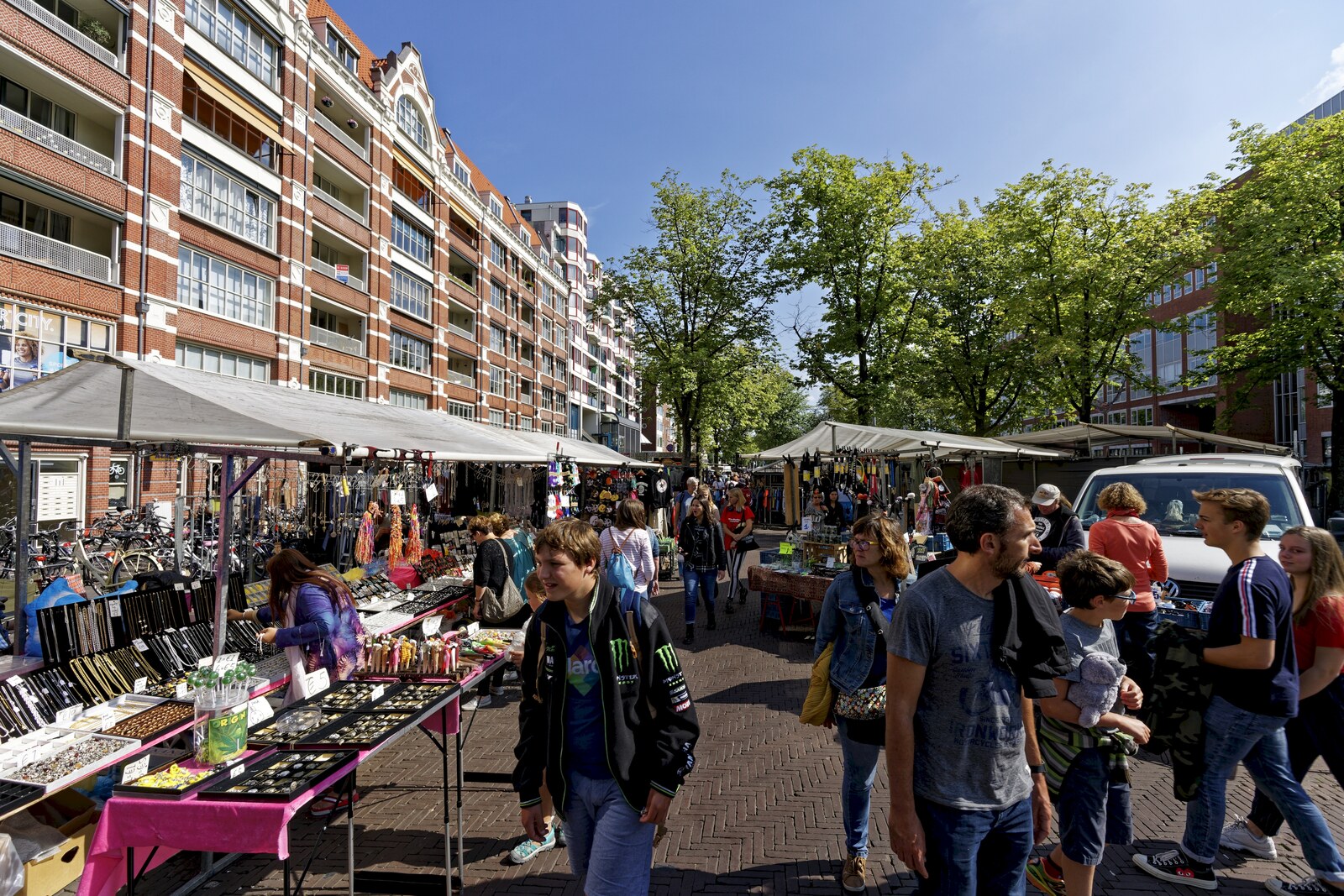
Look around first
What to notice
- Market rows
- Stalls with used clothing
- Books
- Bicycles
The story of the place
Books, used clothing, and bicycles fill the stalls of a market that was once the largest in Amsterdam's Jewish Quarter. For centuries, the city's guilds refused Jews, and many could earn a living only through trade; the poorest brought their goods here on handcarts. Before the Sabbath, the rows were dismantled, and on Sunday they were set up again, with fish, fruit, pickles, worn clothing, and rags laid out for sale. After the war, the market was restored with different sellers, and during construction of the metro, city hall, and opera house, it was temporarily relocated; now trade occupies a reduced site beside the new building.
The market rows at Waterlooplein stand on the site of two canals. In eighteen eighty-two, the city ordered Houtgracht and Leprozengracht to be filled in. Traders from neighboring streets were moved onto the cleared strip, and a year later the city council approved the name in memory of the Battle of Waterloo: there, in eighteen fifteen, a coalition of European armies finally defeated the French emperor Napoleon.
Most of the sellers here were Jewish. Amsterdam's guilds had refused Jews for centuries, so trade remained one of the few occupations open to them. The poorest pushed handcarts, selling fish, fruit, pickles, worn clothing, and rags. They did not want to move to the new square, fearing that customers would not come here. The fear proved unfounded: Waterlooplein became the largest market in the Jewish Quarter. Before the Sabbath, the stalls were dismantled, and on Sunday trading began again.
In the winter of nineteen forty-one, members of the WA, the paramilitary wing of the Dutch Nazi party, came here to wreck shops and beat residents. Jewish and non-Jewish Amsterdam residents opposed them, forming self-defense groups. Among them was Arnold Ariën, a young sign painter and member of the Olympia boxing club, who defended his neighborhood from attacks.
On February eleventh, about forty-five WA members reached Waterlooplein. They were met with iron bars, sticks, and clubs. Ariën was stabbed in the upper body. WA member Hendrik Koot was left unconscious on the ground and died three days later. Nazi propaganda declared him an unarmed victim and claimed that the attackers had cut his throat. A surviving police report describes a serious head injury and Koot's homemade club: a piece of rubber hose, with an iron weight, tied to his wrist.
Koot's death became one of the pretexts for retaliation. On February twenty-second and twenty-third, German police cordoned off the neighborhood around Waterlooplein and seized four hundred twenty-seven young Jewish men. They were sent through the camps at Schoorl and Buchenwald to Mauthausen; two survived this raid. A few days later, tens of thousands of Amsterdam residents began the February Strike. Ariën was released after the first investigation: in the report, he appeared to be a chance passerby. A year later, the case was reopened. Ariën was arrested, sent to Auschwitz, and killed there on August fourteenth, nineteen forty-two.
By then, the market had already been turned into an instrument of isolation. Jews were forbidden to shop and trade at general markets, and the fenced-off area at Waterlooplein was set aside exclusively for Jewish sellers and buyers. In November nineteen forty-one, there were one hundred twenty-four stalls here; in August of the following year, one hundred fifty-six; and by the end of July nineteen forty-three, six remained. The market was then closed.
After the war, trade resumed with different sellers: few of the former stallholders returned. During construction of the metro, city hall, and opera house, the market was temporarily relocated, then assigned a reduced site beside the new building. Used clothing, books, bicycles, and old items are sold here again. The rows have retained Waterlooplein's purpose, but the market Arnold Ariën defended ended on the day the last six traders left here.
Useful on site
Officially open Monday–Saturday 09:30–18:00; closed on Sundays, and in bad weather some stalls may not set up.
Checked: June 28, 2026. Check the official source before visiting.The market and the square itself create different impressions: if there is no trading, focus on the scale of the open space and imagine the vanished canals and tightly packed rows. Among the operating stalls, do not obstruct shoppers, and ask permission before taking close-up photographs of sellers.