 Guide On Map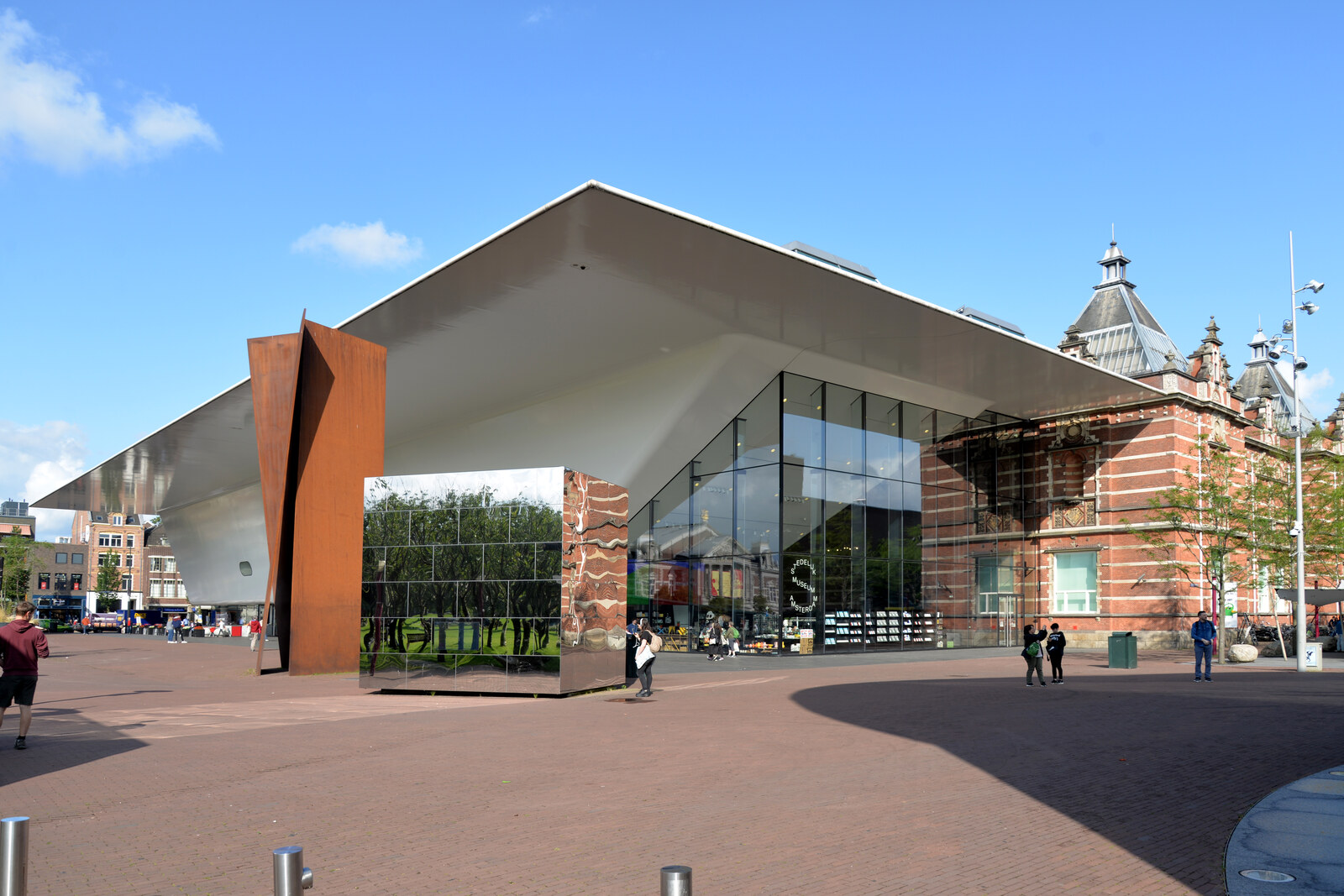
Look around first
What to notice
- Old part of the building
- Round glass window
- Eleven-meter mural
- Man and Animals
The story of the place
Two early murals by Karel Appel have survived in the old part of the art museum. One runs along the eleven-meter wall of the former restaurant, extends onto the adjacent plane, and gathers around a round glass window; a large painting from the same years remains in the collection. Here, the city entrusted the museum with its own art program, and its consequences reached far beyond these galleries.
In November nineteen forty-nine, director Willem Sandberg gave seven galleries in this building to the young artists of the CoBrA group. Sandberg worked to ensure that the city museum showed art that had not yet had time to be recognized. The name “Stedelijk Museum” itself means “city museum”: the director was accountable to Amsterdam for the program, and a failed exhibition could have cost him his job.
CoBrA had emerged a year earlier. The name was formed from the first parts of the names Copenhagen, Brussels, and Amsterdam—the three cities the founders came from. They rejected academic rules, painted together, and borrowed forms from children’s drawings and folk art. Most of them barely had enough money for small canvases.
Seven museum galleries could not be filled with works like these. Exhibition architect Aldo van Eyck asked the participants to increase the scale urgently, and Sandberg gave them materials in advance. In one week, Karel Appel, a young Amsterdam artist who wanted to earn a living from his painting, created Man and Animals here, a canvas roughly three and a half by three and a half meters. Van Eyck placed it directly on the floor, slightly away from the wall. Other paintings hung almost at the ceiling or right by the floor, drawings lay on low platforms, and poems were painted on the walls.
The public decided it was being mocked. A newspaper appeared with the headline “Scribbles, Chatter, and Blots in the City Museum.” At an evening of experimental poetry, the Belgian poet and group organizer Christian Dotremont tried to explain what the artists were aiming for; the event ended in a scuffle in the gallery. The exhibition nearly cost Sandberg his position.
The scandal made the artists known, but it did not provide them with a living in Amsterdam. Appel left for Paris the following year, and CoBrA broke up one year after that. Sandberg kept his job and continued inviting the same artists. In the early nineteen fifties, the city council commissioned Appel to paint the foyer of a museum gallery; then his solo exhibition was held here, and in nineteen fifty-six he received a wall in the former museum restaurant.
Both of Appel’s early murals have survived in the old part of the building. On the eleven-meter wall of the former restaurant, a colored figure extends onto the adjacent plane, and its petals are gathered around a round glass window. Man and Animals, painted during that week with the materials Sandberg had provided, still belongs to the museum.
Useful on site
Daily 10:00-18:00; the official FAQ states that entry is allowed until 17:45.
Checked: June 28, 2026. Check the official source before visiting.Viewing the facade does not require a ticket. The exhibitions, inflatable objects, and underground workshop mentioned belong to the past—do not look for them as current exhibits.