 Guide On Map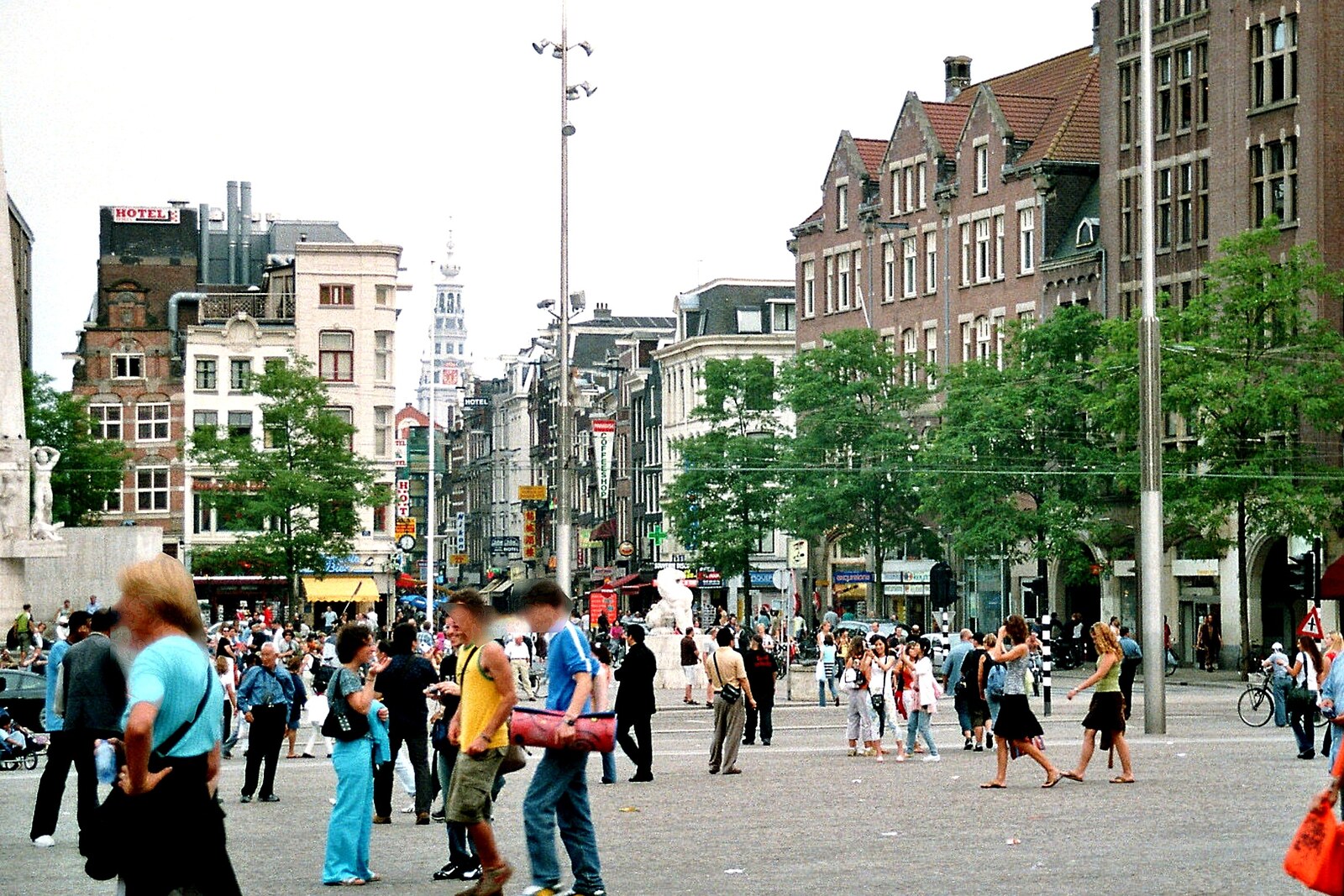
Look around first
What to notice
- Bronze plaque on the facade of the former De Groote Club
- Granite slabs with names set into the paving
- Damrak and Rokin on opposite sides of the square
The story of the place
Dam is now a spacious city square, with thirty-two granite slabs bearing the names of the dead set into its paving. The former De Groote Club stands at the corner of Kalverstraat and Paleisstraat; a bronze plaque is fixed to its facade. Between this building and the palace, the open space offers almost no cover—only the occasional object in the square can shield a person for a moment.
The square’s name tells you what used to be here. The Dutch word “dam” means a dam. Around twelve sixty, residents on the two banks of the Amstel blocked the river with an earthen embankment: the drained peat was subsiding, and water was flooding houses and fields ever more often. A lock for boats was left in the dam, and its crest was gradually widened. It connected the two parts of the settlement; fish was traded by the lock, and the town hall was built nearby. So a place intended to hold back water became a square where people came to trade, seek legal judgment, and wait for city news. Amsterdam’s name also came from “the dam on the Amstel.” The direction of the river divided here is still continued by Damrak toward the railway station and Rokin on the opposite side.
On May seventh, nineteen forty-five, thousands of people came here. The capitulation of the German forces in the Netherlands had been announced two days earlier; newspapers promised the Canadians’ arrival, but the main Allied units had not yet entered the city. German units remained in the streets with weapons: the handover of the city had not been completed.
Popke Sjoerd Bakker came to Dam on business. He sold rubber goods, supported his wife and children, and during the occupation worked for the underground newspaper Vrij Nederland. The newspaper’s editor and one of the resistance leaders, Henk van Randwijk, was planning to speak here to the liberated city. Bakker was assigned to prepare a platform and remove its ceremonial canopy: van Randwijk did not want to address people like a dignitary.
At about half past twelve, several British reconnaissance vehicles drove into the square. People took them for the beginning of the promised Allied entry. At the same time, armed sailors of the Kriegsmarine were still in the corner building of De Groote Club, near Kalverstraat and Paleisstraat.
At about three o’clock, the first shots rang out. Their exact cause has never been established. At that time, the Netherlands Interior Forces—resistance units that had just emerged from underground—were occupying important buildings behind the palace and trying to disarm German servicemen. Two sailors were detained near Paleisstraat; one of them refused to surrender his weapon. After a German soldier was wounded, the military men in De Groote Club opened fire on the crowd from the balcony and windows.
There was almost nowhere to take cover in the open square. People pressed together behind lampposts, kiosks, and a street organ. Several bullets were later found in its casing. Popke Sjoerd Bakker was wounded in the head and died in the hospital. His colleagues from the editorial office took his body away on a cargo bicycle, wrapped in tarpaulin. The speech for which he had prepared the platform was nevertheless delivered by Henk van Randwijk two days later.
The shooting escalated into a battle between German servicemen and resistance units. Karel Frederik Overhoff, commander of Amsterdam’s underground forces, feared that the clash would spread across the entire city. He brought Captain Bergmann from the German command post, led him through the barricade into De Groote Club, and secured a ceasefire. The battle lasted about two hours. Thirty-two civilians were killed, and more than one hundred were wounded. Canadian troops later took the German servicemen from the club into custody; there was no separate trial of those who fired.
A bronze plaque, installed two years after the shooting, remains on the facade of the former De Groote Club. Thirty-two granite slabs bearing the names of the dead are set into the paving of Dam. One bears the name of Popke Sjoerd Bakker.
Useful on site
Public square, accessible around the clock.
Checked: June 28, 2026. Check the official source before visiting.Stay at the edge of the square, where there is less through traffic, and picture not today’s emptiness but the riverbed between Damrak and Rokin. You do not need to enter the palace for this story.