 Guide On Map
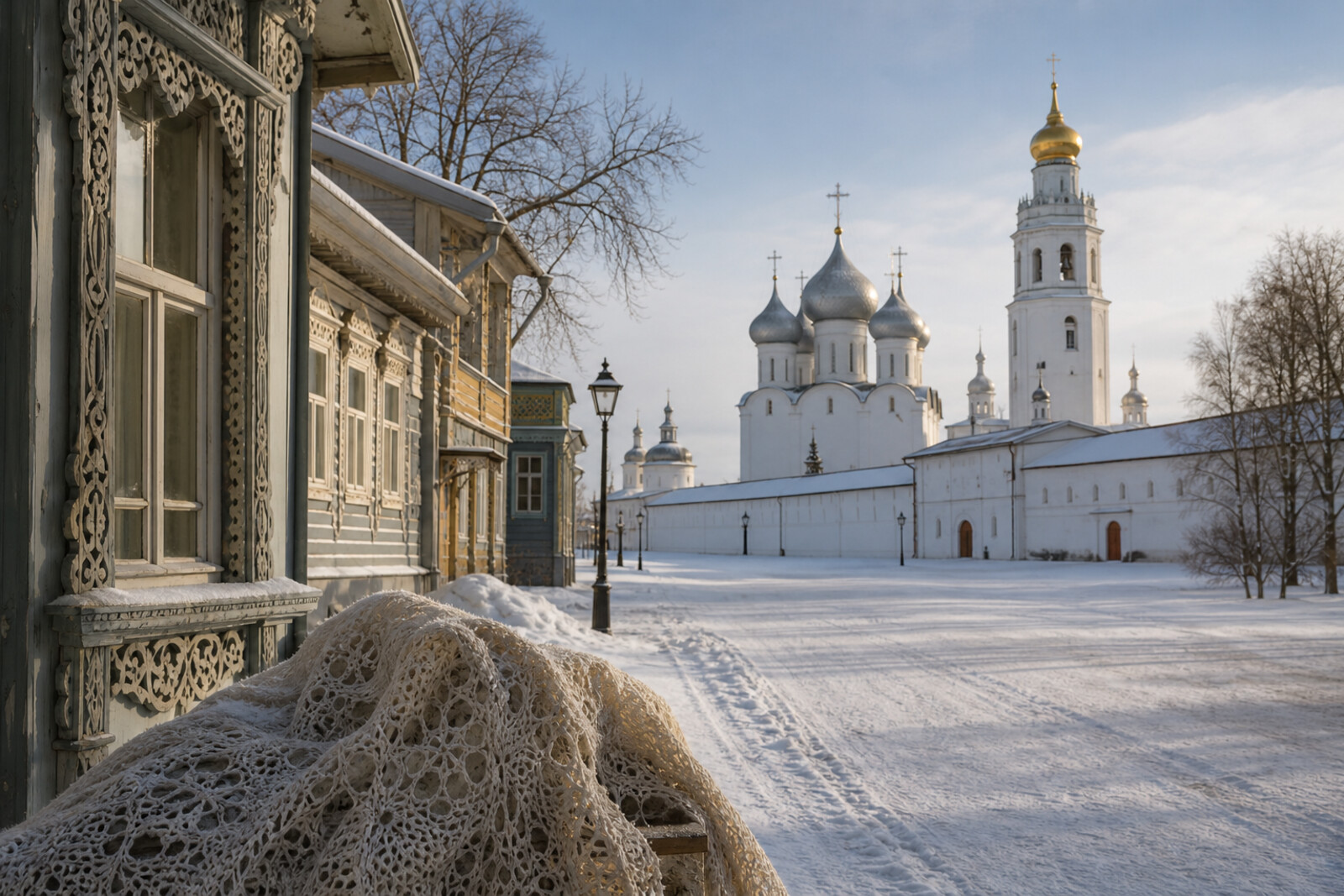
Vologda Kremlin Quarter and Old Houses
From Kremlin Square through Bishop's Court and Leningradskaya Street to Cathedral Hill
Guide On Map on your phone
Open the walk like a regular app
It takes about 10 seconds to install. No app store needed.
The whole path
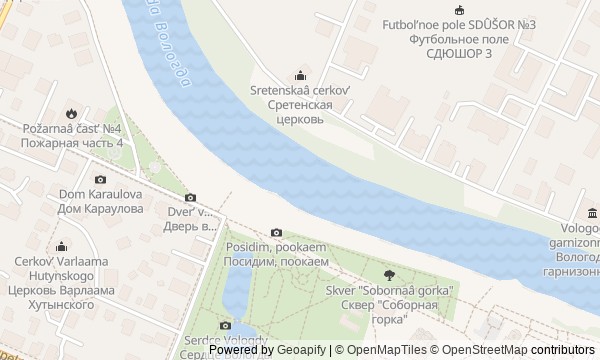
Route map
About the walk
You will walk from Kremlin Square through the cathedral ensemble and the former Bishop's Court, then continue to the Vologda Lace Museum, an old wooden house, and a riverside square.
In the square, you will sort out why the fortress standing here is not the one that gave the place its name. Then the stone cathedral, bell tower, and gate tower will show different ways of preserving a building or returning it to its former purpose.
You will hear about workers paid in bread, a crew that came for the bells, two sold guns, and a pin spotted under glass before the museum opened. You will find out how each story ended when you get there.
The account will be calm and precise. It will separate documents from museum legend, the city's date from a later tale, and the familiar surname on a house from the person usually associated with it.
By the end, you will be able to tell the vanished tsarist fortress from the surviving Bishop's Court and understand why Vologda considers 1147 its founding year.
Why this order
Kremlin Square first raises the question of the vanished tsarist fortress, while nearby Sophia Cathedral preserves the only major stone landmark from that construction. After the story of the cathedral's return to service, the neighboring Sophia Cathedral Bell Tower shows another kind of rescue: museum protection in the twentieth century. From there, the route follows the wall to Pyatnitskaya Tower, separating the surviving Bishop's Court Walls from Vologda Kremlin and moving from the cathedral ensemble to the workings of the bishop's residence. Shalamov House beyond the cathedral continues that thread through the life of a cathedral priest's family. The walk to the Vologda Lace Museum shifts from family history to museum work with fragile objects, while Leningradskaya Street leads from preserving an exhibit to restoring an entire wooden house. The final walk to Cathedral Hill comes after Zasetsky House: there, another bearer of that surname appears, whose book fixed the date carved on the obelisk.
Those who want to understand how Vologda Kremlin and Bishop's Court are arranged Those interested in the human decisions behind museum exhibits and restoration Those who enjoy checking city legends against documents Those who value detailed historical storytelling
Those looking only for a quick overview of the main facades Those who do not enjoy long document-based stories Those expecting a walk exclusively about Vologda lace
Before you go
Check the availability of Sophia Cathedral Bell Tower, Sophia Cathedral, Shalamov House, and the Vologda Lace Museum right before your walk: restoration work, weather, and museum restrictions can change the order of visits. Plan the climb up the bell tower only for a dry, calm day and wear comfortable, non-slip shoes. Allow separate time to enter museums and see their exhibitions; walking between exterior stops does not guarantee automatic admission inside. Do not try to cut through restoration barriers, and follow temporary signs. Bring headphones, a charged phone, and windproof clothing: much of the story is heard in open squares and by the river.
When to go
Set aside half a day for the route. In clear weather, begin with the open stops by the Kremlin and try to reach the bell tower before the weather changes; museum stops work best in the middle of the walk, with Cathedral Hill saved for daylight.
Backup plan
If the bell tower or cathedral is unavailable, do not cancel the first four stops: their main stories can be understood from the square, the church's exterior, the towers, and the Bishop's Court Walls. In rain, spend less time at open facades and take a closer look at one of the accessible museums. If Shalamov House is closed, pause by the memorial plaque and continue to the lace; if the Vologda Lace Museum is unavailable, keep the stop as a story about production and view the building from outside. Treat restoration detours as part of the route, and do not go beyond the barriers. The finale on Cathedral Hill remains an independent exterior stop, but on a wet or icy slope, stay on the maintained paths.
Route conditions
Surface. Paved — 1.3 km (data covers 61% of the route)
Facilities. Toilets — 2
Elevation. Ascent — 11 m; descent — 18 m
OpenStreetMap extract of July 7, 2026: database data, not a check on the ground. Data © OpenStreetMap contributors, ODbL licence
Walk plan
Open in maps ↗- 1
Kremlin Square
Here, the difference will become clear between the tsar's fortress that gave the square its name and the surviving walls of the bishop's residence. - 2
Sophia Cathedral
Here you will learn how, after the devastation, they restored not the church’s outward appearance but the ability to hold services there again. - 3
Sophia Cathedral Bell Tower
Here you will hear how museum staff saved an entire set of old bells. - 4
Pyatnitskaya Tower
Here, the construction of the Bishop's Court Walls will emerge as a way of paying workers with bread during years of famine. - 5
Shalamov House
Here you will hear what it cost the family to send their seventeen-year-old son away to study despite an official's refusal. - 6
Vologda Lace Museum
Here you will see how much handwork was needed to display large, fragile pieces safely. - 7
Zasetsky House
Here you will learn which parts of the old house could be preserved and why the well-known surname misleads visitors. - 8
Cathedral Hill and the Monument to the 800th Anniversary of Vologda
Here you will find out where the city’s official founding date came from and what written and archaeological evidence argues against it.
Route features
Everything you need stays in the browser
Progress, saves and your trip plan are stored on this device.
Add Guide On Map to your home screen so the walk opens outside the browser.
How we handle sources, maps and corrections: our editorial standards