 Guide On Map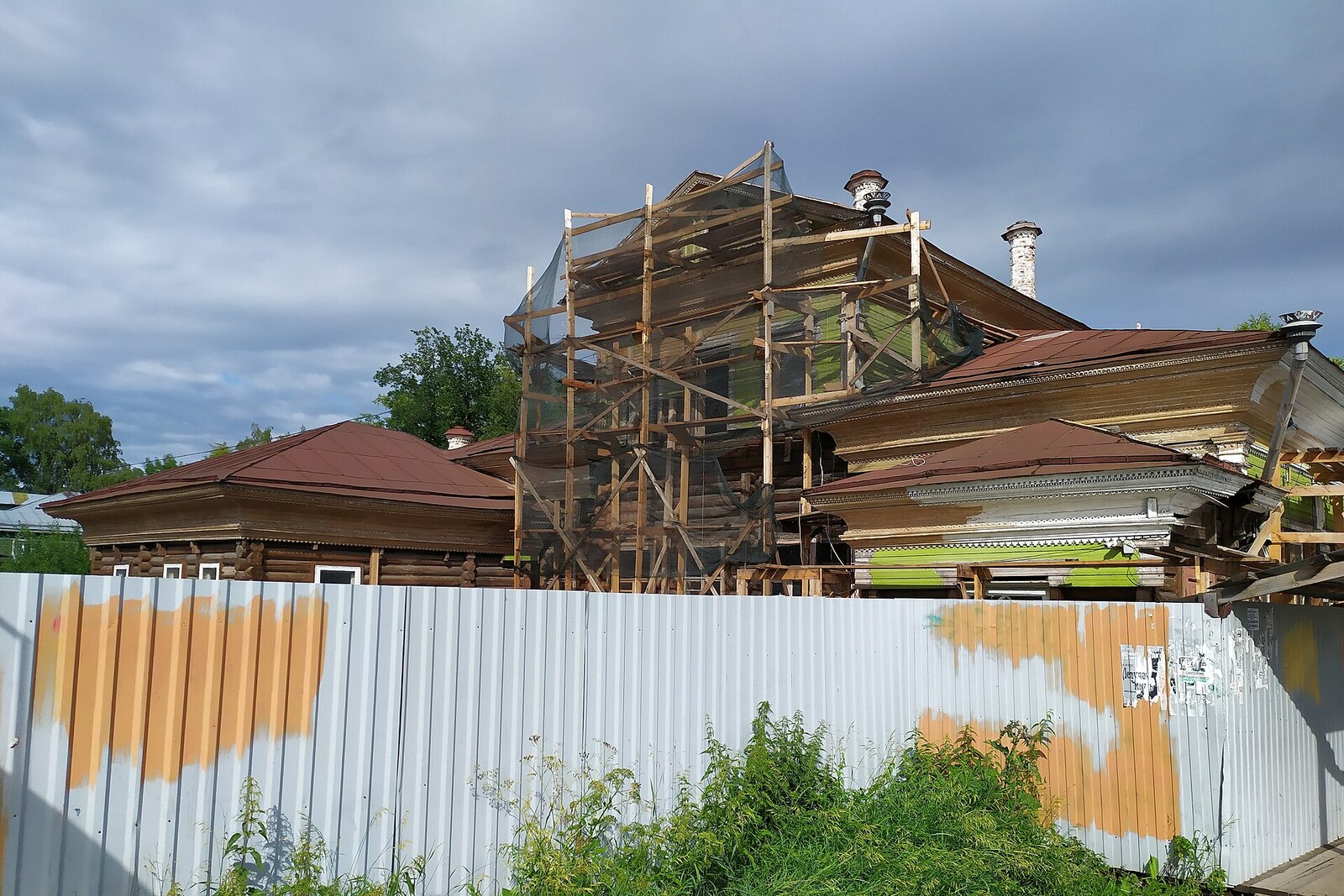
Look around first
What to notice
- Mezzanine
- Carved facade ornamentation
- Wooden walls
- Recreated wing
The story of the place
A tall mezzanine with carved ornamentation rises above the wooden log structure, and five tiled stoves stand inside. The estate itself was built in the second half of the seventeen eighties; later, another owner gave the house its present facade. The former formal rooms were then occupied by school classrooms, while the teacher, inspector, and caretaker lived with their families under the same roof. A hotel and a museum display are now being prepared for the main house, while a cafe is planned for the reconstructed wing.
After the last institutions moved out in two thousand eight, the wooden house was no longer heated. The roof leaked, the paint peeled away, and the lower logs became damp. Four years later, volunteers painted the facades to delay the deterioration, but this was only temporary protection.
In two thousand nineteen, the Vologda entrepreneur German Yakimov took the federally protected monument, together with its plot, on a forty-nine-year lease. The Yakimov family earns money from a chain of flower shops; by then, they had already restored several old houses with the business's income. Here they had to pay for the lease and for the scholarly restoration of a building that does not belong to them and cannot be remade by an ordinary construction crew.
Yakimov commissioned historical research and hired restorers. They raised the log structure to replace the rotten lower log courses, stripped boards of later cladding, and restored the height of doors that had been sawn down. Almost the entire old log structure was left in place. Five tiled stoves survived inside. The ceramicist Vladimir Kholshchagin and his assistant Viktor Yakushev dismantled later repairs: missing sections had once been filled with plaster, which was crumbling. The craftsmen sculpted the missing details anew from the surviving examples. By two thousand twenty-five, all five stoves had been restored.
But the surname on the house appeared much later than the stoves and the log structure themselves. In the first half of the seventeen eighties, the estate was built by Sergei Shulepnikov, a retired cavalry officer who served as a judge of the Vologda Court of Conscience. As early as seventeen eighty-five, he sold it to the landowner Marya Pisareva. The mezzanine and the carved ornamentation that define the present facade were added by the next owner, Alexei Ivanitsky, in eighteen ninety-seven.
Only on August first, nineteen hundred, did Varvara Zasetskaya buy the estate. A year later, she gave it to her husband, Nikolai Zasetsky, a physician and professor at Kazan University. Nikolai lived and taught in Kazan, while renting out the Vologda house to educational institutions. From nineteen oh seven onward, a city four-grade school operated here; it was later converted into a higher primary school, a school at the next level after regular primary school. Children studied in the former formal rooms, while the families of the teacher, inspector, and caretaker lived under the same roof. After the revolution, the building was again occupied by schools, and later by district and educational offices.
The house was often associated with another Zasetsky—Alexei Alexandrovich Zasetsky, the author of the first book about Vologda. He died more than a century before this family bought the estate and did not live here. The name preserved the surname of the last pre-revolutionary owners, who owned the house for about seventeen years and turned it into revenue-producing premises for a school.
The restoration is still underway. A hotel and a museum display are being prepared in the main building, and a cafe in the recreated wing. Behind the facade, which the Zasetskys acquired already completed, remain the restored doors and five stoves that first heated noble rooms and then the classrooms of their tenants.
Useful on site
External viewing only. Restoration work continues in the house; there is no access inside.
Checked: June 24, 2026. Check the official source before visiting.While restoration continues, view the house only from beyond the permitted boundary and do not enter the construction site. Check separately whether interior access is available.