 Guide On Map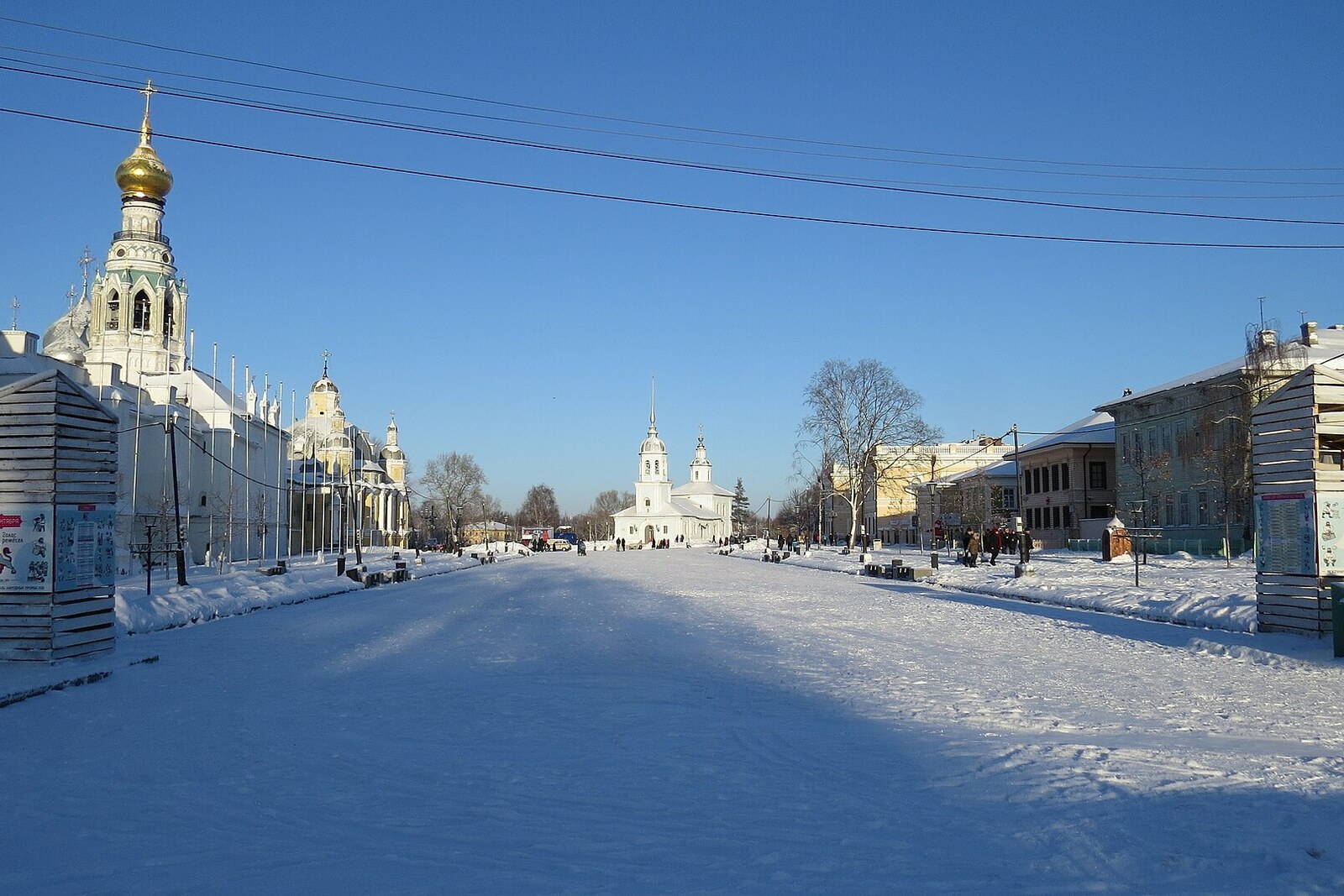
Look around first
What to notice
- Monument to Ivan the Terrible
- Bishop's Court Walls
- Sophia Cathedral
The story of the place
The bronze man with a scepter and orb is Ivan IV (Ivan the Terrible), the first Russian sovereign to be crowned tsar. He stands on Kremlin Square because, in the middle of the sixteenth century, he ordered Vologda's fortified center moved to this bank and began here the largest construction project in the city's history.
Ivan needed a backup northern residence. War was underway on the southern frontiers, while Vologda lay far from any possible attack and stood on the Sukhona–Dvina route to the White Sea. Trade with England went along this road, and it could also be used to evacuate the family and treasury. That is why the widespread claim that the tsar intended to move the entire country's capital here sounds too certain: historians speak more cautiously of a reserve residence and a center for the northern lands.
In fifteen sixty-five, Ivan came to Vologda with his wife and sons, chose a site, and ordered moats dug, piles driven, and stone and lime brought in. Construction began the following year. The fortress was to occupy a vast quadrangle from the Vologda River to what are now Mira Street, Oktyabrskaya Street, and Leningradskaya Street. Inside, beside the future cathedral, a wooden palace and a private chapel were built for the tsar's family.
The people of Vologda paid the price for this plan. A chronicler wrote of “great taxes from the construction of the grad and ships”; at that time, grad meant a fortress. A northern legend preserves an even harsher detail: supposedly, at Easter Ivan ordered all townspeople—men, women, and girls—to carry oak piles into the moat themselves and forbade them to hire workers in their place. This is a legend, not a reliable record of an order.
Executions at the construction site are better documented. A list of people who had been killed, sent by the tsar, was copied into a monastery memorial book. Among the ten people executed in Vologda were three carpenters—Nepokoy, Danila, and Mikhail—and a man whose occupation researchers read as butcher. Historians suppose that the punishment took place in the spring of fifteen sixty-nine because the work was progressing slowly, although the book itself gives no reason. Two old foreign accounts connect the punishment with builders who were starving and slaughtered calves for food. The authors disagree even about who these people were, so the details of this scene cannot be presented as proven fact. What is known reliably is something else: the carpentry trade brought the three named men to the tsar's construction project, and their names appeared on the list of those executed.
By fifteen seventy-one, the builders had managed to raise only part of the stone wall and towers; the remaining sections had to be completed in wood. Ivan left Vologda and did not return to the project. The sources give no exact reason. That same year, Moscow burned after a raid by the Crimean khan, and its reconstruction required people and money. Later, the need for a northern refuge also disappeared.
The last remains of the huge fortress were dismantled in the early nineteenth century. The walls behind the Monument to Ivan the Terrible belong to another structure—the Bishop's Court, the enclosed residence of the archbishops of Vologda. They were built mainly in the seventeenth century inside the former tsar's fortress. The present square is called Kremlin Square after a structure that no longer exists around it.
Useful on site
The square is accessible around the clock; part of the space may be occupied by temporary barriers because of restoration work.
Checked: June 24, 2026. Check the official source before visiting.View the monument from different sides of the square without entering work zones. The exterior walls remain visible even when the buildings are closed.