 Guide On Map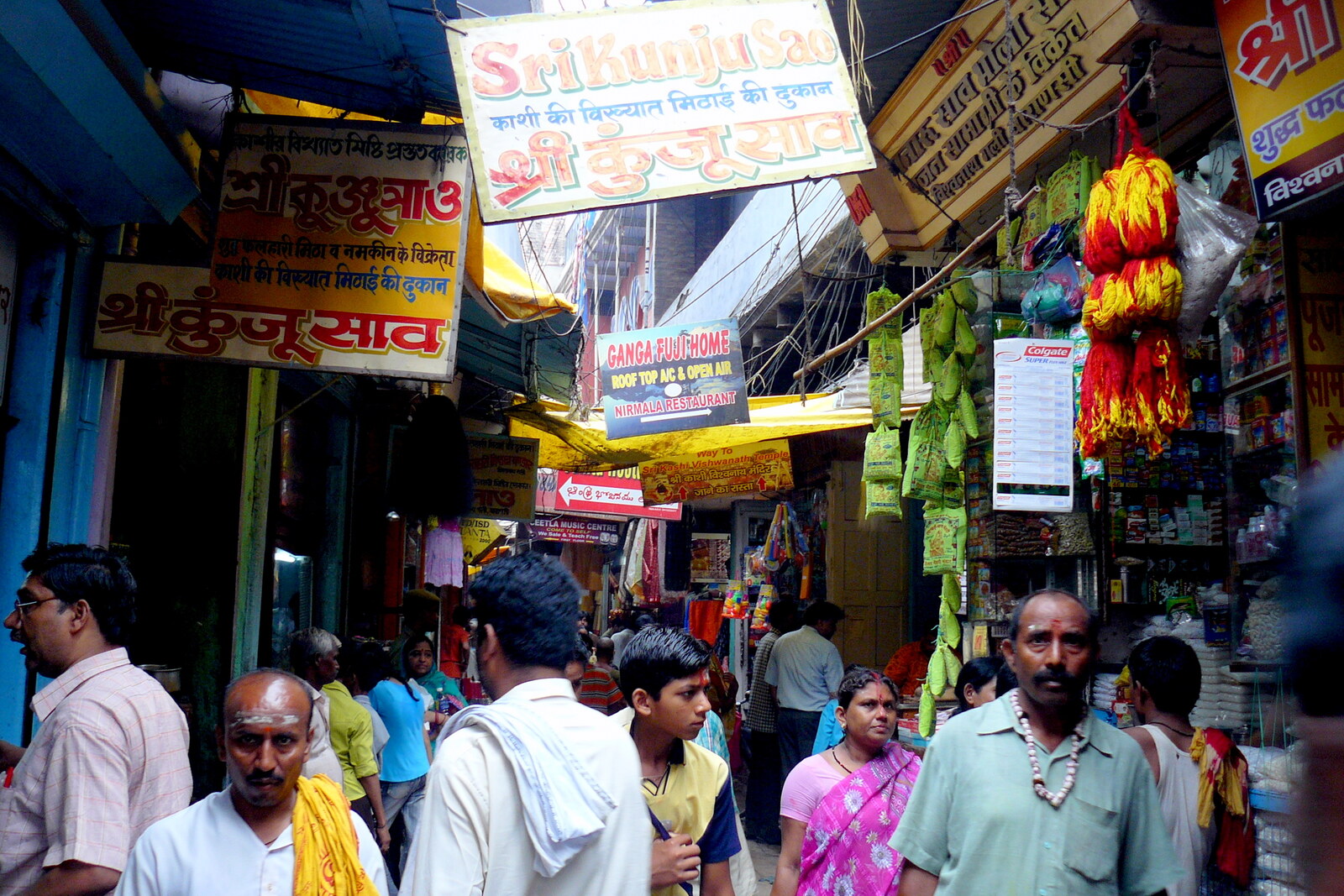
Look around first
What to notice
- A narrow passage between houses
- Shopfront facades
- Stalls with flowers and offerings
The story of the place
Vishwanath, “Lord of the World,” is one of Shiva's names; gali means a lane. The name means the road to Kashi Vishwanath Temple. It owes its present purpose to a decision made far from Varanasi.
In the middle of the eighteenth century, the commander Malhar Rao Holkar wanted to restore the temple on its former site, but he could not obtain that land. His daughter-in-law, Ahilyabai Holkar, the ruler of Malwa, completed what he had begun: she needed a functioning temple, not an endless dispute over its location.
She came to this decision only after a hard struggle for her own position. Her husband died during the siege of Kumbher Fort. Then her father-in-law died, followed by her only son, who had managed to rule Malwa briefly. Some of the nobility objected to a woman on the throne, but the Maratha peshwa confirmed her rights, and the army supported her. Ahilyabai controlled the revenues of the principality and spent them on roads, inns, and shrines far beyond Malwa.
She did not wait for the former site. Ahilyabai acquired neighboring land south of it and built a new Kashi Vishwanath Temple here between seventeen seventy-seven and seventeen eighty. Construction was completed during her lifetime, and a constant flow of pilgrims headed toward the small temple courtyard.
Residents set out the first stalls of flowers and offerings along the passage. Merchants arriving from Marwar, Bihar, and the southern regions of India established inns nearby. The front rooms of residential houses were given over to shops. Sellers made their living no longer from occasional trade, but from the same flow of people: before the temple, a pilgrim needed offerings, and after the visit, food, clothing, or a gift. That is how a passage through a residential quarter became a market.
Wooden goods gained a special place. Carvers worked in other quarters of Varanasi, but sold toys and lacquered boxes for sindoor here: a pilgrim could take home an object made in Varanasi. Later, city documents explicitly called Vishwanath Gali a toy market. Bangles, copper utensils, silk saris, and religious books were sold nearby—the goods changed, but the stream of customers remained tied to the temple.
Behind the present-day shops stands that same compact temple that Ahilyabai managed to complete. It never gained a broad square: the road ran between houses, and the houses faced the road with commercial facades. The ruler's name is not written on the lane's signs. Vishwanath's name has remained on them because her construction gave this passage both its direction and its customers.
Useful on site
The lane is open as a city street; shops keep their own hours, and the trade in offerings comes to life first.
Checked: June 28, 2026. Check the official source before visiting.Do not block the passage, and ask in advance whether storing shoes or belongings requires a purchase from a particular shop.