 Guide On Map
Old Tbilisi: Shrines, Sulfur Baths, and Narikala Fortress
From Meidan Square through Abanotubani and Leghvtakhevi to Narikala Fortress
Guide On Map on your phone
Open the walk like a regular app
It takes about 10 seconds to install. No app store needed.
The whole path
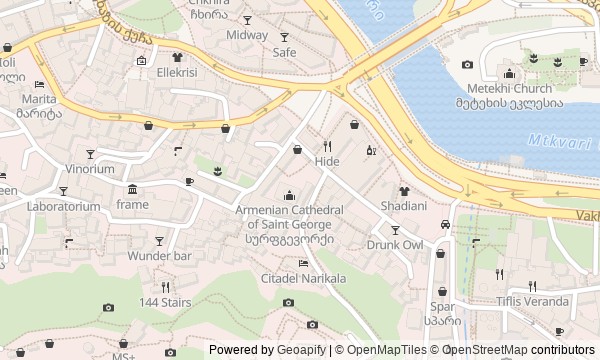
Route map
About the walk
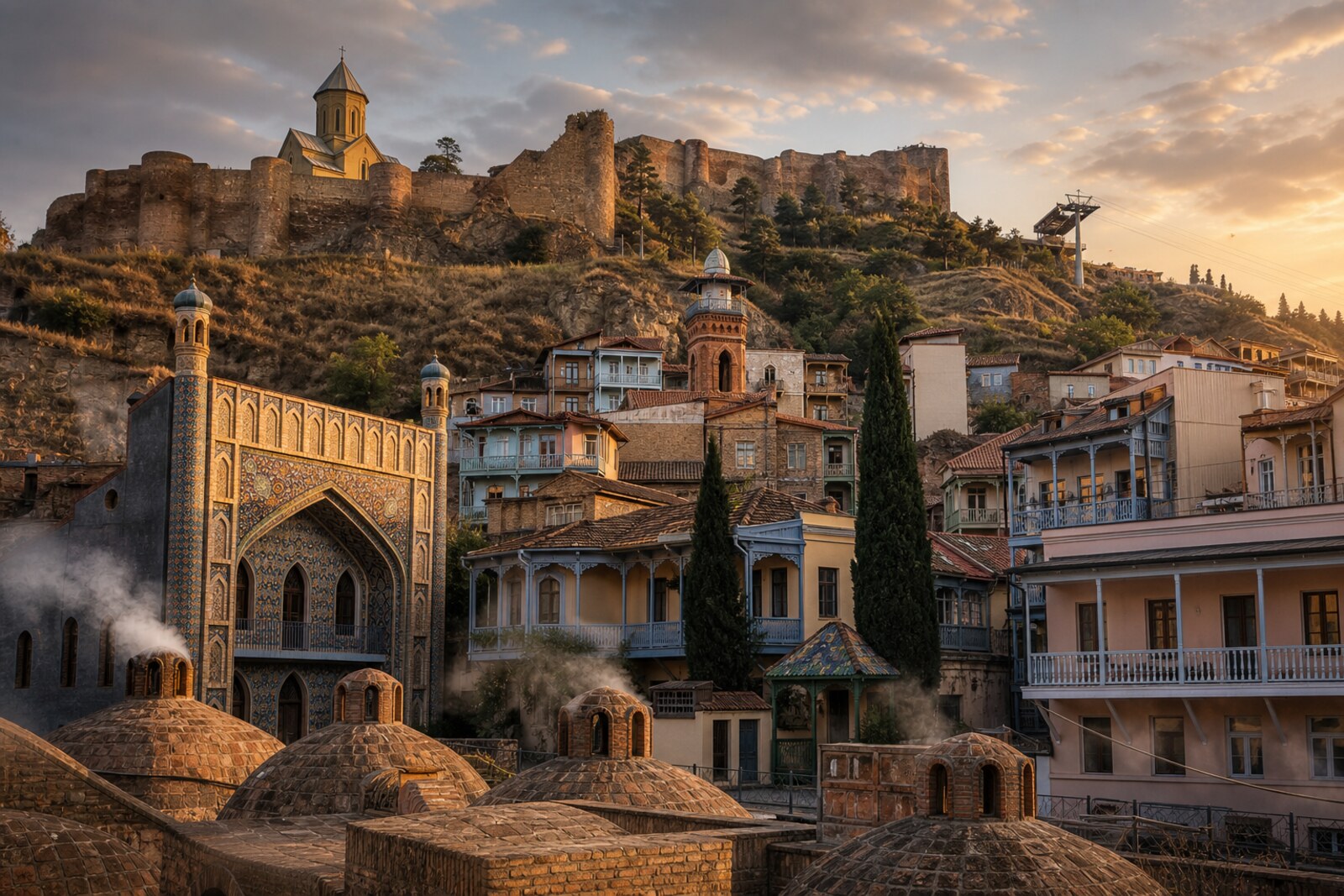
You will begin at Meidan Square, among old trading names, then pass through the Armenian cathedral and Sioni Cathedral toward a mosque on the slope. The road will then drop to the brick domes of Abanotubani, the blue facade of Orbeliani Baths, and the stream in Leghvtakhevi. The walk ends with a climb to the walls of Narikala Fortress.
Along the way, small, stubborn questions will surface. Why were roses brought to a grave? Why did the return of the main shrine coincide with soldiers at the cathedral? How did two pulpits end up in a single prayer hall? And why did the name of a tannery outlive the workshops themselves?
The story moves from an object to a human act. It will set the legend of a warm spring against archaeology, and the local version against what is known for certain. By the end, you will be able to read Old Tbilisi through specific traces: a cross, two mihrabs, bath domes, a vanished trade, and a fortress wall.
Why this order
At Meidan Square, the Armenian cathedral stands beside the former shared market; at neighboring Sioni Cathedral, it becomes clear that a church could also be a place of state coercion. From Sioni Cathedral, the route returns to the market's southern edge and climbs to Juma Mosque, where two Muslim communities shared not a square but one hall. After the mosque, the descent to the domes explains its proximity to the baths and leads to the springs for which the royal court was moved here. Orbeliani Baths comes immediately after: once you have seen the rooftops, you arrive at the facade of the building where water became a full bathing ritual. Beyond the baths, the stream draws you into Leghvtakhevi, where that same water enabled another kind of city work: tanning. From the gorge, the route climbs to Narikala Fortress. After workshops, churches, and baths at the bottom of the city, the fortress ridge shows why control of the citadel could decide a struggle for the throne.
Those visiting Old Tbilisi for the first time Those looking for urban and religious history without postcard rhetoric Those ready for an uphill climb and stairs
Those looking for a walk only along level streets Those wanting a guide to restaurants and contemporary city life Those who do not enjoy dense historical storytelling
Before you go
Choose shoes with a grippy sole: stone near the baths and in the gorge can be wet, and the final stretch climbs uphill. Churches and the mosque remain places of prayer—keep your voice low, observe clothing requirements, and do not interrupt services; entry inside cannot be assumed. Exploring the bath district does not include bathing: the room, bath attendant, and treatments are arranged separately with the bath you choose. Before climbing to Narikala Fortress, check current signs and barriers, as access to individual sections may change during work.
When to go
2–3 hours
Backup plan
If the church or mosque is closed to visitors, look at the masonry, facade, and courtyard from the accessible side, then continue the route—the key story does not require going inside. After rain, shorten the Leghvtakhevi section to where the surface remains secure, and do not go beyond barriers for a view of the waterfall. If the passage to Narikala Fortress is closed, end the walk at the nearest permitted viewing platform. You can skip bathing entirely or move it to another time: the order of stops remains unchanged.
Route conditions
Surface. Paved — 2.7 km; unpaved — 12 m (data covers 93% of the route)
Stairs. Flights: 13, 457 m in total
Access. Wheelchair — no; stroller — limited (stairs)
Facilities. Toilets — 9; drinking water — 13
Elevation. Ascent — 118 m; descent — 49 m
OpenStreetMap extract of June 18, 2026: database data, not a check on the ground. Data © OpenStreetMap contributors, ODbL licence
Walk plan
Open in maps ↗- 1
Meidan Square and Surp Gevorg Church
Here, multi-community Tiflis enters the route through the fate of a single grave and the festival that arose around it. - 2
Sioni
The shrine reveals how a solemn ceremony became a prologue to the abolition of the throne. - 3
Juma Mosque
Two sets of prayer furnishings show how separate communities agreed to share one hall. - 4
The Domes of Abanotubani
The domes connect the city legend with archaeology and the transfer of the royal court. - 5
Orbeliani Baths
One bath session will turn how the sulfur baths work into an understandable physical procedure. - 6
Leghvtakhevi
The gorge will return the tanners’ vanished work to the neighborhood and explain its second name. - 7
Narikala Fortress
The final height will show why the struggle for the capital was decided by the last change of garrison.
Route features
Everything you need stays in the browser
Progress, saves and your trip plan are stored on this device.
Add Guide On Map to your home screen so the walk opens outside the browser.
How we handle sources, maps and corrections: our editorial standards