 Guide On Map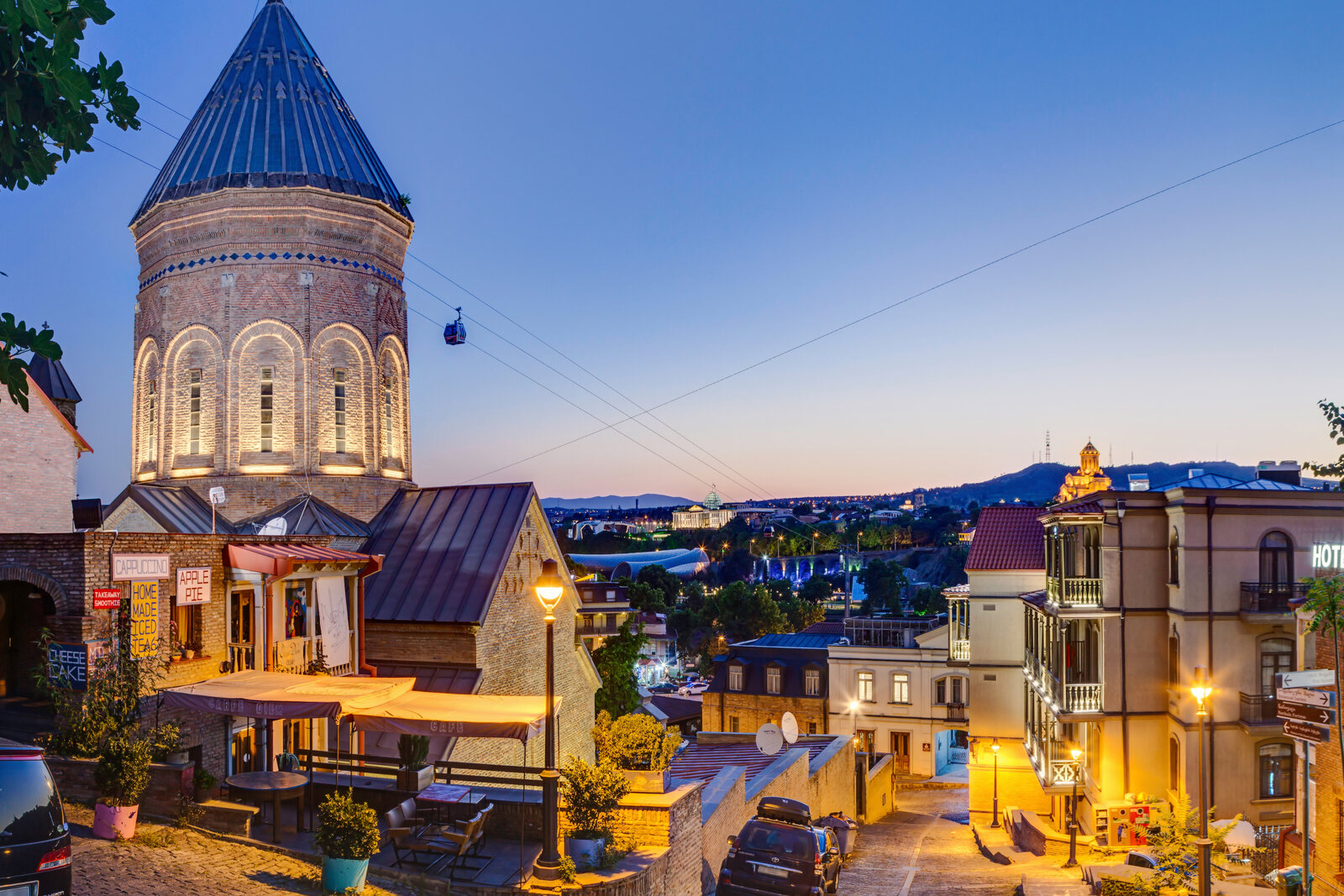
Look around first
What to notice
- The facade of Surp Gevorg Church
- The khachkar stone in the courtyard
- Sayat-Nova's slab
- The gravestone of Gevorg Bashinjaghian
The story of the place
At the edge of the square rises the facade of Surp Gevorg Church, the cathedral around which Tiflis's Armenian community gathered for centuries; it is now the seat of the Armenian Apostolic Church in Georgia. Its name means Saint George. Researchers have not established the exact date of its foundation and place the church's appearance sometime between the seventh and thirteenth centuries.
Meidan Square is this square's old name: in Eastern cities, this was what an open place for trade and gatherings was called. Tiflis's main bazaar stood here. In the seventeenth century, the traveler Jean Chardin listed Armenians, Greeks, Jews, Persians, Indians, Turks, and Europeans whom he encountered there. Nothing remains of the former rows of shops, but the names of the neighboring streets—Silver Street, Iron Row, Bread Square, and Wine Ascent—show how the people around Meidan Square earned their living.
At the edge of the market stands Surp Gevorg Church, which for centuries served as the main church of Tiflis's Armenian community and has now become the cathedral of the Armenian Apostolic Church in Georgia. “Surp” means “saint,” and Gevorg is the Armenian form of the name George. According to church tradition, Saint George was a Roman soldier executed for his Christian faith. Medieval sources called him Zoravar, a military commander. The church's exact age is disputed: researchers date its foundation to sometime between the seventh and thirteenth centuries. It received the name Meidani Surp Gevorg Church specifically after the neighboring square.
In the courtyard lies the slab of Sayat-Nova, a Tiflis ashugh, a poet-singer who composed and performed his own songs. He was born into an artisan's family, first earned his living as a weaver, and then served at the court of King Erekle II as a singer and poet. Sayat-Nova wrote in Armenian, Georgian, and Turkic languages. In seventeen ninety-five, he was killed during the campaign of Agha Mohammad Khan. Church tradition places his death at Surp Gevorg Church and says that the poet refused to renounce Christianity. Other biographers name Haghpat Monastery as the place of his death. His grave was indisputably here.
By the beginning of the twentieth century, the memory of Sayat-Nova had endured less well than his songs. An authorial notebook preserved Armenian and Turkic texts, while singers continued to pass on many Georgian works. In nineteen twelve, the artist Gevorg Bashinjaghian publicly protested the poet's neglect and proposed placing a memorial stone by the church. The poet Hovhannes Tumanyan supported him. The Society of Armenian Writers formed a committee; funds were raised through donations and ashugh concerts.
In the spring of nineteen fourteen, a stone in the form of a khachkar—an Armenian carved stele with a cross—was unveiled in the courtyard of Surp Gevorg Church. It bore three lines from Sayat-Nova's address to Erekle II. Participants in the ceremony brought roses to the grave, and singers performed the poet's songs. Vardaton, the “Festival of Roses,” grew out of that day.
The Georgian poet Ioseb Grishashvili attended the unveiling. After the ceremony, he began searching for Sayat-Nova's Georgian songs, preserved in the performances of other ashughs, and published the collected texts four years later.
Vardaton is still held here. On the last Sunday of May, a memorial service is held in the cathedral, flowers are laid at the memorial stone, and then a concert is held on Meidan Square. Bashinjaghian, who began the campaign for this stone, is buried beside Sayat-Nova. Inside the church, murals that the artist created in nineteen twenty-two and nineteen twenty-three have survived.
Useful on site
An open city site and an exterior view of an active Armenian cathedral; access inside depends on the service, community rules, and the situation on site.
Checked: June 27, 2026. Check the official source before visiting.Keep quiet in the courtyard; if entry is restricted, you can listen to the stop in full from outside the church.