 Guide On Map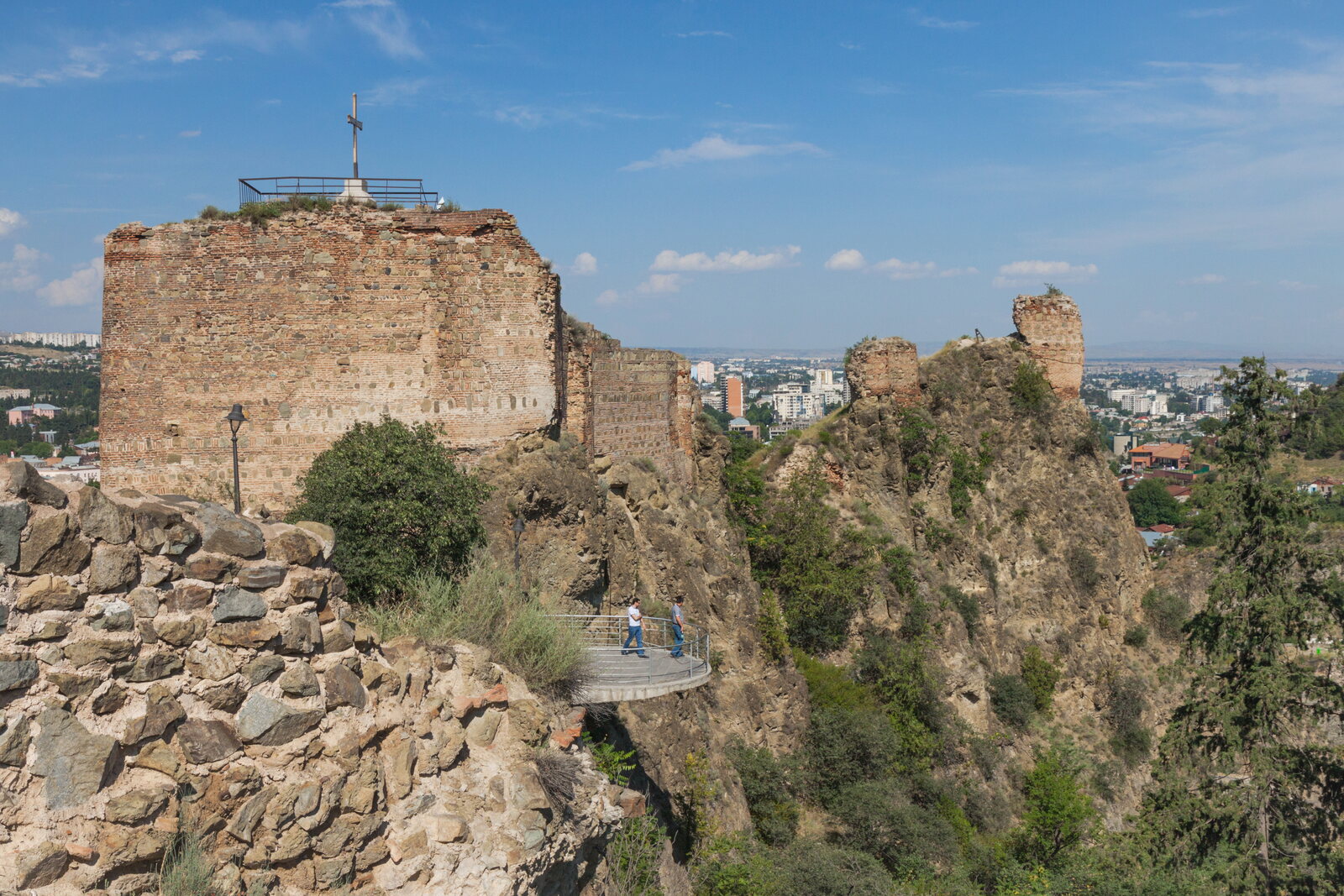
Look around first
What to notice
- Stone walls on the ridge
- The inner citadel
- Walls descending toward the city neighborhoods
The story of the place
Here, by the stone walls of Narikala Fortress, the story begins in seventeen forty-seven: Teimuraz II, king of Kartli, set out on a diplomatic mission to Iran. Until his return, Kartli was to be governed by his son—Erekle II, king of neighboring Kakheti. Abdullah Beg, a Georgian prince from another branch of the Bagrationi, was left to assist him.
For Abdullah Beg, this was a demotion. Under the Iranian shah, he had already served as governor of Kartli, ruled Tbilisi, received income from lands in Lower Kartli, and considered the throne here his inheritance. Now he was being asked to look after another man's kingdom. Abdullah Beg fortified himself in his residence at Samshvilde, hired Dagestani detachments, and won over the Qizilbash—serving warriors of the Iranian shah who held Tbilisi's fortresses. Had they held the capital, Erekle would have had to hand Kartli over to his rival.
Erekle first defeated Abdullah Beg's army at Samshvilde, then in the vicinity of Sololaki and Tsavkisi. After that, the fortifications above the city itself remained. The Qizilbash occupied Tabori, Metekhi, the Lower Fortress, and Narikala Fortress. Erekle took them one by one: first Tabori and Metekhi, then the walls descending toward the city neighborhoods, and finally the citadel on the ridge.
In seventeen forty-eight, the garrison at Narikala Fortress changed. Erekle stationed Georgian fortress soldiers here. The Qizilbash detachments that had been in the Tbilisi fortress for more than a century left it for good. When Teimuraz returned from Iran a year later, the capital was already subject to him and his son.
Erekle intended to arrest the defeated claimant. Catholicos Anton I—the head of the Georgian Church and Abdullah Beg's paternal half-brother—interceded for Abdullah Beg. Erekle abandoned the arrest, and Abdullah Beg left his brother Anton I in Samshvilde and departed for Tabriz. The throne for which he had raised an army and brought in mercenaries would not come to him again.
In the seventeenth and eighteenth centuries, the word “narikala” referred to a fortress's inner citadel. Such narikalas existed in Gori, Dmanisi, and other cities, but it remained a name only here. The lower belt of Tbilisi's fortifications lay closer to the houses and streets; the stone walls on the ridge were the last line of defense. It was this line that Erekle took last.
Useful on site
Access to the fortress, courtyard, and walls depends on ongoing rehabilitation and barriers on site; use only open sections and officially accessible viewpoints.
Checked: June 27, 2026. Check the official source before visiting.Do not go around closed passages or climb onto unprotected masonry; choose only an officially accessible viewpoint.