 Guide On Map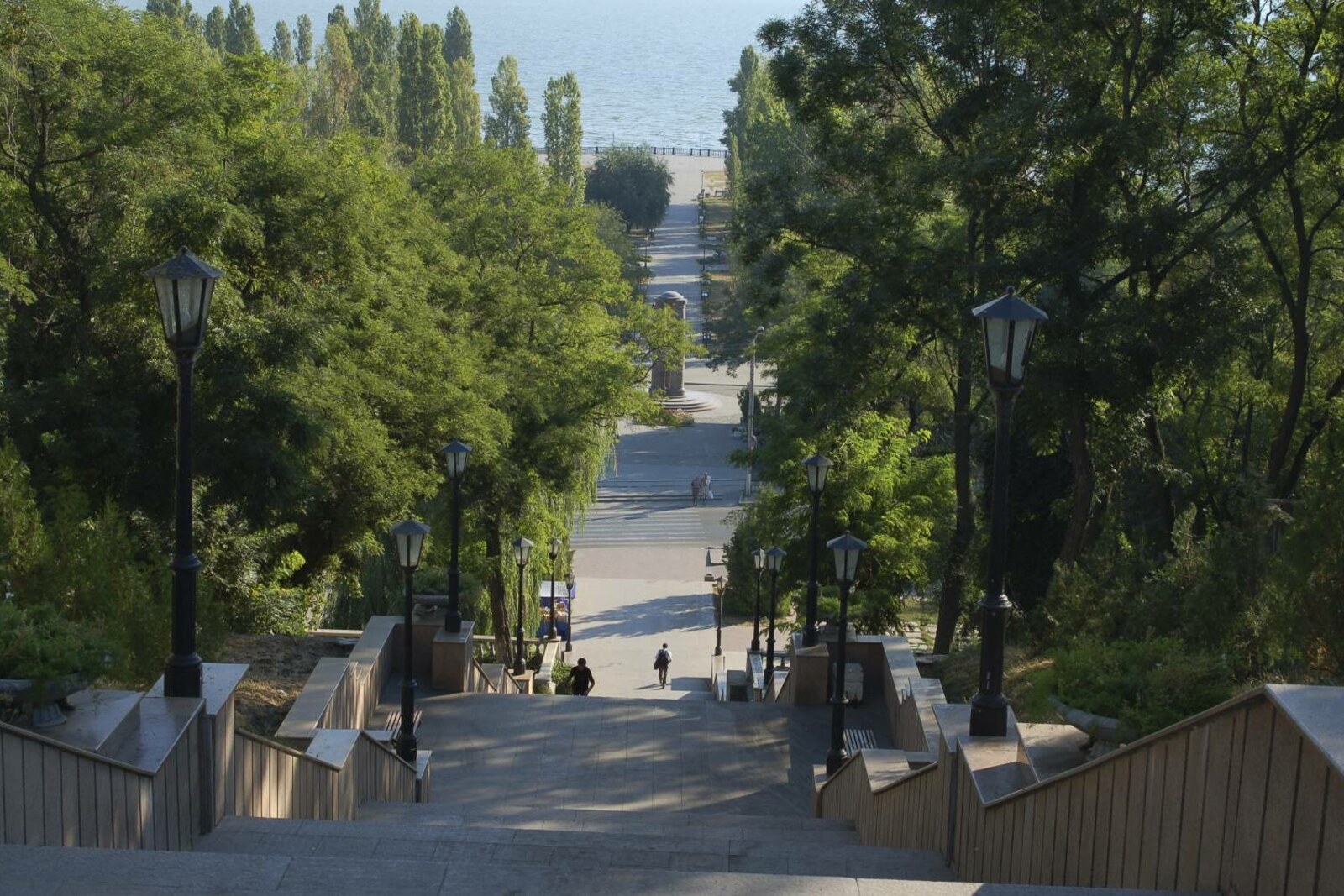
Look around first
What to notice
- Granite steps
- Thirteen landings
- Marble dial
- Metal gnomon
The story of the place
Thirteen landings divide the steep descent between the upper town and the shore; its steps are now granite, though they were originally carved from local limestone. Port warehouses and ships once stood below, while Grecheskaya Street began above, so the passage was used by those who needed to climb from the quay into town or descend to trade. A marble dial lies on the upper landing, and a metal triangle casts a shadow in place of a hand. This scale was once used to compare local solar time, but the sundial lost its accuracy after repairs.
Gerasim Depaldo never saw the staircase that came to bear his name. Toward the end of eighteen twenty-two, the thirty-four-year-old Taganrog merchant stipulated in his will that fifteen thousand rubles be set aside to build a “descent to the exchange.” At the time, the exchange was the place where merchants made deals. Warehouses stood near the shore, while traders' homes were above, on Grecheskaya Street. Depaldo lived by trade through this port and left part of the capital he had earned for a route between the city's two levels.
A few weeks later, the merchant died. The builders completed the descent in that same year, eighteen twenty-three: thirteen landings and one hundred forty-two steps of local limestone. People used them to reach the exchange, warehouses, and ships. Before the Revolution, the staircase was called the Stone Staircase—the name recalled whose money had become a public passage.
Ten years later, the Taganrog Sundial was installed on the upper landing, the oldest of its kind still functioning in Russia. The metal triangle on the marble slab is called a gnomon; the edge of its shadow serves as the hand. The scale showed local solar time, while adjustments for different months made it possible to compare it with mechanical clocks. During later repairs, the gnomon was replaced several times, so its former accuracy was lost.
By eighteen fifty-five, the sundial had already stood here for twenty-two years. During the Crimean War, British and French ships entered the Sea of Azov to destroy supplies used to provision the Russian army. Below lay grain, timber, and resin; a ready route led upward. The commercial descent proved a convenient route for a landing force.
On May twenty-second according to the Russian calendar then in use, the squadron commanders demanded that Taganrog surrender and that the defenders be withdrawn beyond the city. The military governor, Yegor Tolstoy, who was responsible for the defense, refused. After an artillery bombardment, English sailors landed by the shore and moved up the Stone Staircase. Yermolov, commander of a Cossack hundred, dismounted his men and blocked the ascent with rifle fire. The landing force did not reach Grecheskaya Street.
On other stretches of shore, the allies managed to set fire to warehouses of grain, timber, and resin, several vessels, and government buildings. The next day, the squadron left toward Mariupol. Tolstoy did not surrender the city, the Cossacks held the top of the staircase, and the sailors carried out part of their task on shore and returned to their ships without capturing Taganrog.
There are no traces of that battle on the steps: the old limestone was replaced with granite during repairs. What remains is the passage they fought over—a direct ascent from the former port warehouses to Grecheskaya Street. Its upper point is still marked by the marble dial.
Useful on site
An open urban public space with no ticket requirement; actual passage may be temporarily restricted by cleaning, ice, or repairs.
Checked: June 24, 2026. Check the official source before visiting.First examine the sundial and the view from above; descend only if the condition of the steps is suitable and you feel confident.