 Guide On Map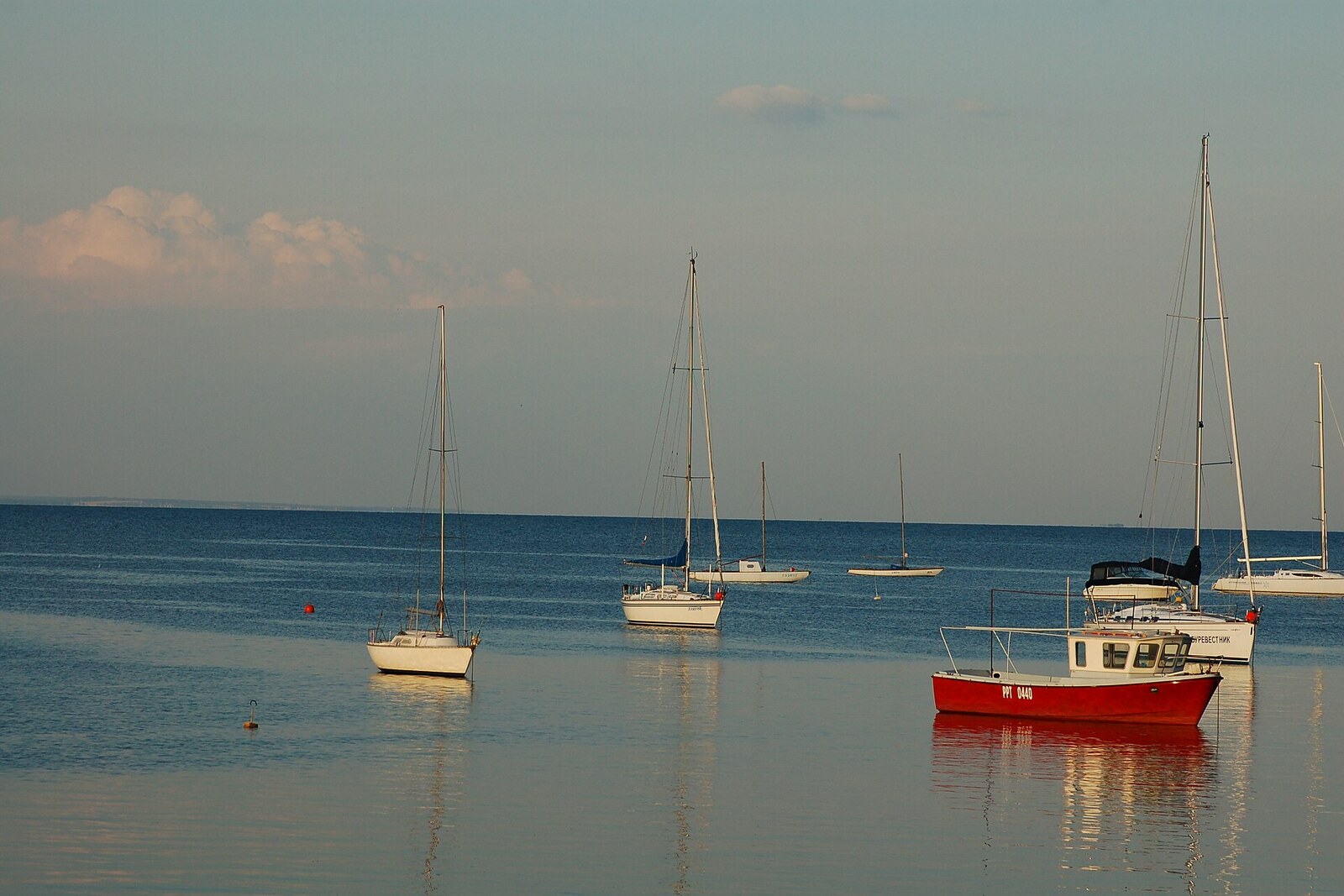
Look around first
What to notice
- Promenade boulevard
- Port berths
- Rail spur
- Line of Taganrog Bay
The story of the place
A broad boulevard stretches above the filled-in shore of Taganrog Bay, and beyond the trees and slopes begins the operating port with its berths. The ground beneath the embankment proved so weak that it had to be supported by piles; afterward, the shore was paved and reinforced so the water would not wash it away again. A rail spur runs along the water, and the present name, connected with Pushkin’s name, appeared on this shore only in the middle of the twentieth century.
In the early eighteen thirties, Taganrog merchants and owners of trading houses submitted a memorandum on the needs of the port. The old harbor was growing shallow, cargoes were stored on the shore, but there was no convenient road between the exchange and the berths. The merchants asked for the harbor to be put in order and for an embankment to be laid along the water, so carts could travel straight to the ships.
The memorandum was supported by Otto Romanovich Pfeilitzer-Frank, the appointed head of Taganrog and chief overseer of merchant shipping on the Sea of Azov. He sought permission for the construction and sent a request to Mikhail Semyonovich Vorontsov, governor-general of the southern provinces. Vorontsov approved the plan and in eighteen thirty-three sent the young military engineer Alexander Yakovlevich Laskin to Taganrog with a construction crew.
Laskin drew up a plan and cost estimate. The city received an interest-free loan for thirty-seven years for the work. When they began filling in the shore, it became clear that the ground was too weak and had to be additionally reinforced with piles. In the autumn of eighteen forty-three, an east wind raised the water, and part of the unfinished embankment sank badly.
Frank was responsible for the project. He was blamed for the accident; it became one of the formal grounds for his resignation. He left office without waiting for the opening of the road that he himself had steered through the approval process. Laskin remained in Taganrog, continued working on port structures, and rose from junior officer to colonel.
The embankment opened in eighteen forty-nine. It was named Vorontsovskaya in honor of the governor-general who had set the merchants’ request in motion. A horse-drawn road ran along the shore, and in eighteen seventy-three a rail spur to the port was laid beside it. When the volume of port operations declined at the end of the century, townspeople paved the shore, reinforced the slopes, and created a boulevard. The promenade embankment took over the former cargo route from Birzhevoy Descent to the harbor. Behind it are still the berths of the operating Port of Taganrog.
Pushkin’s name appeared here in nineteen fifty-two, when the former Vorontsovskaya Embankment was officially given the name “Pushkinskaya Embankment.” In everyday city speech, it became Pushkinskaya Embankment. The Russian poet Alexander Pushkin did indeed spend one day in Taganrog in June eighteen twenty, traveling with the family of General Nikolai Raevsky, but no completed embankment existed then. When Pushkin spent the night at the municipal authorities’ guest house, this shore was still a cargo strip by the old harbor; construction of Laskin’s road began only fifteen years later.
Useful on site
The central part of the embankment is accessible as an urban public space; individual sections and approaches may change because of phased reconstruction.
Checked: June 24, 2026. Check the official source before visiting.Listen to the story while standing at a safe pedestrian spot: the horizon matters more than trying to get as close as possible to port operations.