 Guide On Map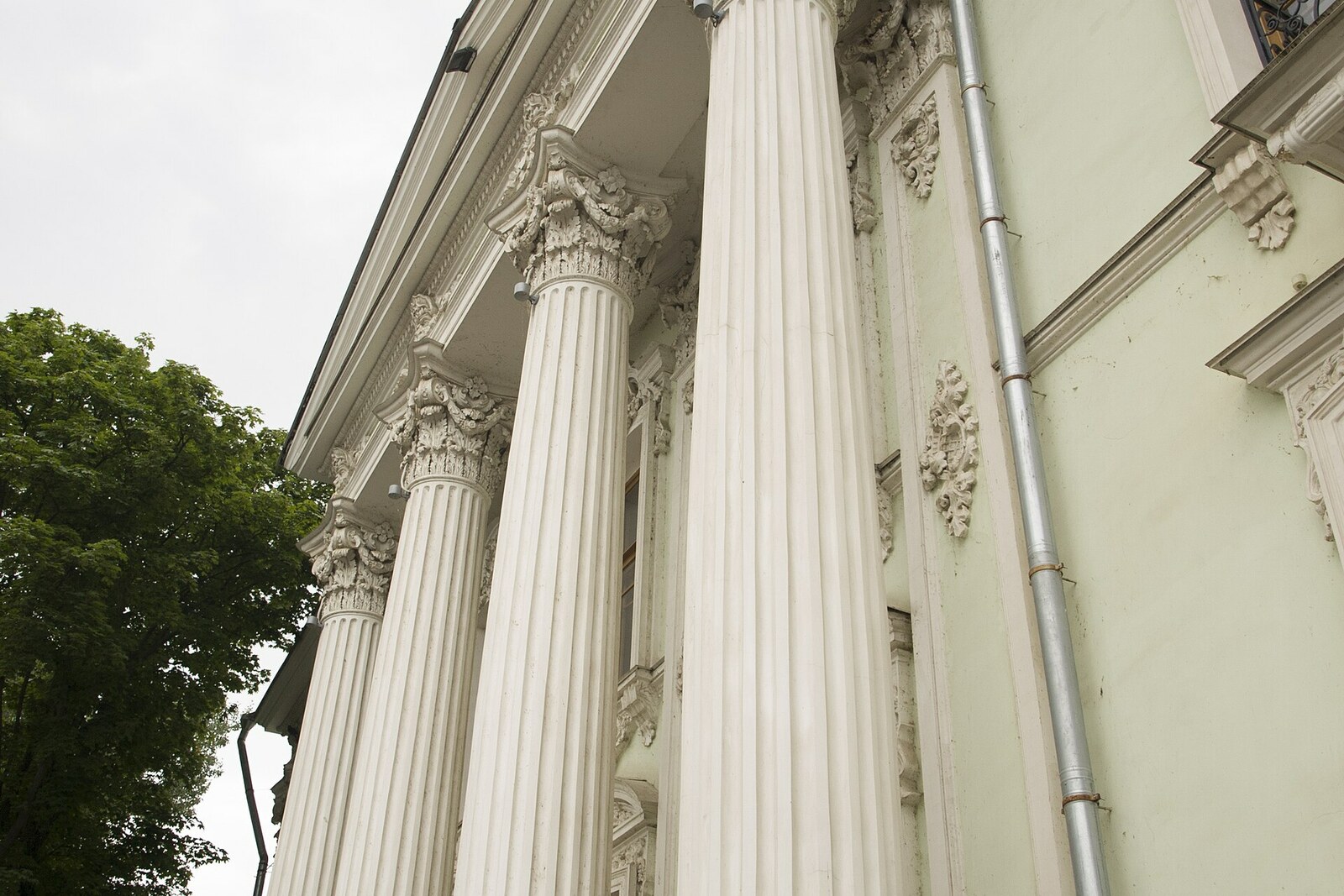
Look around first
What to notice
- The facade colonnade
- The marble staircase
- The double-height hall
- Museum display cases with family relics
The story of the place
The colonnade conceals a large city house designed for family life, receptions, and a numerous staff. Marble steps led up to a tall hall lit on two levels, while the rooms held a library, paintings, musical instruments, and a wine cellar. Later, the merchant community gathered here, and then the building began preserving the city’s memory in museum display cases.
Behind the palace colonnade is the Taganrog Museum of Local History: its halls tell the story of Taganrog and the Azov Region, from ancient settlements to the twentieth century. The surname on the sign belongs to Nikolai Dmitrievich Alferaki—a landowner, official, and collector who built this house for his family.
Alferaki drew income from land, city houses, and commercial premises. In eighteen forty-eight, he commissioned the St Petersburg architect Andrei Stackenschneider to build a palace on what is now Frunze Street, then called Catholic Street. The finishing work alone took several more years. When the family finally moved here from St Petersburg, more than a hundred paintings, seven grand and upright pianos, furniture, a library, carriages, and a wine cellar holding about eight thousand bottles arrived with them in horse-drawn carts. To run this household, Alferaki brought a cook, a confectioner, a gardener, a carpenter, a coachman, and other workers; many traveled with their wives and children.
Nikolai Alferaki lived here for only about three years. In eighteen sixty, he died of liver disease, leaving his wife, Lyubov Kuzminichna Alferaki, with their sons and an enormous house. Three years later, she had to receive a guest for whom the city officials had chosen this very palace.
Nineteen-year-old Tsarevich Nikolai Alexandrovich arrived in Taganrog—the heir to the Russian throne. His mother, Empress Maria Alexandrovna, felt unwell and remained aboard the steamship lying at anchor. Rooms in the Alferaki home were prepared for the empress’s son.
The tsarevich arrived at about one in the afternoon. At breakfast, Dmitry, the hostess’s eldest son, sat with him. The heir then looked at the paintings, spoke with the young master of the house, and played billiards with someone from his entourage. After the city dinner, he returned to the palace for tea. Lyubov Kuzminichna then introduced him to her younger sons.
Behind this reception was the work of people whose names usually disappear from palace history. Radin, the family cook, was responsible for the heir’s table. When he left, Nikolai Alexandrovich ordered that Radin be given a diamond stickpin and left money for the rest of the servants. He gave the family his large photographic portrait with an inscription of thanks and the cup from which he had drunk tea.
He never became emperor. In the spring of eighteen sixty-five, the tsarevich died in Nice of tuberculous meningitis; his younger brother Alexander became heir. Decades later, Alferaki’s son Sergei recorded that his brother Achilles continued to keep the signed portrait and the cup.
That same Achilles, introduced to the tsarevich in this house as a teenager, later became city head—the elected leader of Taganrog. By then, the heirs had sold the palace to the merchant Negroponte, and the merchant community had set up the Commercial Assembly Club here. Achilles Alferaki proposed opening a city museum in Taganrog. His successor, Pavel Iordanov, brought Anton Chekhov into the effort, and on June twenty-second, eighteen ninety-eight, the city duma established the museum.
At first, the collection was housed in another building. Only in nineteen twenty-seven did the city give it the former Alferaki home. Now the museum display cases hold relics of this family, passed on by its descendants, and a marble staircase leads to the double-height hall where the heir to the throne was once received. In the rooms that Nikolai Alferaki filled with his own collection, the museum first proposed to the city by his son is now open.
Useful on site
Tue–Sun 10:00–18:00, ticket office until 17:00; closed Mon. Until 31.08.2026, Saturdays 10:00–19:00, ticket office until 18:00. 01.07.2026 is a sanitation day.
Checked: June 24, 2026. Check the official source before visiting.The facade itself shows the owner’s ambitions; the museum entrance adds halls and objects that outlived their former owners.