 Guide On Map
Suzdal: From the Kremlin to the Monastery Walls
From the Nativity of the Theotokos Cathedral through Market Square to Spaso-Evfimiev Monastery
Guide On Map on your phone
Open the walk like a regular app
It takes about 10 seconds to install. No app store needed.
The whole path
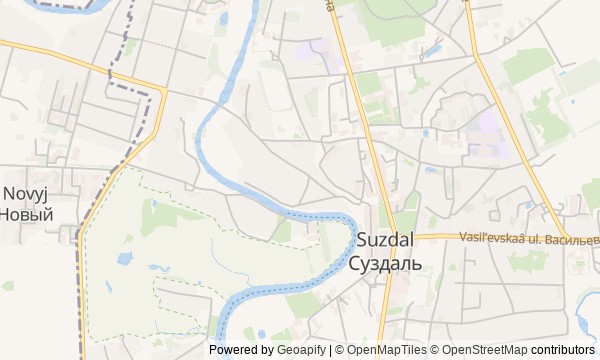
Route map
About the walk
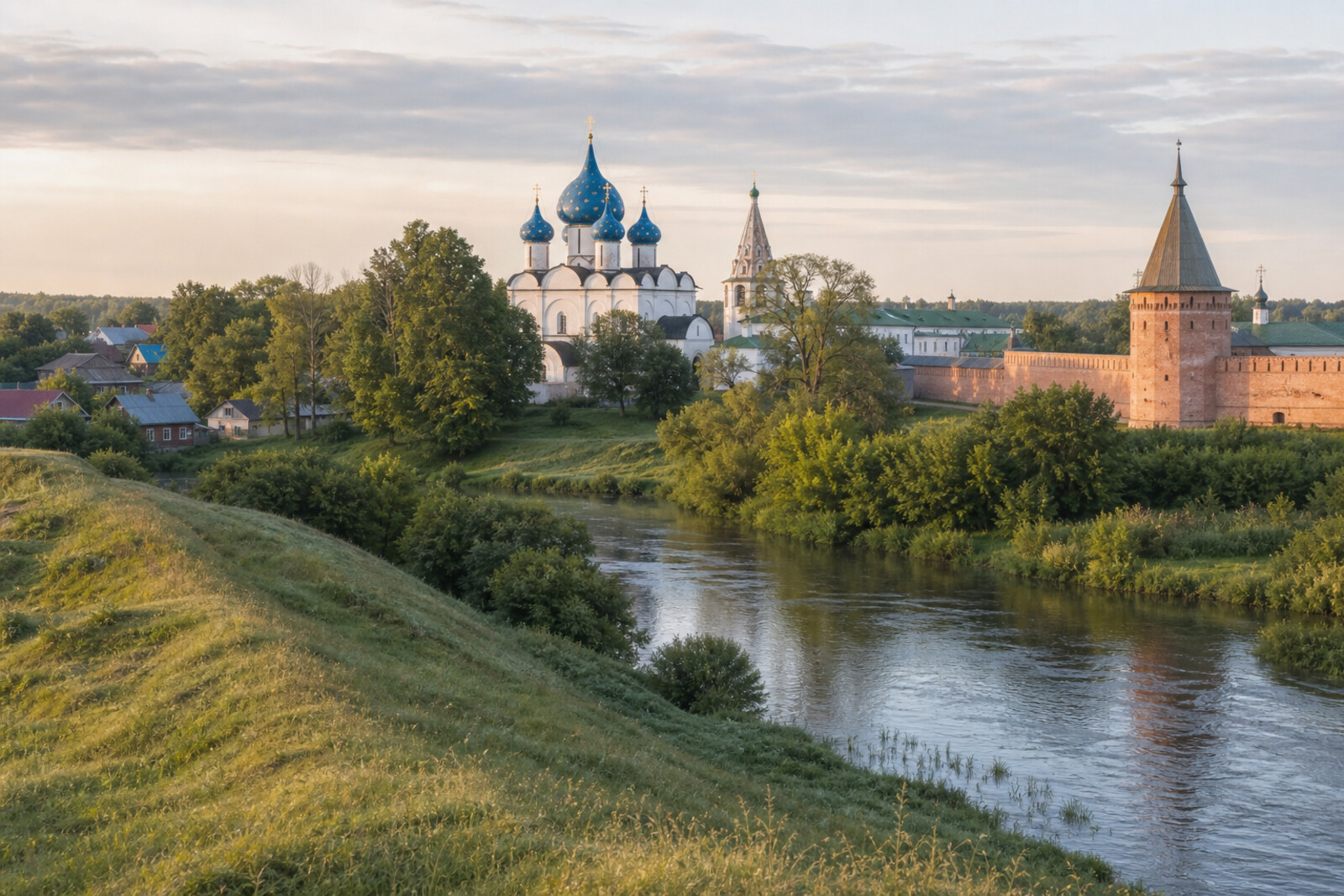
You will begin in the Suzdal Kremlin and finish at the walls of Spaso-Evfimiev Monastery. First you will circle the ancient fortified core, then cross the Kamenka River to a museum street of wooden buildings, return to Market Square, and head north toward three monasteries.
The cathedral, grassy rampart, long arcade of shops, and monastery enclosures will all look familiar. But beside them, less comfortable questions will arise. Why will a princely meeting end in a shared celebration? Why will a merchant write that he heard the order but has no wish to build? What will a wife manage to do while her sick husband is being taken across Siberia?
In every story, you will compare events with documents and surviving objects. A legend will remain a legend, and a conjecture a conjecture. By the end, you will be able to tell Suzdal's fortress outline from its museum street, and understand why three different stories of unfreedom unfolded behind the walls of the three northern monasteries.
Why this order
First you will find yourself inside the ancient fortified center and understand what its outline defended; the next stop is the rampart itself, the boundary between the cathedral and the burned-out town. Beyond the rampart's southern break, a bridge across the Kamenka River leads to the museum: after the vanished wooden walls, you will see how restorers saved civilian wooden buildings. Back at Market Square, the story shifts from the voluntary rescue of buildings to forced rebuilding in stone. Lenin Street then takes you out of the trading center to Rizopolozhensky Monastery and begins the northern chain of monasteries. Descending Pokrovskaya Street, you will move from two neighboring women's communities to the fate of a woman forced to take the veil. The final crossing of the Kamenka River brings you to Spaso-Evfimiev Monastery: opposite the women's monastery stands a men's monastery where the state established a prison.
Those who want to see more than the postcard center Those who care about the human decisions behind famous monuments Those ready for a long historical walk
Those looking for a short loop through the main views Those who prefer light urban legends to documentary analysis Those who do not want to enter stories of coercion and imprisonment
Before you go
Choose sturdy footwear: the rampart, grassy sections, and riverside paths require care after wet weather. Check access to the Kremlin exhibitions, the Museum of Wooden Architecture, and the Spaso-Evfimiev complex in advance—individual buildings may be unavailable even when the grounds are open to visitors. Rizopolozhensky Monastery and Pokrovsky Monastery remain religious spaces: follow the clothing requirements, do not enter closed passages, and do not disturb services. Interiors are not the only thing that matters on this route, so do not cancel the walk because one site is closed: many key details can be read from outside.
When to go
Do not divide your time evenly between stops. You will need the most time in the Kremlin, among the relocated wooden buildings, and in the final monastery complex; the rampart, Market Square, and Rizopolozhensky Monastery can be explored more compactly. At the Pokrovskaya Street stop, leave time not only for the courtyard but also for the story of Solomonia and Evdokia. Set aside extra time for crossings, rest, and possible waits at entrances.
Backup plan
If interiors are closed, keep the full sequence and work with the exterior: the cathedral's lower and upper masonry, the crest of the rampart, the silhouettes of the wooden churches, the arcade of the Trading Rows, the bell tower, and the monastery enclosures. The stories of Pokrovsky Monastery and Spaso-Evfimiev Monastery are clear already at their walls and gates. In wet weather, do not take doubtful paths or cut across slopes: return to the regular city streets, even if the crossing takes longer. If time is short, do not cut the finale—shorten your visit to individual exhibitions, but reach the last fortress wall.
Route conditions
Surface. Paved — 4.2 km; unpaved — 1 km (data covers 94% of the route)
Stairs. Flights: 1, 46 m in total
Access. Wheelchair — no; stroller — limited (stairs)
Facilities. Toilets — 3
Elevation. Ascent — 50 m; descent — 45 m
OpenStreetMap extract of July 4, 2026: database data, not a check on the ground. Data © OpenStreetMap contributors, ODbL licence
Walk plan
Open in maps ↗- 1
Suzdal Kremlin
Here you will learn how the bishop's court kept a family dispute from turning into another battle. - 2
Kremlin Ramparts
Using the surviving crest, you will trace the boundary of the city destroyed during a princely retreat. - 3
Museum of Wooden Architecture
Here you will learn how dismantled rural buildings became a new museum street. - 4
Market Square
Here you will trace how the merchants’ refusal to pay ended with the appearance of a stone Gostiny Dvor. - 5
Rizopolozhensky Monastery
Here you will compare the late Life of a princess with archaeological traces of two neighboring women’s communities. - 6
Pokrovsky Monastery
Here you will see how a monastic name was meant to bar a woman from ever returning to court. - 7
Spaso-Evfimiev Monastery
Here you will walk from the fortress enclosure to the cells and the lost site of the prisoners’ burial ground.
Route features
Everything you need stays in the browser
Progress, saves and your trip plan are stored on this device.
Add Guide On Map to your home screen so the walk opens outside the browser.
How we handle sources, maps and corrections: our editorial standards