 Guide On Map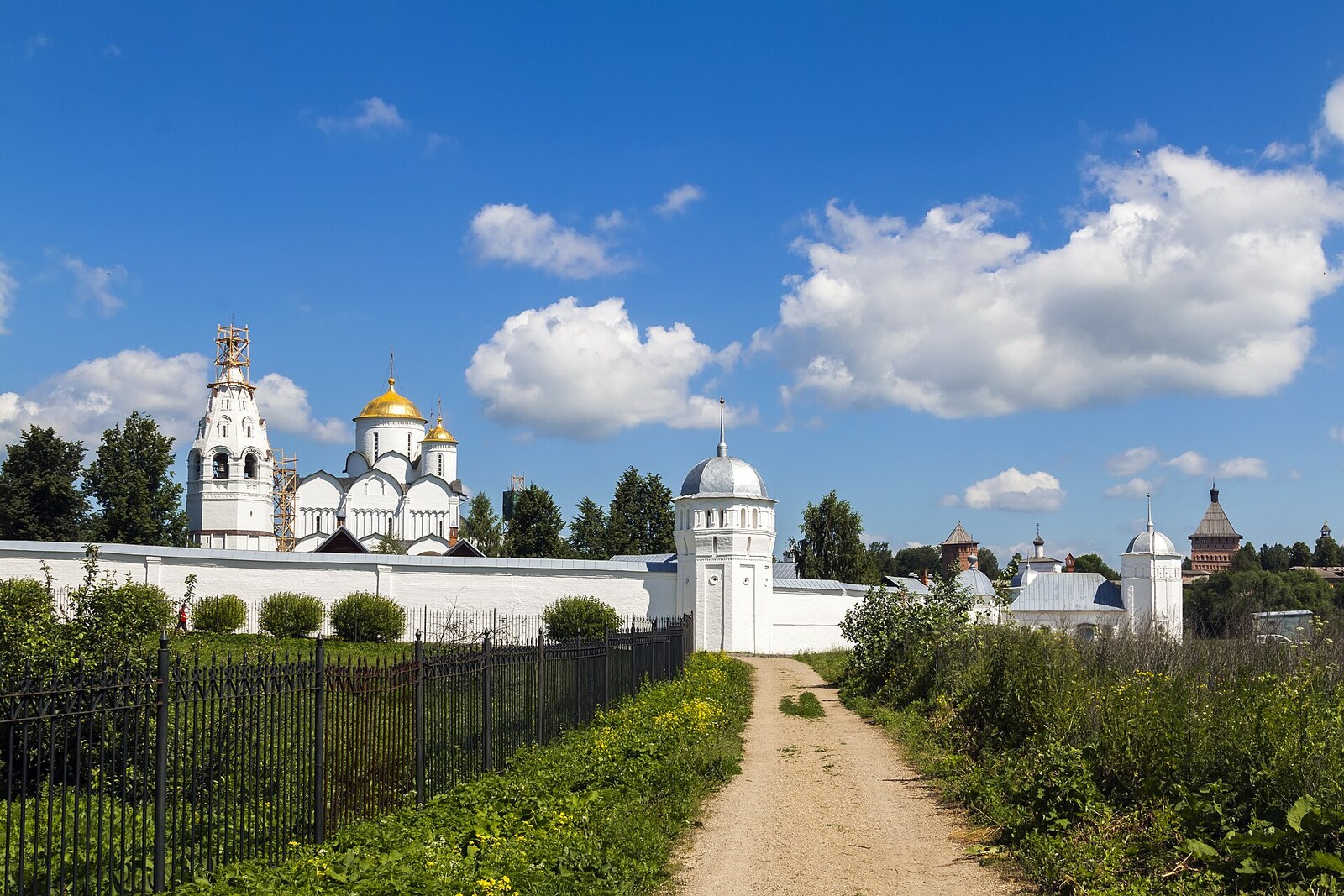
Look around first
What to notice
- The white-stone Intercession Cathedral
- The Holy Gates of the Intercession Monastery
- The bell tower
- The relics of Sofia of Suzdal
The story of the place
Pokrovsky Monastery was founded in the fourteenth century by the Suzdal prince Andrei Konstantinovich, but not a single monastic charter from the fourteenth or fifteenth centuries has survived. Documents appear alongside the attention of the Moscow court: in the early sixteenth century, the monastery began to receive grand-princely donations, land, and privileges. In the same period, stone churches and gates began to be built here.
No later than the autumn of fifteen twenty-six, the nun Sofia was already living behind these walls. Just a year earlier, she had been called Solomonia Saburova and had been Grand Princess of Moscow—the first wife of Vasily III. Her change of name explains one of Pokrovsky Monastery's former functions: noblewomen who had to be removed from court forever were brought here.
Solomonia had lived with Vasily for twenty years, but they had no heir. The Grand Prince wanted a son to whom he could pass on the throne. Childlessness was not considered church grounds for divorce, and many clergymen called a new marriage while the wife was still alive unacceptable. Vasily suppressed the opposition, dissolved the marriage, and in November fifteen twenty-five ordered Solomonia to be tonsured as a nun. Judging by the surviving evidence, she did not give her consent.
Tonsure was meant to prevent her from returning to her former life: a nun renounced her family, status, and own name. Solomonia became Sofia. In January fifteen twenty-six, Vasily married Elena Glinskaya, and four years later she bore him Ivan—the future Ivan the Terrible.
The Suzdal monastery was not chosen by chance. Vasily III had invested money in it even during his marriage to Solomonia. At his order, the white-stone Intercession Cathedral, the Holy Gates of the Intercession Monastery, and the bell tower were erected—the principal buildings that have survived here to this day. The cathedral was dedicated to the Intercession of the Theotokos, a church feast of her protection; the monastery received its name from it.
The former wife was not left without support. In the autumn of fifteen twenty-six, Vasily granted the nun Sofia the village of Vysheslavskoye with its surrounding villages as a lifelong possession. She lost her status as Grand Princess, but lived here on income from her own holding, rather than as a nameless prisoner.
Sofia remained at Pokrovsky Monastery until her death and was buried in the burial vault beneath the cathedral. Veneration began at her tomb, and the rejected wife entered church history as Sofia of Suzdal. In nineteen ninety-five, her remains were removed from the burial vault and transferred to the Intercession Cathedral.
A women's monastery now operates here again. Inside the cathedral, built with Vasily III's money, are the relics of the woman whom he ordered removed from his family forever.
Useful on site
An active monastery. In the published schedule, the evening service begins at 17:00, in winter at 16:00; the liturgy is at 08:00 on weekdays and Saturdays, and at 09:00 on Sundays and feast days. Confirm the general access arrangements for the grounds with the monastery in advance.
Checked: June 24, 2026. Check the official source before visiting.This is an active women's monastery: do not photograph people without permission, and do not attempt to enter closed residential sections. You can listen to the main account by the fence or in the accessible courtyard.