 Guide On Map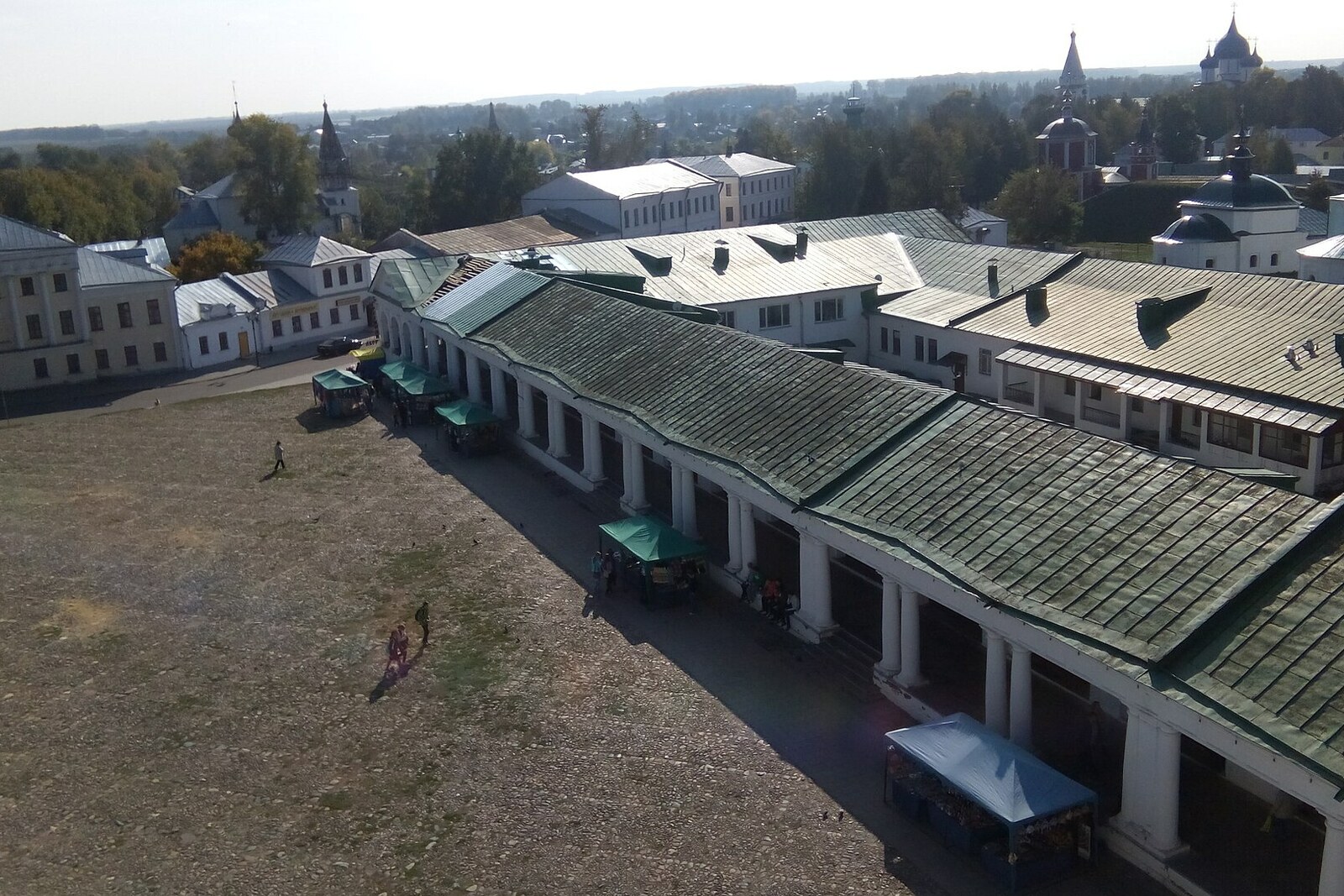
Look around first
What to notice
- Long colonnaded gallery
- Central gates
- Individual trading premises
The story of the place
Market Square took shape in the center of Suzdal’s posad, where craftsmen and merchants lived. In the eighteenth century, the wooden Gostiny Dvor held one hundred thirty-eight shops. When it was decided to replace it with stone Trading Rows, the costs were placed on the shop owners, and the entire trading community had to discuss the construction.
On November seventh, seventeen ninety, Suzdal’s merchants were gathered in the city duma and required to subscribe to the construction of stone shops. Pyotr Zhinkin, a merchant who, like the others, was asked to pay for a new shop, wrote beside his name: “He has heard the order, but does not wish to build.”
By then, trade had long occupied this square. Merchants sold their goods in a wooden Gostiny Dvor—the name for a unified complex of shops for local and visiting merchants. After Suzdal’s new plan was approved, the city duma was to replace it with a stone building, but it had no funds of its own. The costs were shifted onto those who made their living from trade.
Twenty-five people agreed. The rest did not sign. A few years later, the merchants and trading townspeople declared jointly that, “due to their lack of means,” they could not build stone shops. Khmetevsky, the town governor—the head of the city administration and police, who was pressing for the plan’s implementation—threatened to demolish their old wooden shops. A fire in Kazan brought a delay: afterward, the construction of new Gostiny Dvors throughout the country was temporarily prohibited.
When the ban was lifted, Suzdalians delayed for several more years. In eighteen oh five, Vladimir Governor Ivan Dolgorukov, intending to clear the streets and squares in accordance with the approved plan, ordered the demolition of old shops, houses, and gardens that obstructed the new Moscow Road and the commercial center. Four days later, seventy merchants and townspeople signed an undertaking to build one hundred one shops.
The signature proved to be only the beginning of the expenses. Over five years, the traders were required to contribute money more than ten times; the usual levy was fifty rubles per shop. They chose representatives from among themselves to purchase lime, stone, and bricks and supervise the construction. Each was assigned a place in advance: haberdashery was placed in the front row, with iron goods and vegetables beside it, bread and butter along the sides, and meat and fish on the Kamenka River side. Thus, one square acquired rows with separate trading units instead of a cluster of wooden counters.
In September eighteen eleven, a fire destroyed most of the remaining wooden shops and the roof of the nearly completed stone Gostiny Dvor. The roof was restored by the end of the year, and trade began in the new premises the following year.
The northern section of the gallery from that building, counted from the central gates, has survived; sections dismantled later were restored in the twentieth century. Individual shops still run behind the columns today. The merchants who had refused to pay for stone shops for fifteen years ultimately left behind precisely shops here—built in one long row.
Useful on site
The square and exterior viewing are available at all times; the hours of individual shops and establishments vary and are not part of the route.
Checked: June 24, 2026. Check the official source before visiting.First, look at the entire façade from across the square, then walk beneath the arches and take in their rhythm from inside. Operating shops are not museum spaces—respect their regular hours.