 Guide On Map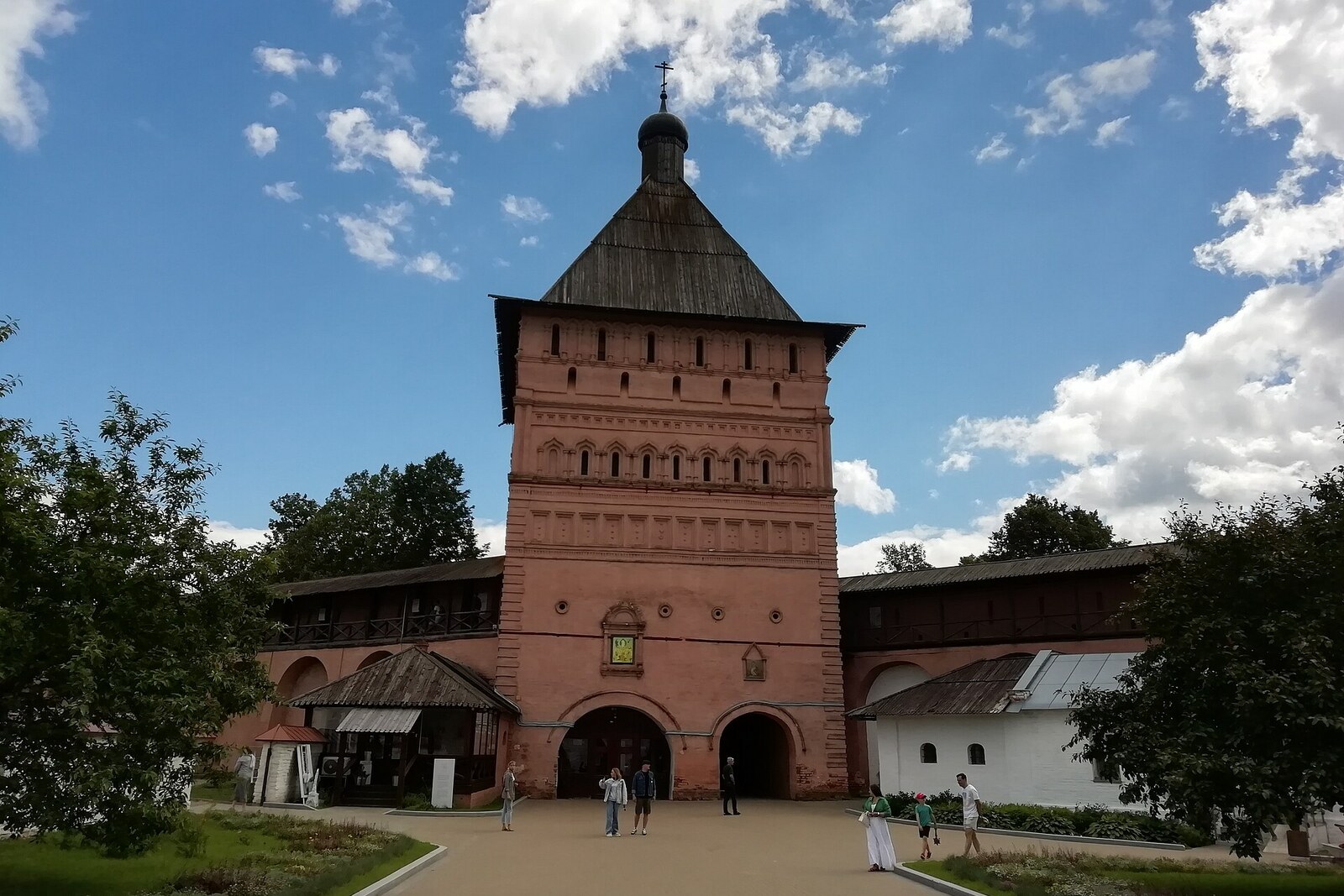
Look around first
What to notice
- Fortress wall with twelve towers
- Former prison building
- High inner wall
- Memorial plaque
The story of the place
In the middle of the fourteenth century, a men’s monastery was founded here, and its upkeep was provided by the Suzdal prince. The princes of Suzdal and Moscow granted Spaso-Evfimiev Monastery land and privileges, and by the end of the seventeenth century it had become one of the wealthiest monasteries in Rus’.
The monastery’s name combines a dedication and a human name. It was called the Savior monastery after its main church, the Transfiguration of the Lord. Euthymius was a monk whom the Suzdal prince Boris Konstantinovich invited from Pechersky Ascension Monastery to establish a men’s monastery here. Euthymius became its first abbot and introduced a communal rule: the monks owned no personal property, ate together, and followed a single routine. He was buried here; after Euthymius was canonized in the middle of the sixteenth century, the monastery came to be called Spaso-Evfimiev Monastery.
The stone walls with twelve towers were built later, in the seventeenth century. They protected the wealthy monastery, but in seventeen sixty-six Ekaterina II ordered a prison opened behind them. The abbot was responsible for the prisoners, and the monastery enclosure spared the prison authorities the need to build a separate fortress.
In April eighteen twenty-nine, Natalia Shakhovskaya wrote to her husband, imprisoned here: “We will see each other again soon. You will hold the children to your heart.” Fyodor Shakhovskoy, a former Guards major and member of the secret Union of Prosperity, sought to limit autocratic rule and introduce representative government. After the failed Decembrist uprising, the court stripped him of his rank and nobility and sent him into Siberian exile for twenty years. His wife and two young sons remained at the family estate.
In Siberia, Shakhovskoy developed a severe mental disorder. Natalia asked for permission to take her ill husband to a remote estate and care for him under supervision. Nikolai I refused. He ordered Shakhovskoy transferred to the prison of Suzdal Monastery and held on the same terms as the other prisoners, allowing his wife to settle nearby.
A separate building for such confinement already existed here. Shortly before Shakhovskoy’s arrival, the former cells had been rebuilt: low single cells were arranged along a corridor, and a walking yard was left in front of the building, separated from the rest of the monastery by a high inner wall.
Shakhovskoy was brought from Yeniseysk with frostbite. A doctor recorded injuries to his nose, ear, fingers, and leg, although the escort had been issued two fur coats, mittens, and other warm clothing for the prisoner. At Natalia’s request, a doctor and the old servant Larion were admitted to her husband. The servant was allowed to care for the prince but forbidden to leave the monastery.
Natalia intended to come herself; the spring flooding of the rivers delayed her journey. At the beginning of May, Shakhovskoy stopped taking food. It was later called a hunger strike, but the monastery report speaks only of a man in a state of severe mental disorder who was not eating. A few weeks later, he died.
Natalia asked for the body to be given to her so that she could bury her husband at Moscow’s Donskoy Monastery or at the family estate. Nikolai I refused again and ordered Shakhovskoy left here, in the cemetery for prisoners. In nineteen twenty-four, the old gravestones were demolished, and the exact location of the grave was lost. A memorial plaque remains on the former prison building; behind its inner wall, there is now a museum exhibition about Suzdal Prison.
Useful on site
Daily 10:00–18:00, last entry at 17:00. According to the published technical schedule, the complex closes from 14:00 on every third Monday of the month; check the hours again on the day of your visit.
Checked: June 24, 2026. Check the official source before visiting.The complex is large, and access to individual exhibitions may vary. If time is limited, choose the materials about the monastery prison first, then visit the other spaces.