 Guide On Map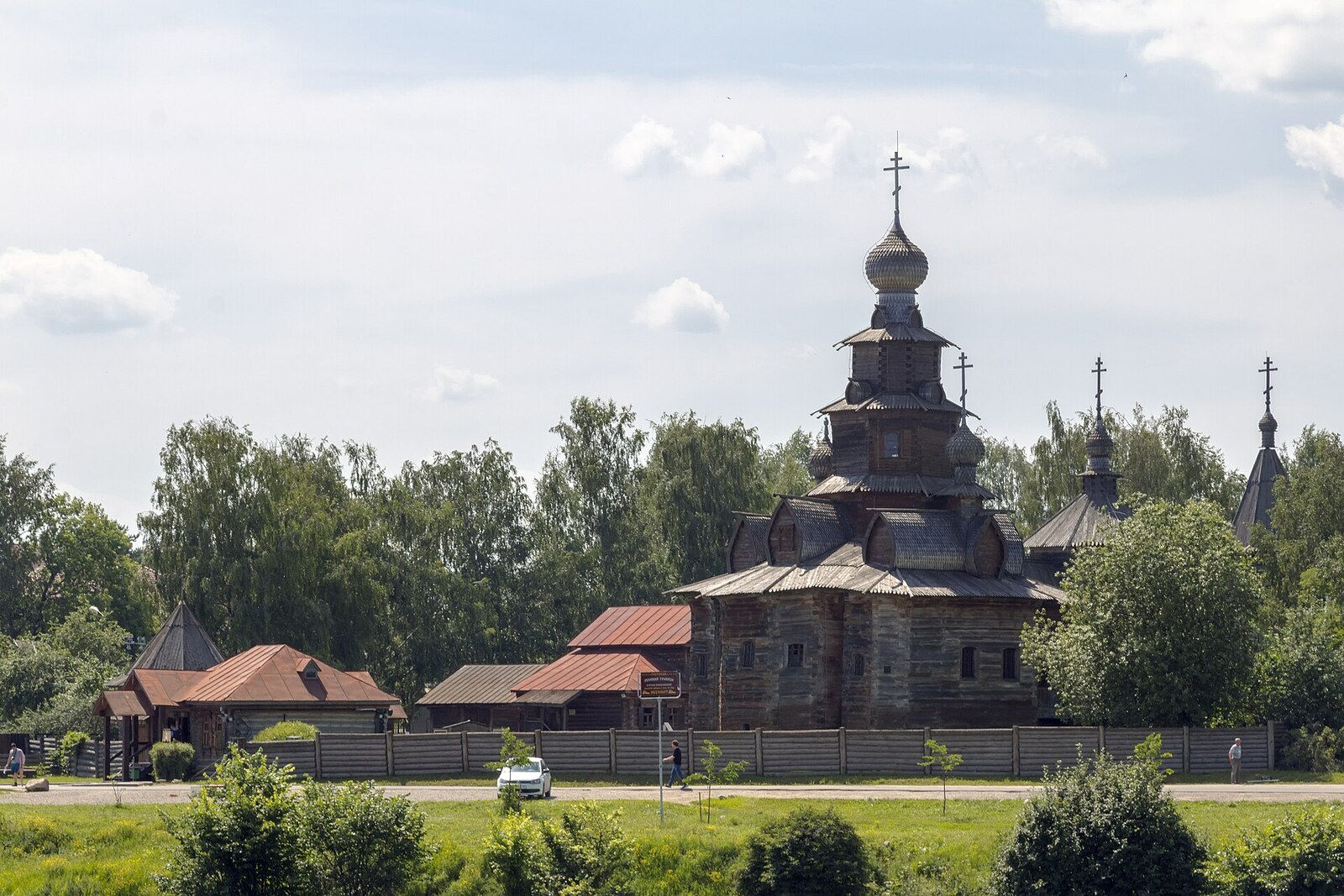
Look around first
What to notice
- Two rows of wooden houses
- Transfiguration Church
- Resurrection Church
- Windmills
The story of the place
The Museum of Wooden Architecture was established where Dmitriev-Pechersky Monastery once stood, and later two parish churches that were lost in the nineteen thirties of the twentieth century. The museum grounds were laid out as a rural street.
The houses on either side of this street were never neighbors. They were built in different villages of Vladimir Oblast in the eighteenth and nineteenth centuries, and only museum staff placed them side by side. The exhibits here are the buildings themselves: churches, izbas, granaries, drying barns, wells, and windmills.
It all began with an action by Aleksei Varganov, the first director of the Vladimir-Suzdal Museum-Reserve. In nineteen sixty, he sought to save the dilapidated wooden St Nicholas Church from the village of Glotovo. Varganov did not wait for permission from high-ranking officials: he ordered the church dismantled, had the logs taken to Suzdal, and handed them over to restorers. The director had to explain his unauthorized decision to the regional party committee. The church was restored in the Kremlin, where it still stands, and its transportation marked the beginning of the future museum.
Eight years later, the regional executive committee approved the creation of a large exhibition on this bank of the Kamenka River. The master plan was assigned to Valery Anisimov, a thirty-one-year-old architect at the Vladimir Restoration Workshop. He had already earned his living for ten years by studying and restoring old buildings. Now he had to decide which rural structures could remain in their original locations and which would be lost before restorers could reach them.
Expeditions surveyed more than sixty settlements. Specialists found thirty-eight valuable structures; eleven were recommended for relocation, while the rest were to be preserved where they stood. Each selected house or church was first measured, described, and photographed. Sometimes ten years passed from the initial survey to the completion of the work—this was how long it took to save the Transfiguration Church from the village of Kozlyatyevo.
Mikhail Sharonov, the foreman of the Suzdal section of the restoration workshop, supervised the dismantling and reassembly. He worked alongside carpenters for whom old log structures were a daily craft and livelihood. In the villages, they dismantled the buildings, then transported the parts here and reassembled them according to Anisimov's plans. By nineteen seventy-four, the team had erected fifteen buildings on this bank. Sharonov later received a state prize for restoring Suzdal's monuments and turning them into museum exhibits.
Anisimov chose this site because of its own loss. Dmitriev-Pechersky Monastery once stood here; its later stone churches had already been demolished by the time the museum was created. Restorers installed the transported buildings on the foundations of vanished structures similar to them in purpose and size. Two rows of houses repeated the outline of Tomilov Lane—a small side street that once ran here—and churches were placed at the end.
The museum now has eighteen monuments from thirteen settlements. The Transfiguration Church came from Kozlyatyevo, the Resurrection Church from Patakino, and two windmills from Moshok. Their shared history began only here, when Sharonov's carpenters assembled scattered log structures into a single street on the foundations of a vanished part of Suzdal.
Useful on site
Daily 09:00–19:00; ticket office and entry until 18:00. According to the published technical schedule, the complex closes from 14:00 on every third Wednesday of the month; check the hours again on the day of your visit.
Checked: June 24, 2026. Check the official source before visiting.The ensemble's overall outline is visible even on the approach, but a close look at the buildings depends on access to the museum grounds. Do not expect every building to be open inside.