 Guide On Map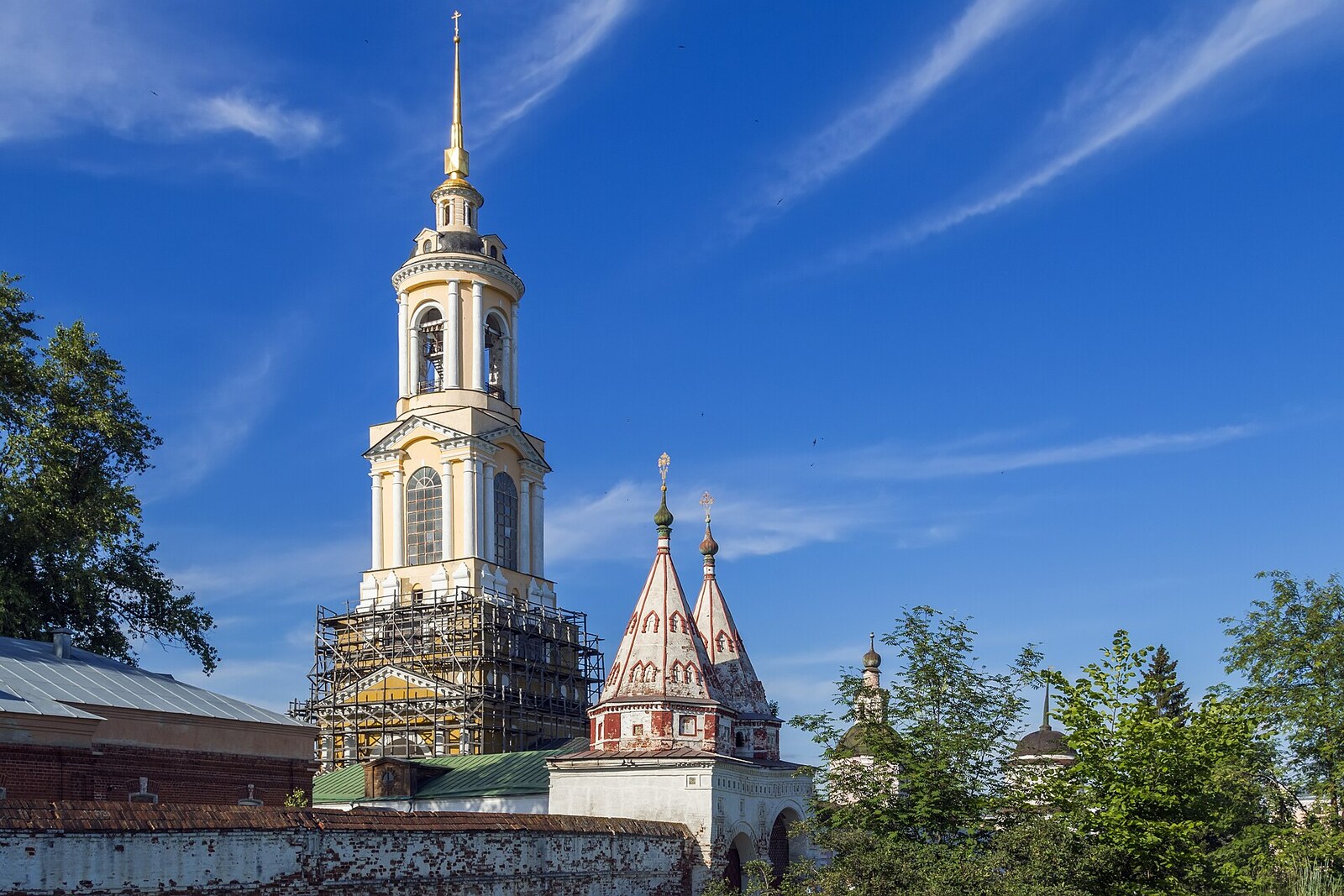
Look around first
What to notice
- Cathedral of the Deposition of the Robe
- Reliquary with the relics of Euphrosyne
- Two-tented Holy Gates of the Deposition of the Robe Monastery
- Prepodobenskaya Bell Tower
The story of the place
The first Rizopolozhensky Monastery had no stone buildings. At the beginning of the thirteenth century, Bishop Ioann founded a wooden women’s monastery at the crossroads in the northern part of the posad and dedicated it to the feast of the Deposition of the Robe of the Theotokos. The monastery’s name derives from the name of the feast.
The robe in the monastery’s name is a garment of the Theotokos. According to church tradition, in the fifth century the brothers Galbius and Candidus secretly carried it out of Palestine to Constantinople. Emperor Leo I and Patriarch Gennady placed the relic in the Church of Blachernae. In commemoration of this translation, the main church of the Suzdal monastery was consecrated, and after the church the entire monastery was called Rizopolozhensky Monastery. It emerged at the beginning of the thirteenth century beyond the town fortifications and was a women’s monastery. The exact date of its foundation is unknown; the customary year twelve oh seven appeared in a written work only five centuries later.
Old documents also give the monastery another name: the monastery of Princess Euphrosyne of Suzdal. This nun was remembered here so well that her name sometimes replaced the official one.
The account of her was recorded in the middle of the sixteenth century by the monk Grigory—about three hundred years after the events, from the oral traditions of local nuns. Therefore, his Life cannot be accepted as an exact biography. It calls Euphrosyne Princess Feodulia, the daughter of the Prince of Chernihiv, whom her family sent to Suzdal to marry Prince Fyodor Yaroslavich, the elder brother of Alexander Nevsky.
The chronicle does indeed report that in twelve thirty-three Fyodor died on the eve of the wedding: the feast had been prepared, mead beverages brewed, the bride brought in, and princes invited. The chronicler did not give the bride’s name. The late hagiographical account proposed linking her with Feodulia.
According to that account, after her fiancé’s death the princess could have returned to her father’s court, which gave her support and a place in the princely family. She continued here and asked the abbess—that is, the female superior—to tonsure her, meaning to receive her as a nun. Feodulia received the name Euphrosyne and remained in the monastery without holding the office of abbess.
The Life attributes to her a decision that changed the layout of this part of the town. Euphrosyne divided the women wishing to enter monastic life: unmarried women remained at Rizopolozhensky Monastery, while widows and women who had previously been married entered the neighboring Trinity Monastery. Separate churches were intended for the two communities; the Life even forbade virgin nuns to speak with married women of the town. The neighboring Trinity women’s monastery really did exist. Historians cannot prove that Euphrosyne herself founded it, but archaeologists have established that at the beginning of the thirteenth century the urban homesteads that stood here were removed, and the street running between them disappeared.
In seventeen sixty-four, Trinity Monastery was abolished, and its nuns were transferred here. Trinity Church remained nearby until nineteen thirty-four, when it was blown up. At the site of the separate monastery for widows, there is now neither a church nor buildings from the thirteenth century.
Euphrosyne was buried in the monastery. All the wooden buildings she could have seen have disappeared; the present stone cathedral was erected about three centuries later. Today the monastery again functions as a women’s monastery, and the Cathedral of the Deposition of the Robe contains a reliquary with the relics of the nun who once came to Suzdal as a princely bride.
Useful on site
Active monastery; a regional guidebook indicates daily access from 08:00–19:00. The openness of individual churches depends on services and monastery work.
Checked: June 24, 2026. Check the official source before visiting.In the active monastery, stay on passages open to visitors, speak quietly, and take services into account. Even without entering the courtyard, the bell tower is easy to view from outside.