 Guide On Map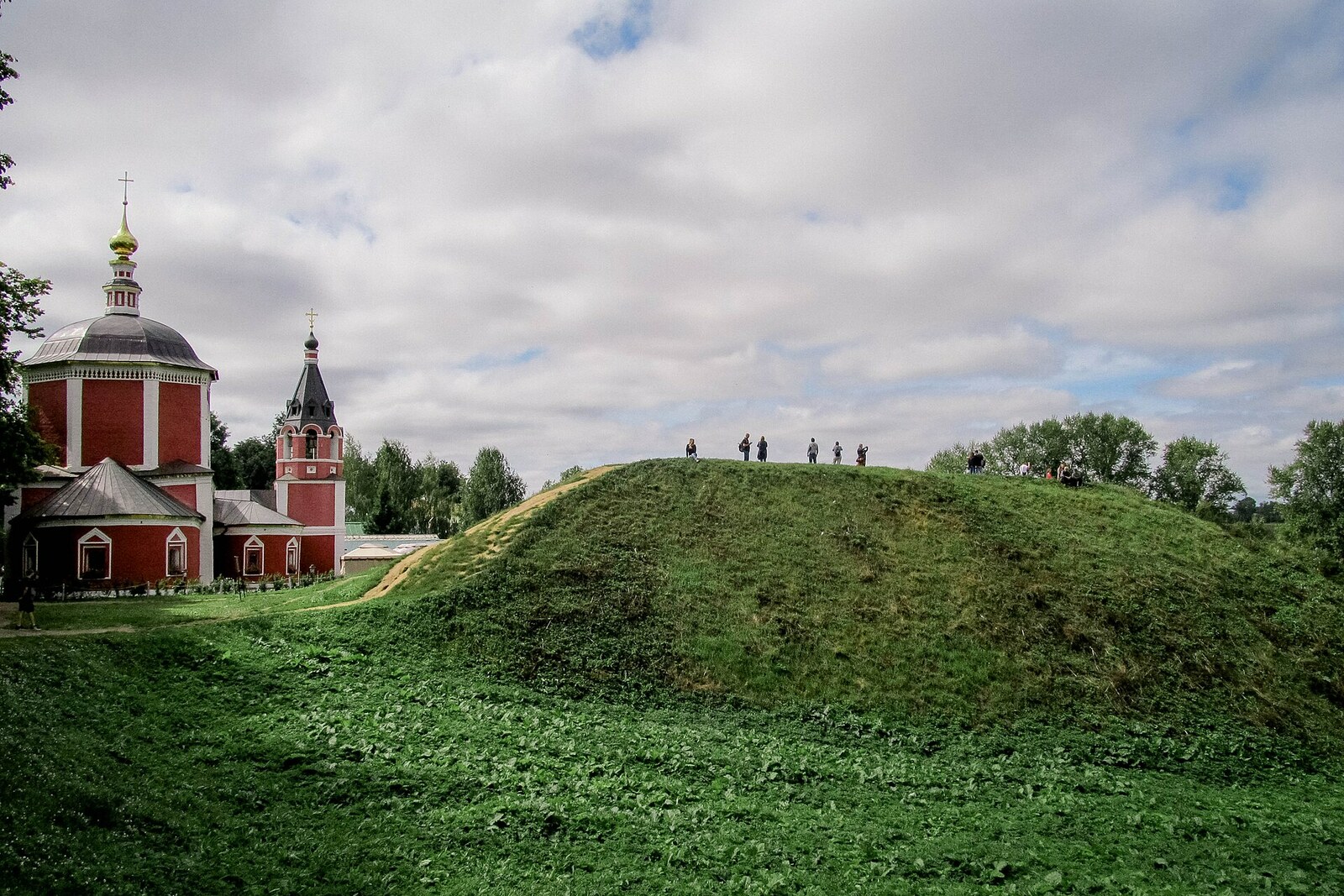
Look around first
What to notice
- The grassy crest of the rampart
- The moat on the eastern side
- Passages through the rampart
The story of the place
The Kremlin Ramparts became Suzdal's new defensive boundary: when they were built in the eleventh century, the fortifications of the small promontory settlement in the northwestern part of the present Suzdal Kremlin were leveled, leaving no traces of them on the surface. By the end of the same century, Russian princes were already fighting over Suzdal.
The Kremlin Ramparts are an earthen ridge on which a wooden wall once stood. In the winter of ten ninety-six to ten ninety-seven, the Chernihiv prince Oleg Svyatoslavich ordered Suzdal, which he himself had recently captured, to be burned.
Oleg sought the northeastern holdings of Vladimir Monomakh. First, near Murom, he defeated Monomakh's son Izyaslav, occupied Rostov and Suzdal, installed his own governors here, and began collecting tribute. Mstislav, another of Monomakh's sons, marched from Novgorod against him. He was to reclaim the family lands after his brother's death.
Oleg understood that he would not hold Suzdal. As he left, he ordered the city set on fire. The chronicler recorded the scale of the devastation through a single exception: beyond the Kamenka River, the compound of Pechersky Monastery and the wooden Church of St. Demetrius survived. Everything else mentioned in the account perished. Mstislav caught up with Oleg near Suzdal and defeated his army. Oleg fled first to Murom, then to Ryazan, and lost the Rostov and Suzdal he had captured.
Archaeologists usually associate the construction of a complete ring of fortifications along the present perimeter with the rebuilding of the city under Vladimir Monomakh at the turn of the eleventh and twelfth centuries. It is not yet possible to distinguish the building stages more precisely: the ramparts have been investigated only in a few small sections. One thing is known: since the eleventh century, the foundation of the fortifications has been renewed many times, but never moved.
The earthen ridge served as the base for a wooden wall. Log structures and towers stood on it, and roads passed through the gates. A bend in the Kamenka River protected the fortress on the river side, while to the east, where people could approach the city by land, they raised the strongest rampart and dug a deep moat in front of it. Within this perimeter stood the princely and episcopal courts, the cathedral, and the townspeople's houses—precisely what they tried to preserve behind the wall and precisely what Oleg doomed to the flames as he retreated.
The wooden fortifications continued to be renewed for several more centuries. After the great fire of seventeen nineteen, the walls and towers were not rebuilt. The crest was lowered and turned into a place for walks. Where roads now cut through the grassy embankment, gate towers once stood: not a single log of the gates remains, and only the passages through the rampart have survived.
Useful on site
An open urban landform with no ticket office or fixed hours; it is safer to walk along the crest only in daylight and when the surface is dry.
Checked: June 24, 2026. Check the official source before visiting.After rain, climb only on a secure path and do not go close to the edge of the slope. For the narration, it is enough to choose a stable point with a view of the line of the rampart.