 Guide On Map
White Sucre and the Struggle for the Right to Govern
From Plaza 25 de Mayo through the old center to La Recoleta
Guide On Map on your phone
Open the walk like a regular app
It takes about 10 seconds to install. No app store needed.
The whole path
Route map
About the walk
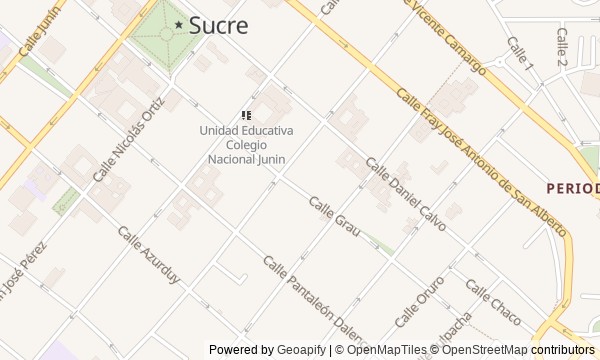
You will begin at Plaza 25 de Mayo and walk through the old center to the high square of La Recoleta. At first, the route stays close to the city's principal institutions: a former university chapel, a law school, two churches, and the cathedral complex. Then you will turn onto residential Pantaleón Dalence Street and climb above the white roofs.
In one hall, a signature will create a republic. A page will be torn from another book. A crack will remain in a bell tower, and only two faces will remain from a revered painting. You will ask why preservation can destroy an original and who gets to decide the color of an old house.
The story stays attentive to documents and human stakes. Contested versions remain versions. After the climb to La Recoleta, you will no longer mistake white Sucre for a single piece of colonial decor: you will see court decisions, church gifts, and later preservation rules within it.
Why this order
The square becomes the starting point because here a private arrest became a public uprising. Casa de la Libertad comes next: beside the place of street pressure, you will see the hall where political choice was later fixed with signatures. The university continues the theme of the document and shows where local lawyers found the language for arguing about power—and how easily power could destroy an official record. After the legal halls, Basilica of Saint Francis changes the way an idea travels: instead of text, a bell signal moves through the city. Returning to the cathedral complex sets the revolutionary alarm bell beside another urban force—the gifts through which residents physically transformed a shrine. San Felipe Neri continues the fate of the deposed head of the Audiencia after the square, moving from public politics toward refuge, altar, and crypt. On neighboring Pantaleón Dalence Street, the whiteness of the churches spreads to homes, but proves to be the result of agreements and paint. The climb along this street to La Recoleta ends the route on the former outskirts: a monastery turned into barracks reveals one final change of purpose—and one last struggle for presidential power.
Those who want to understand independence through decisions and documents Those who value verifiable history without heroic gloss Lovers of old cities where a facade conceals several eras
Those expecting an easy overview walk without political history Those uninterested in legal disputes and the fate of documents Those who prefer a route without a long final climb
Before you go
The interiors on this route belong to museums, churches, the university, and a working school, so access cannot be considered guaranteed. Check visiting conditions for Casa de la Libertad and San Felipe Neri separately in advance; they depend most heavily on the established entry rules. At Sucre Cathedral and Basilica of Saint Francis, keep services in mind and do not disturb worshippers. Comfortable shoes, water, and sun protection will help for the climb to La Recoleta. The entire story can be followed from exterior stops, but Casa de la Libertad is worth including as the route's main interior.
When to go
It is best to start in the first half of the day, leaving time for museum entry and delays at working institutions. The central stops are close together, so do not rush them artificially: most of the time will go not to walking, but to looking closely at details. Approach San Felipe Neri without counting on immediate entry, and take a short break before the final climb.
Backup plan
If Casa de la Libertad is unavailable, look at the portal and continue the route: the university will explain where the legal language of independence came from, even though you will not see the hall where the decision was made. Treat closed churches as exterior stops and do not try to reshape the whole walk around chance access. If you cannot climb to the terrace at San Felipe Neri, move the conversation about the white city to Pantaleón Dalence Street, where its surface is visible up close. If you are tired before the final slope, use local transport to the La Recoleta area: the final panorama matters to the route's meaning, not as a test of physical endurance.
Route conditions
Surface. Paved — 699 m (data covers 30% of the route)
Facilities. Toilets — 1
Elevation. Ascent — 89 m; descent — 19 m
OpenStreetMap extract of July 4, 2026: database data, not a check on the ground. Data © OpenStreetMap contributors, ODbL licence
Walk plan
Open in maps ↗- 1
Plaza 25 de Mayo
The square shows how the arrest of one lawyer carried a dispute over power from offices into the streets. - 2
Casa de la Libertad
The former chapel is needed on the route as the place where a dispute between neighboring powers was settled by choosing a separate republic. - 3
University of Saint Francis Xavier and the Caroline Academy
This stop will explain how legal education helped draft a dangerous act and preserve it after the official record was destroyed. - 4
Basilica of Saint Francis and the Liberty Bell
The bell tower will show how a complex political conflict was conveyed to the whole city through one clear signal. - 5
Sucre Cathedral and the Chapel of the Virgin of Guadalupe
Here you will trace the cost of saving a shrine, of whose original image only a small part was preserved. - 6
San Felipe Neri
The former ruler's refuge concludes his story a few steps from his former residence. - 7
Pantaleón Dalence Street: the city's white editing
A residential street makes it possible to see Sucre's white appearance as the result of rules in force and repeated repainting. - 8
La Recoleta and Pedro de Anzúrez Square
The final stop brings together the disputed site of the city’s founding and the documented killing in a monastery temporarily turned into barracks.
Route features
Everything you need stays in the browser
Progress, saves and your trip plan are stored on this device.
Add Guide On Map to your home screen so the walk opens outside the browser.
How we handle sources, maps and corrections: our editorial standards