 Guide On Map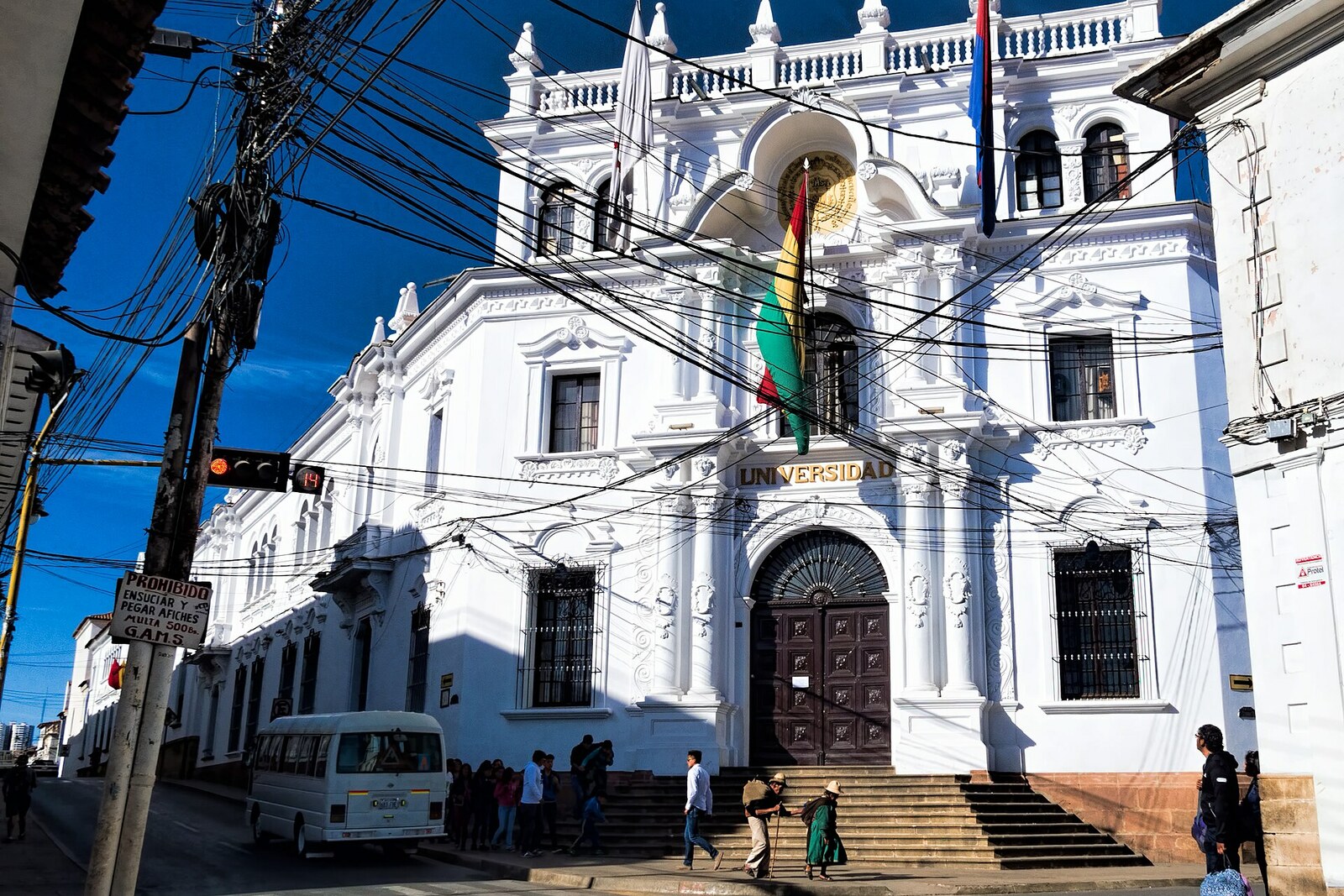
Look around first
What to notice
- University façade
- Main entrance
- University hall
The story of the place
The name University of Saint Francis Xavier on the university façade recalls the Jesuits, who founded this educational institution in sixteen twenty-four and chose the missionary Saint Francis Xavier as its patron. After the order was expelled from Spain's possessions, a university degree ceased to be the final stage for a future lawyer: graduates were also admitted to the Caroline Academy for two more years. There they drafted documents, considered cases, took turns serving as prosecutors and defenders, and then practiced in the Audiencia. The main entrance leads to the university hall, but without a certificate from the Academy, a person was not admitted to practice as a lawyer.
On January twelfth, eighteen oh nine, forty-eight doctors gathered in the university hall. Here, doctors were people who held an academic degree, mainly lawyers. Pizarro, president of the Audiencia, handed them a packet from Rio de Janeiro: Infanta Carlota Joaquina, the sister of the captive Spanish king Ferdinand VII, proposed that she be recognized as having the right to govern Spain's possessions in America.
The reply was drafted by Jaime de Zudáñez—the very lawyer whose arrest later roused the townspeople at Plaza Mayor. Zudáñez earned his living through legal practice, represented Indigenous residents before the Audiencia, and knew which word in an official document turns an objection into an accusation. His brother Manuel, the university's attorney, prepared a formal opinion. The assembly declared Carlota's claims subversive and refused to recognize her directives.
These lawyers did not proclaim independence at that time. They defended the rights of Ferdinand VII and maintained that his captivity did not transfer the crown to his sister. But their reasoning led to a dangerous question: if the lawful monarch is not nearby, who gains the right to act in his name? The answer was sought by people who had been taught for years to analyze precisely such disputes.
The university and the Caroline Academy served different purposes. The Jesuits founded the university in sixteen twenty-four and chose Saint Francis Xavier—Francisco Javier in Spanish, one of the first Jesuits and a missionary in Asia—as its patron. Hence the name on the façade.
In seventeen sixty-seven, King Charles III expelled the Jesuits from his possessions. Nine years later, during his reign, the legal Caroline Academy appeared; its name means “Charles's,” in honor of the king himself. Ramón de Rivera y Peña, the interim prosecutor of the Audiencia, proposed admitting university graduates here and training them in judicial work for two years. They drafted documents, considered cases, took turns serving as prosecutors and defenders, and then practiced in the Audiencia itself. Only after presenting a certificate of such training was a candidate admitted to practice as a lawyer.
Jaime de Zudáñez completed both stages: he received a university degree and practiced at the Caroline Academy. That is why the January reply to Carlota was not an appeal, but a legal act with an opinion, signatures, and a precisely named violation. This was how things worked here: the university granted the degree, the academy taught students to turn an argument into a document, and the Audiencia decided what consequences that document would bring about.
Viceroy Santiago de Liniers ordered the papers concerning Carlota's claims destroyed. On May twentieth, Pizarro tore the relevant pages out of the university's book of proceedings. Five days later, he tried to arrest his opponents; only Zudáñez could be seized. What followed in the square is already known.
After the movement was crushed, the brothers were imprisoned. Manuel died in custody. Jaime was sent to the fortress of Callao near Lima; after being released in eighteen eleven, he left for Chile. There he was included in the commission that drafted the provisional constitutional regulation of eighteen twelve. The document still retained the name of Ferdinand VII, but directives from institutions outside Chile were no longer recognized as binding. Zudáñez then worked in Buenos Aires, took part in preparing the Argentine constitution, and ended his life as a judge in Montevideo.
The pages torn from the university book by Pizarro were never returned. Zudáñez preserved another copy of the January act and took it away with his papers. A century later, the text was discovered in an archive in Uruguay. The document, written by a graduate of the Caroline Academy in the university hall, survived not in the book where it had been registered, but in the luggage of the lawyer who afterward had to leave his native city.
Useful on site
Operating university; no guaranteed tourist access to the main building.
Checked: June 24, 2026. Check the official source before visiting.The university remains a working institution: do not expect to enter classrooms freely, and do not disturb classes. The stop's content is also revealed in front of the façade.