 Guide On Map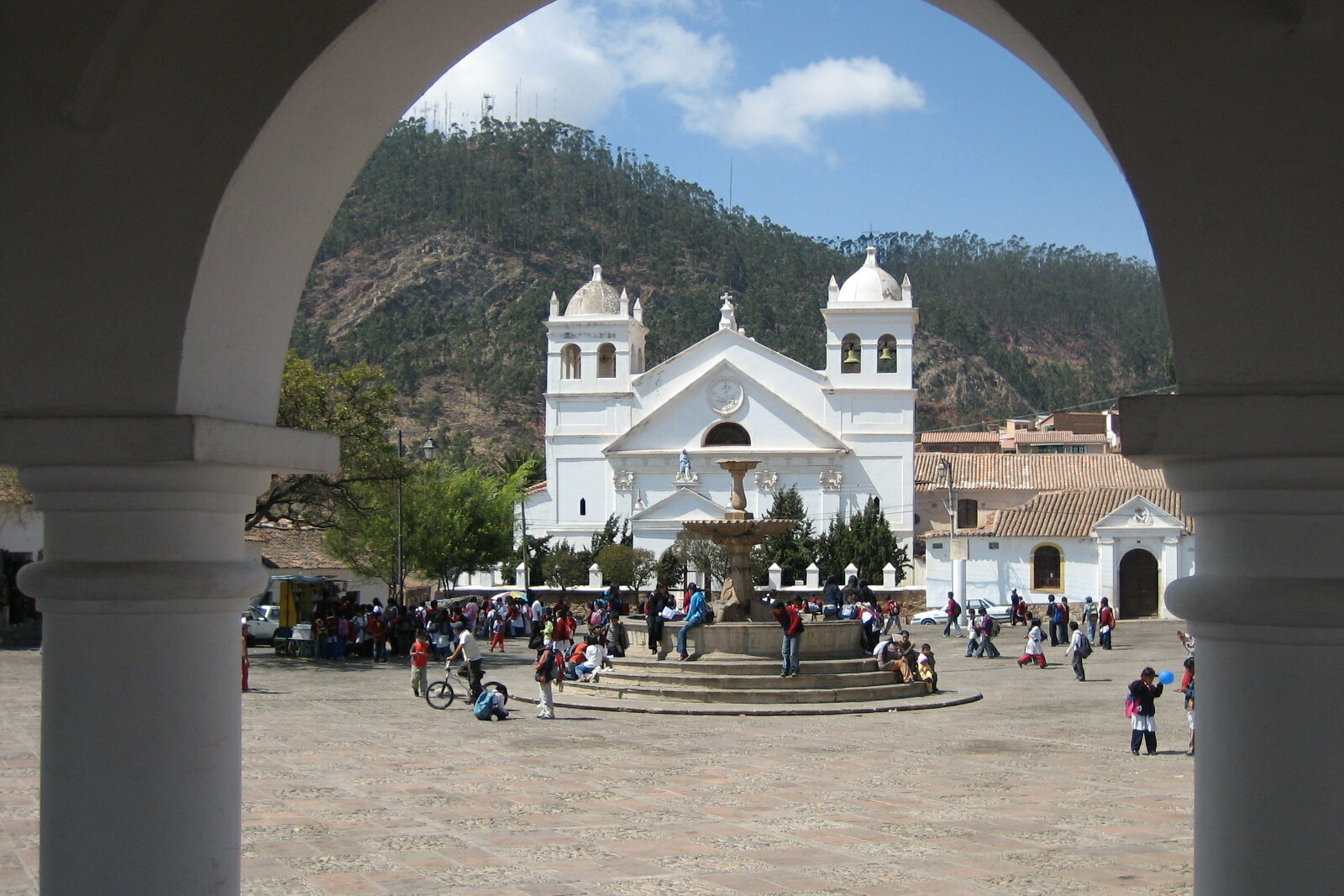
Look around first
What to notice
- White church
- Monastic courtyard
- High monastery wall
- Memorial plaque
The story of the place
The square has two names. In conversation, it is called La Recoleta, after the Franciscan monastery in front of it. Its official name honors Pedro de Anzúrez, a Spanish captain to whom city tradition attributes the founding of La Plata. The same tradition places the laying of the city on this terrace at the foot of Churuquella. No record of that ceremony has survived, and historians debate both the date and whether Anzúrez could have been here at the time. The square was named for the role of founder accepted by the city; the exact location of the event remains unproven.
The word “Recoleta” explains why the Franciscans moved up to the edge of the built-up area of that time. They called a recoleta a religious house for a secluded and stricter life. Francisco de Morales, a Franciscan entrusted with establishing such a house, founded a small church and the monastic compound of Santa Ana de Monte Sión here in the early seventeenth century. A steep slope separated the brothers from the populated center.
More than two centuries later, the secluded cells received another purpose. In eighteen twenty-six, Antonio José de Sucre, president of the new republic, ordered the reduction of the small monastic communities. The Franciscans were moved to Potosí, and the La Recoleta complex was handed over to the army for use as barracks. That is why the deposed president was brought here rather than to the city prison.
Pedro Blanco Soto was a career officer and acting president, appointed by the assembly on December twenty-sixth, eighteen twenty-eight. Several months earlier, he had acted on the side of the Peruvian general Agustín Gamarra, whose army entered Bolivia. Blanco’s opponents considered him Gamarra’s protégé. Colonel Mariano Armaza and Lieutenant Colonel José Ballivián sought his removal and seized the president on the last day of the year. In the assembly, Blanco was accused of having called in the Peruvian troops. There was no time to decide on the charge: the prisoner was sent to the La Recoleta barracks.
Blanco spent six days at the head of the republic. In the monastery, he was locked in a cell by an inner courtyard. According to the later account of the officer who commanded the guard at the time, the soldiers had been read an order in advance: if Blanco’s supporters tried to free the prisoner, they were not to hand him over alive. In this officer’s version, around midnight, a sentry announced that people had appeared by the high wall. Blanco was sleeping on a wooden platform. He got up and went to the door to find out what was happening. The sentry pushed him back with a bayonet and fired; the military men who entered after him continued the killing.
The guard announced that the prisoner had tried to escape. Later testimony made this version disputed. In a testamentary letter from eighteen forty-seven, Captain Basilio Herrera admitted that he had carried out the execution on Armaza’s orders. It was not possible to determine who dealt each blow. Blanco died during the night before January first, eighteen twenty-nine, and the assembly handed the presidency to José Miguel de Velasco.
In eighteen thirty-seven, the government returned the complex to the Franciscans. The white church in front of the square was substantially rebuilt later, but old parts of the monastery have survived in the inner courtyards. A Franciscan community is now here again, and part of the premises is open as a museum. A memorial plaque inside marks the place where Blanco was killed; neither his cell nor the plaque can be seen from the square.
Useful on site
The square and the outdoor viewpoint are freely accessible. Monastery museum: Mon–Fri 09:00–11:30 and 14:30–16:30; Sat 09:00–11:30; Sun closed; visits only with a guide.
Checked: June 24, 2026. Check the official source before visiting.You can reach the panorama independently of access to the monastery rooms. After the climb, give yourself time to catch your breath and look at the city in layers, rather than only as a backdrop for a photograph.