 Guide On Map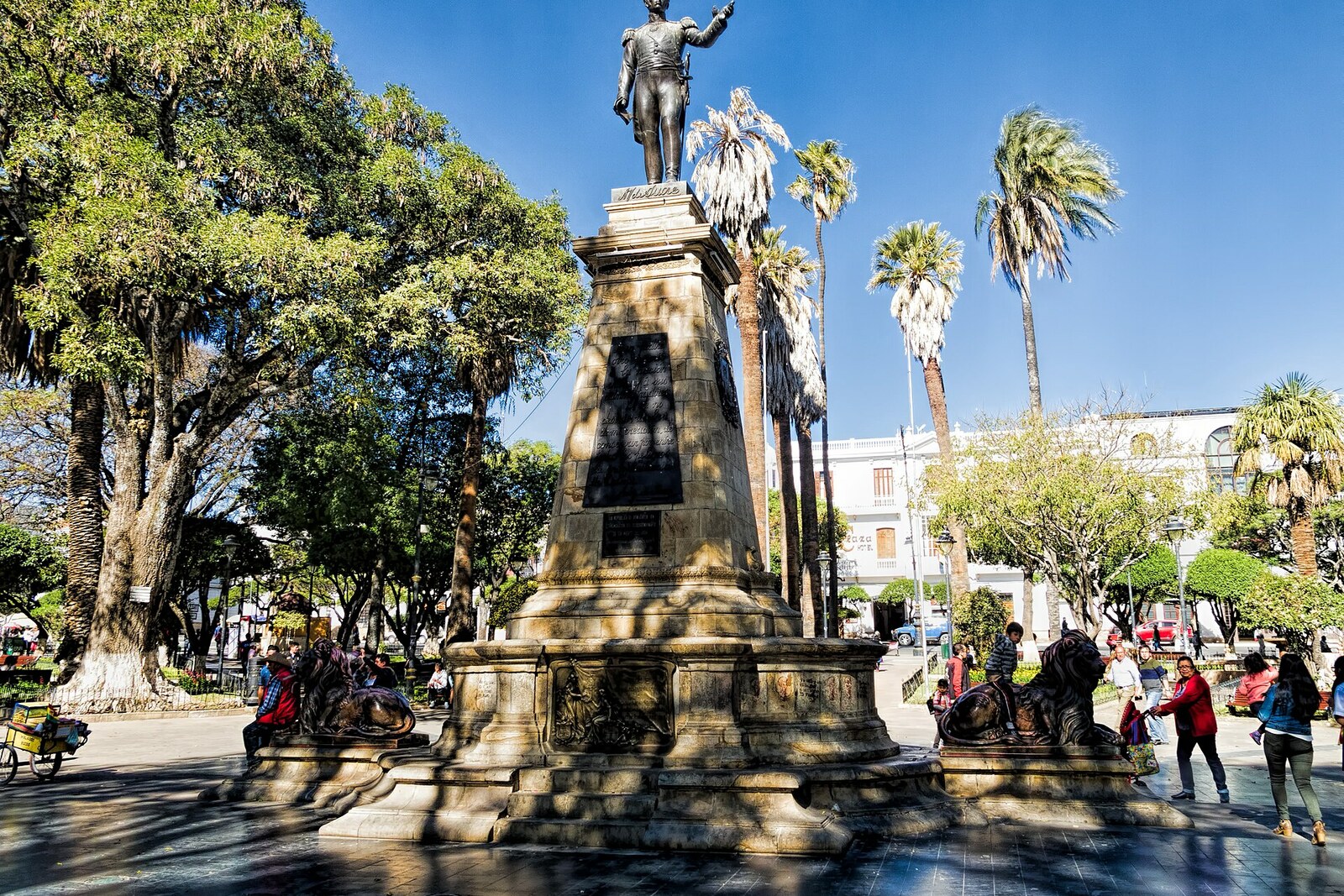
Look around first
What to notice
- Façade of Sucre Cathedral
- City hall building
- Façade of the department administration
The story of the place
In colonial Sucre, this was the Main Square, around which the city’s principal institutions stood. On neighboring sides were the court and prison, the residence of the president of the audiencia, the archbishop’s palace, and Sucre Cathedral; for a needed decision, townspeople moved from one façade to another. The corner now occupied by the department administration marks the site of the former residence, while the prison of that time has not survived. Today, people arrange meetings and hold city ceremonies between Sucre Cathedral, city hall, and the administration.
On the evening of May twenty-fifth, eighteen oh nine, soldiers entered the home of Jaime de Zudáñez. Sucre was then called La Plata. Zudáñez served at the Royal Audiencia of Charcas—the chief court of a vast region—and defended those who could not hire a lawyer. Law was both his profession and his standing; now the president of the audiencia, Ramón García de León y Pizarro, accused him of conspiracy.
The background began in Spain. The French emperor Napoleon forced the Spanish monarchs to abdicate, and King Ferdinand VII was taken prisoner. His sister Carlota Joaquina, who was at the Portuguese court in Brazil, proposed governing the Spanish possessions in her brother’s name. The judges of Charcas rejected her claims. Pizarro and the archbishop agreed to consider them. A rumor spread through the city that the president intended to hand the region over to the Portuguese; Pizarro himself was convinced that the judges wanted to remove him. He decided to get ahead of his opponents and ordered the arrest of six people. Five managed to hide. Zudáñez was found at home.
On the way to the judicial prison, he shouted that they were going to kill him and called on the townspeople for help. His sister ran after him, demanding that her brother be released. A crowd gathered behind the escort and moved onto the then-Plaza Mayor—the Main Square.
The events came together here because of the layout of the colonial city. Around the square stood the court and prison, Pizarro’s residence, the archbishop’s palace, and Sucre Cathedral. To demand a prisoner’s release, find an intermediary, and reach the man who had ordered the arrest, the townspeople did not have to go beyond the neighboring façades.
The archbishop went in to Pizarro and brought Zudáñez out, released. The crowd did not disperse: people suspected that the missing prosecutor was also being held under lock and key. Alarm bells rang in the churches. Those gathered demanded weapons from the presidential arsenal. Pizarro first agreed to hand over cannon and guns, then ordered the soldiers to fire. A witness in the subsequent investigation spoke of one dead person; other reports named more people killed and wounded.
The townspeople turned the cannon they had received against the presidential residence. At about three in the morning, Pizarro signed his resignation. The man who had intended to keep his office with a single arrest was himself taken into custody. The next morning, the judges of the audiencia assumed government of the region and declared that they answered directly to the captive Ferdinand VII, without the mediation of the viceroy in Buenos Aires.
Independence was not proclaimed that night. The participants acted in the name of the Spanish king, and their motives differed: some feared the Portuguese court, others defended the position of the local court, and still others were already seeking self-government. Yet the judges sent emissaries to other cities, and the dispute over who had the right to rule in the absence of the monarch became a chain of uprisings and a war that ended fifteen years later with the independence of Bolivia.
Zudáñez’s victory did not last long. A few months later, a new royal president restored the former order. Zudáñez was arrested again; he spent about half a year in confinement, then, ill, was sent through Lima to the fortress of Callao. Once released, he left for Chile and never returned to his native city. Pizarro also lost his former position: he remained a prisoner for almost half a year, and another man was sent to lead the audiencia.
Today people arrange meetings here and hold city ceremonies; Sucre Cathedral, city hall, and the department administration face the square. On the corner now occupied by the administration building stood the residence against which the cannon were turned. The former judicial prison has not survived in that form. The date in the square’s name remains local: May twenty-fifth, eighteen oh nine—the night when Zudáñez was led through Plaza Mayor under escort and brought out of prison at the demand of the townspeople gathered here.
Useful on site
Open city square; accessible around the clock, but ceremonies and closures may change the usual routes.
Checked: June 24, 2026. Check the official source before visiting.Walk around the perimeter of the square, then look at it from the center: this makes it easier to understand how quickly news could have spread across the whole space.