 Guide On Map
Mission District: From Mission Dolores to the Mural Alleys
From Mission Dolores through Valencia Street and 24th Street to Balmy Alley
Guide On Map on your phone
Open the walk like a regular app
It takes about 10 seconds to install. No app store needed.
The whole path
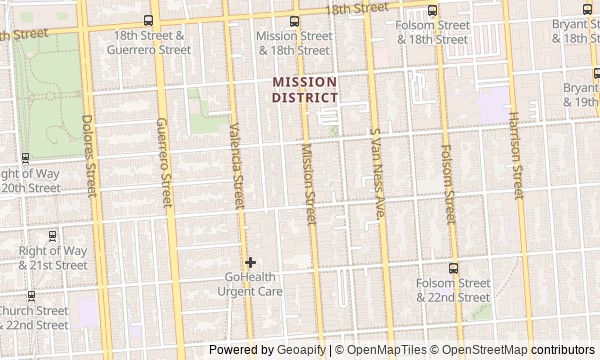
Route map
About the walk
You will cross the Mission District from west to east: from an old chapel and cemetery to a park, Valencia Street, the plaza by the subway station, and two mural alleys.
At first, the road will speak about land and who was allowed to remain here. By the park, that question shifts from the missionary regime to temporary housing after the earthquake. Farther on, the facades become evidence of how residents fought for a home of their own, a wall of their own, and the right to decide what would appear on it.
Questions will come up along the way. Why did a wooden house that had been bought have to be moved away? How did a painting on someone else's building help artists buy a place of their own? Why was a vanished mural restored in just one day?
The story moves through records, debts, lumber, paint, and traces of repair—calmly, without promotional excitement. By the end, you will be able to tell the difference in the Mission District between a drawing on a wall and a wall the neighborhood had to fight for.
Why this order
Mission Dolores sets the opening price of an imposed order; the neighboring park continues the conversation about land, now through residents' struggle for a public place and temporary homes after the earthquake. From cottages that were moved away, the route turns to The Women's Building, where the community, by contrast, secured a permanent home. Clarion Alley shows how the right to control one's own space extended to street walls. Then the plaza by the station brings the same dispute into a large urban construction project and its consequences for the neighborhood. The mural Carnaval carries the route along 24th Street and shows how a shared photograph became a protected facade. Next, Precita Eyes reveals a workshop that taught collaborative mural-making and restored damaged works. Balmy Alley ends the route where this method began—with children and the first walls secured by women artists.
People who want to understand the Mission District through the lives of its residents, rather than through a list of sights People interested in murals as community work, not only as a backdrop for photographs People who value documentary human stories and visible traces of change
People expecting an easy walk focused only on bright facades People looking for an overview of the major symbols of all San Francisco People not ready for a detailed account of the violence of the colonial mission
Before you go
Plan the walk for daylight: in the alleys, small inscriptions and fragments of murals are easier to make out, and the walks between stops are more pleasant without rushing. The main route works with exterior viewing alone, but visiting the old chapel, garden, and cemetery adds time and depends on access on the day. Before setting out, check the current hours for the mission and Precita Eyes separately; the route does not promise a fixed set of open interiors.
Clarion Alley and Balmy Alley are still passageways, not pedestrian halls. Do not stand in front of garages or doors, let cars pass, do not enter private property, and do not touch the murals. Bring water and clothing for the wind: the open slope of the park and the dense development along 24th Street feel very different.
When to go
About 2 hours 40 minutes when viewing the stops from outside. With visits to the old mission, garden, and cemetery, allow about 3 hours 10 minutes.
Backup plan
If the old chapel is unavailable, view it from the street beside the tall basilica: the difference in the buildings' scale and age preserves the foundation of the first story. In rain or poor visibility, do not linger in narrow passageways or try to view walls from the roadway. Clarion Alley and Balmy Alley can be skipped, with a safe walk along regular sidewalks to 24th Street. End the shorter version at Precita Eyes: even when the interior is closed, this stop connects the separate murals with the people and organization that have sustained the local tradition for decades.
Route conditions
Elevation. Ascent — 19 m; descent — 25 m
OpenStreetMap extract of June 18, 2026: database data, not a check on the ground. Data © OpenStreetMap contributors, ODbL licence
Walk plan
Open in maps ↗- 1
Mission Dolores
Here begins the story of the price Indigenous people paid for the missionary order. - 2
Mission Dolores Park
This stop connects the struggle for public land with temporary homes after the earthquake. - 3
The Women's Building and “MaestraPeace”
Here, a building of their own and a shared mural turn out to be two parts of the same victory over debt. - 4
Clarion Alley
The alley will show how the right to a wall must be gained, lost, and regained. - 5
24th and Mission: the plaza by the station
Here you will see why the artists placed the train on human hands. - 6
The Mural “Carnaval”
This stop will show how the awkward architecture of the facade became part of the image and its protection. - 7
Precita Eyes Center
Here the route moves from a finished mural to the workshop where collaborative painting is taught across generations. - 8
Balmy Alley
The finale will return the collective method to the children’s project and the first walls received by the women artists.
Route features
Everything you need stays in the browser
Progress, saves and your trip plan are stored on this device.
Add Guide On Map to your home screen so the walk opens outside the browser.
How we handle sources, maps and corrections: our editorial standards