 Guide On Map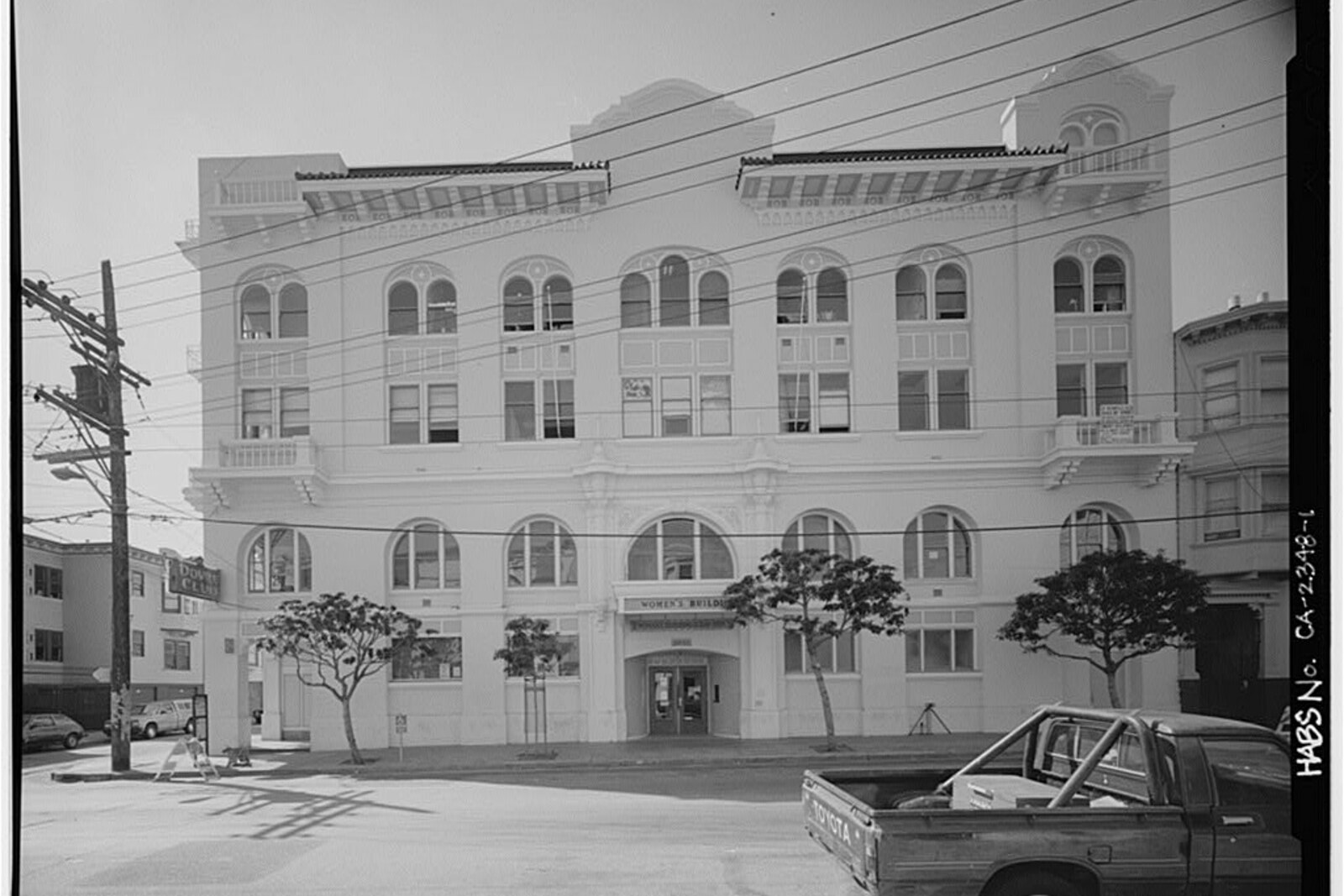
Look around first
What to notice
- A five-story mural on two facades
- Women’s figures
- Names on the walls
- A bouquet of seven flowers
The story of the place
Inside the five-story building are a theater hall, a large kitchen, and meeting rooms: a Norwegian society that owned Dovre Hall once met here. Several nonprofit organizations still share these spaces today; here, people receive help finding work and affordable housing, managing a budget, handling tax paperwork, and addressing legal matters. Outside, both street-facing facades are covered by a mural with women’s figures and names collected by neighborhood residents; among them is a shared bouquet of seven flowers.
In the mid-nineteen seventies, Roma Guy, one of the organizers of San Francisco Women's Centers, Inc., was preparing a conference on violence against women. She needed a place where people could speak about what they had lived through, get help, and make arrangements for joint action. San Francisco State University suddenly withdrew the space, and the organizers had to urgently look for another hall. After that, Roma began campaigning for a home of their own, one that no one could take away just before an event.
A suitable building was found here. It was then called Dovre Hall and belonged to a Norwegian society. Inside, there was already a theater hall, a large kitchen, and meeting rooms. Nearby, around Valencia Street, women’s cafés, bookstores, and collective houses were operating. To Roma, this meant that different organizations could not only rent space under one roof, but also refer women to one another.
The purchase could have destroyed San Francisco Women's Centers, Inc. Nan Parks, a consultant brought in to assess whether the project was feasible, concluded that raising the money, maintaining the enormous building, and bringing it up to code would most likely be impossible. Some participants proposed spending the funds on helping women rather than on real estate. Roma continued the campaign.
Dovre Hall cost five hundred thirty-five thousand dollars, and the down payment was one hundred twenty-five thousand. In nine months, the organizers raised more than that amount through charity runs, concerts, and private donations. The Norwegian owners agreed to finance the remainder themselves. In the summer of nineteen seventy-nine, one of the first community centers in the United States owned and run by women opened here.
After the deal, there was barely enough money for day-to-day operations and required repairs. Dozens of volunteers took down partitions, did carpentry, and painted; a women’s electrical collective replaced the wiring. Room rentals and events brought in income, but they tried to keep spaces affordable for small community organizations. The mortgage was paid off over fifteen years. In nineteen ninety-three, Roma Guy led her final fundraising campaign, called “A Room of One’s Own,” and the debt was cleared.
For the center’s fifteenth anniversary, its committee commissioned the artists to create a small painting above the entrance. Seven artists from the San Francisco Bay Area—Juana Alicia, Miranda Bergman, Edythe Boone, Susan Kelk Cervantes, Meera Desai, Yvonne Littleton, and Irene Perez—decided that the small section was not enough. They brought the committee a sketch covering both street-facing walls from top to bottom. The project was accepted.
Before work began, the artists sent questionnaires to visitors and neighbors: whom should they portray, and whose names should they write in? They then invited anyone interested to help paint. Over eighteen months, almost one hundred volunteers climbed the scaffolding. The calligrapher Olivia Quevedo spent hundreds of hours transferring the women’s names suggested by the community onto the walls.
The name “MaestraPeace” was also coined collectively. The Spanish word “maestra” means a female master or teacher, while the English word “peace” means peace; together, the words recall the English word “masterpiece.” Across five stories appeared real women and mythical foremothers, healers, artists, and community activists from different countries. The mural was completed in nineteen ninety-four—at the same time as the celebration of the paid-off mortgage.
Today, people inside receive help looking for work and affordable housing, making a budget, filling out tax documents, and obtaining legal advice; several nonprofit organizations share the rooms. Outside, the signature of the seven artists remains: each chose and painted one flower, and instead of seven separate signatures, a shared bouquet appeared on the wall.
Useful on site
The facades are visible from the public sidewalk. Interior access depends on programs and events; self-guided visits on Tuesdays are listed on the website, but the page contains template text, so entry should be verified separately.
Checked: June 30, 2026. Check the official source before visiting.You can read the main mural from the street, gradually walking around the accessible sides of the building. Do not count on going inside: the interior extensions of the work are visible only with authorized access.