 Guide On Map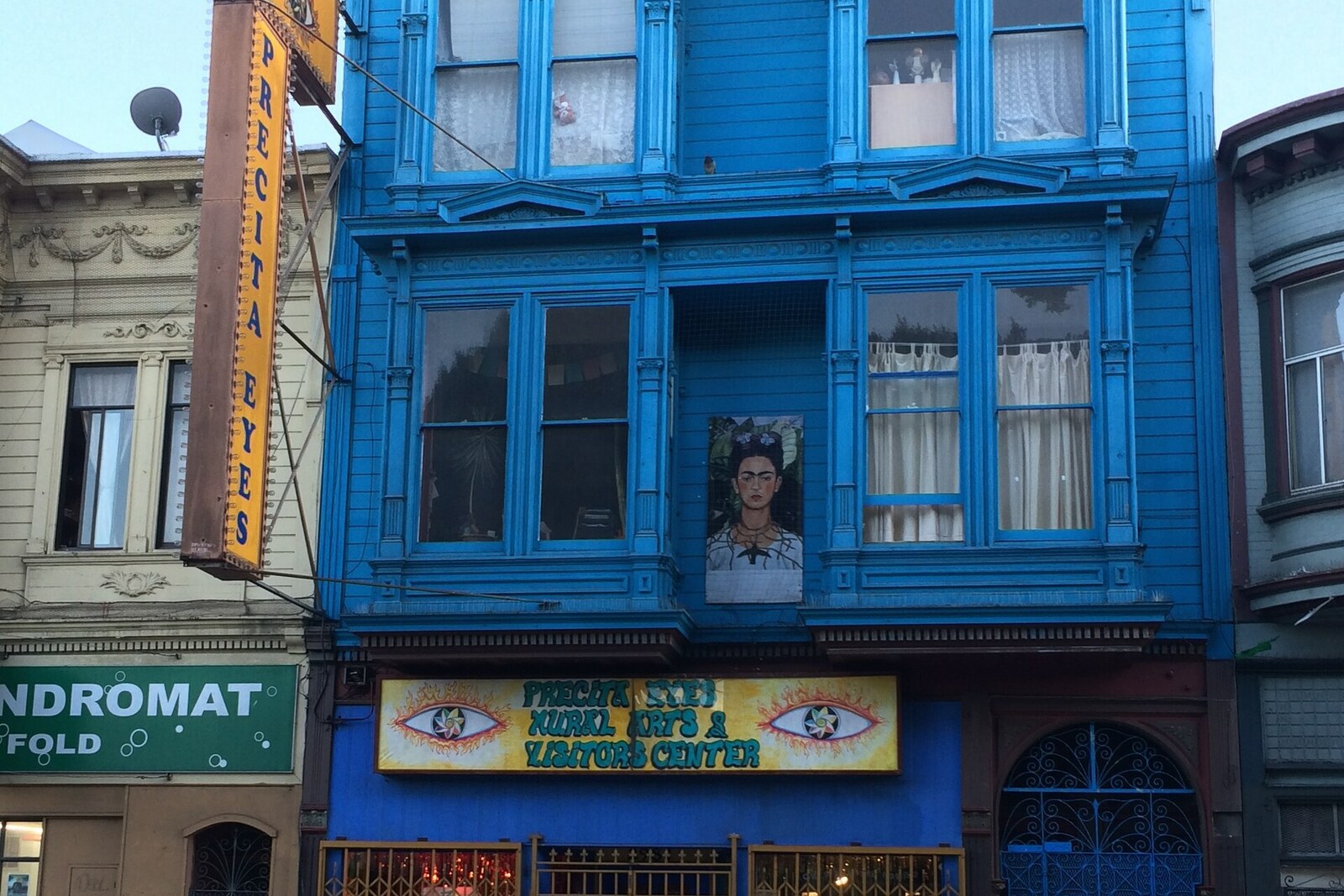
Look around first
What to notice
- The center's facade
- Gallery
- Paint and tools shop
- The Suns of San Francisco mural on four interior walls
The story of the place
The name Precita Eyes appeared before this center. In nineteen seventy-seven, the artist Susan Kelk Cervantes completed a mural at a local school together with local residents. The participants wanted to continue, and Susan turned her evening painting class into a muralists' workshop. They did not yet have a wall: the first compositions were assembled on framed sheets of plywood.
When one such work needed a signature, they could not name a single author. They chose three words: “Precita,” the place the participants came from; “eyes,” the means by which they saw the future picture; and “muralists,” what they had decided to do. Thus an ordinary signature became the group's name.
Susan learned the collaborative method of working from Mujeres Muralistas, an association of women artists in the Mission District. A client—a school, hospital, or shelter—would ask for a wall to be painted. Future viewers drew what they wanted to preserve on it, explained their choices, and decided together how to arrange the images. The lead muralist brought these drawings together into a composition and transferred it to the wall, while the participants helped paint it. The center still teaches exactly this, rather than handing newcomers unrestricted sections of wall.
At first, this work brought in almost no money. Susan's husband and the group's cofounder, Luis Cervantes, made custom mattresses at a factory for more than forty years; the family lived on his salary. Susan recalled that for many years she herself received no income from Precita Eyes at all.
By nineteen ninety-seven, the organization occupied two rented spaces near Precita Park. It was evicted from the second one. A year later, Susan and her colleagues tried to buy the current premises on 24th Street, but they were fifteen thousand dollars short of the down payment. That was exactly the price of a mural they had been commissioned to paint on a McDonald's restaurant at the intersection of 24th Street and Mission. Supporters of the group raised the payment for this work, the missing sum became part of the down payment, and the premises were bought. A painting on someone else's wall paid for the center's own walls.
There was also room on them for a project that had previously been left without a home. Back in nineteen ninety-one, workshop participants had conceived the mural Suns of San Francisco for one of the University of California buildings, but the commission was canceled. After the center was bought, the composition was transferred here: it stretched for about twenty-four meters across four interior walls.
Around the year two thousand, the premises began to be used for exhibitions. Artists needed a clean background, so the walls were covered with draperies, nails were driven into them, and water damaged the lower part. The painting gradually disappeared from view and remained unfinished. Susan remembered it. In two thousand twenty-four, conservators Kerra Hendrickson and Gabi Moreta brought twelve students and volunteers here. For three months, they filled holes, stabilized crumbling sections, and restored missing figures; for some, this was their first work on a mural.
This space now contains a gallery, a paint and tools shop, the workshop's office, and the starting point for tours of the Mission District's murals. And behind the exhibition draperies remain the four walls of Suns of San Francisco—a work on which another group of newcomers learned to repair a mural before receiving a wall of their own.
Useful on site
The official website simultaneously lists Monday through Saturday from 13:00 to 17:00, Monday through Friday from 10:00 to 17:00 and Saturday from 12:00 to 17:00, and, in its questions section, Saturday from 12:00 to 16:00. Check the hours on the day of your visit; viewing the exterior does not depend on the shop.
Checked: June 30, 2026. Check the official source before visiting.The premises' hours may change, so check them on the day of your walk. If the center is closed, do not try to get inside: the organization's story can be heard by the facade.