 Guide On Map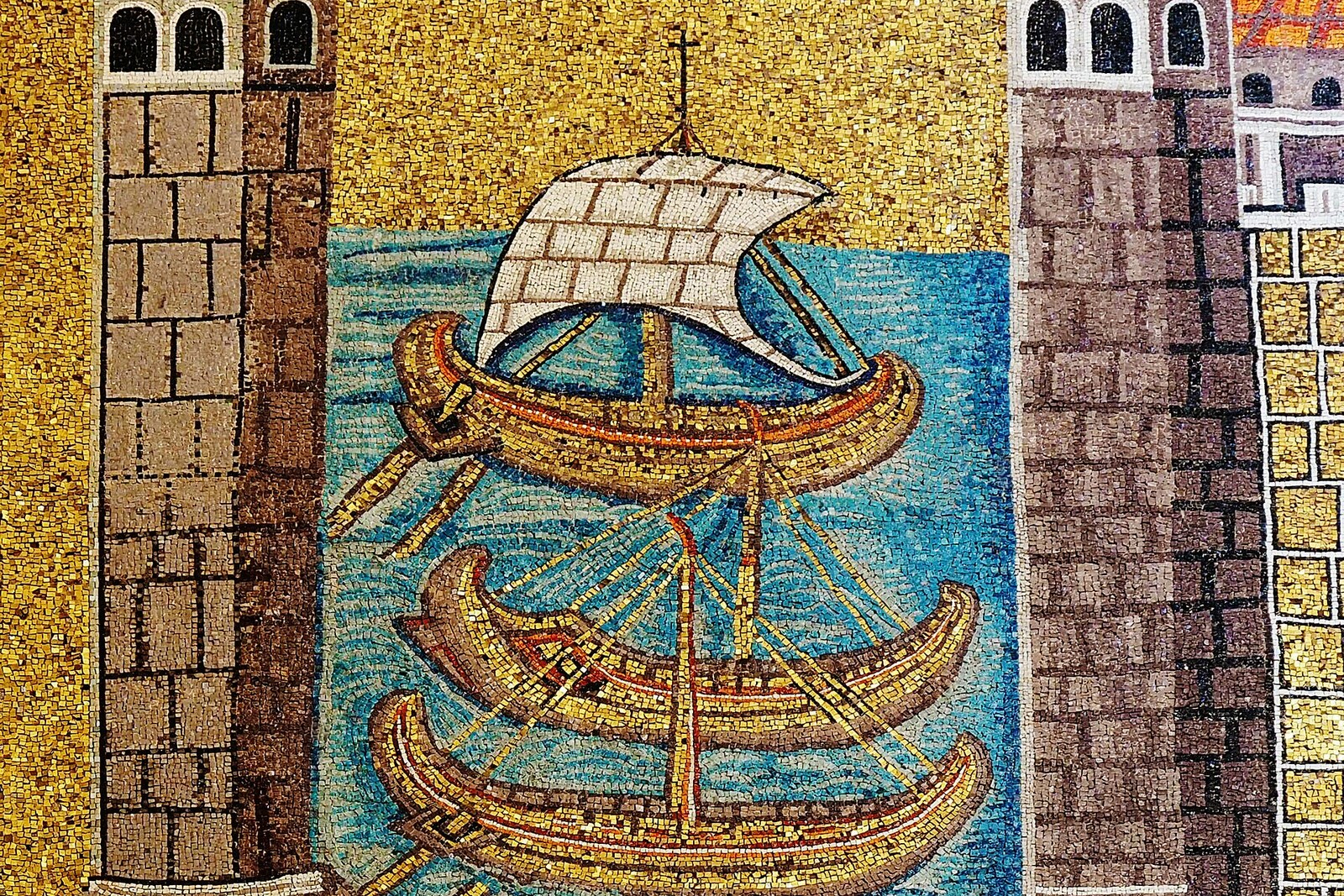
Look around first
What to notice
- The palace mosaic with white columns
- Hands on the columns
- Curtains in the palace openings
- Processions of martyrs and holy virgins
The story of the place
A basilica for the Arian court was built beside the royal residence. The Gothic military aristocracy ruled Italy, but most people of Ravenna belonged to the Nicene church, so the royal family and courtiers prayed here separately from the city bishop. Inside, mosaic processions stretch along the nave: martyrs move toward Christ, and holy virgins proceed toward the Virgin Mary. A crypt for the relics of Ravenna’s first bishop was arranged at the altar end.
In the mosaic of Theodoric’s palace, hands remain between the white columns. The bodies are no longer there: the craftsmen removed them from the wall, cube by cube, but missed the fingers that extended onto the columns already completed.
Half a century earlier, the Ostrogothic king Theodoric built this basilica beside his residence and dedicated it to Christ the Savior. He needed a palace church for the Arian court. Theodoric held Italy with the help of the Gothic military aristocracy, but ruled a country where most Romans belonged to the Nicene church. Here the royal family and courtiers could pray according to their own rite, without being subject to the bishop of Ravenna.
Theodoric ordered his palace, the Port of Classe, courtiers, and processions moving toward Christ to be depicted on the walls. Under the palace arches stood people from his circle. The royal household occupied a place within the sacred picture of the world, and worshippers saw above them those on whom their position and livelihood at court depended.
After the Byzantines captured Ravenna in five forty, this order collapsed. The Byzantine emperor Justinian, who was returning Arian churches to the Nicene church, gave their property to the Ravenna clergy. In five sixty-one, Archbishop Agnellus was transforming the former royal church into a church for another community. He dedicated it to Martin of Tours—an bishop revered as an opponent of heresies—and named it the Basilica of Saint Martin in Golden Heaven.
On Agnellus’s orders, mosaicists removed the figures of the Gothic court. Curtains appeared in the openings of the palace, and along the nave the craftsmen laid out processions of martyrs and holy virgins. The men proceed from Ravenna toward Christ; the women, from the Port of Classe toward the Virgin Mary. The Arian community lost its principal palace church; Agnellus consecrated it for Nicene worship. The upper scenes from Christ’s life were preserved, but the patron and his people were removed from the walls. Only the hands on the columns reveal their presence.
Agnellus’s processions converge at the altar end. Three centuries later, it was the altar itself that gave the basilica its present name. According to church tradition, Archbishop John VII wished to protect the remains of Apollinaris from raids on coastal Classe and transferred them within the city walls. Apollinaris was revered as the first bishop of Ravenna and the founder of its Christian community. A crypt was arranged beneath the altar for the relics, and the Church of Saint Martin came to be called Sant’Apollinare Nuovo—the Basilica of the New Saint Apollinaris—to distinguish it from the small old city church of the same saint.
In eleven seventy-three, the monks of this basilica still maintained that Apollinaris’s body was kept with them. Monks from Classe said the same of their altar. Pope Alexander III, settling the dispute between the two monasteries, ordered the tomb in Classe to be opened. Revered remains and three old silver plates bearing the name of Apollinaris were found there. The city monks produced their own lead plate: its inscription stated that Archbishop John had placed the saint’s body here. Researchers recognized it as a medieval forgery—the engraver tried to give the letters an ancient appearance, but several letter forms betrayed his period. The body was recognized as being in Classe; this basilica retained the name “New,” and its monks’ lead plate is now kept in the Diocesan Archive.
Useful on site
8 March — 1 November 2026: daily 9:00–19:00; 3 November 2025 — 7 March 2026: 10:00–17:00. Last entry 30 minutes before closing.
Checked: June 24, 2026. Check the official source before visiting.Examine the walls by tiers: first the palace and the port, then the processions, and after them the upper scenes. To see the key details, you need to go inside.