 Guide On Map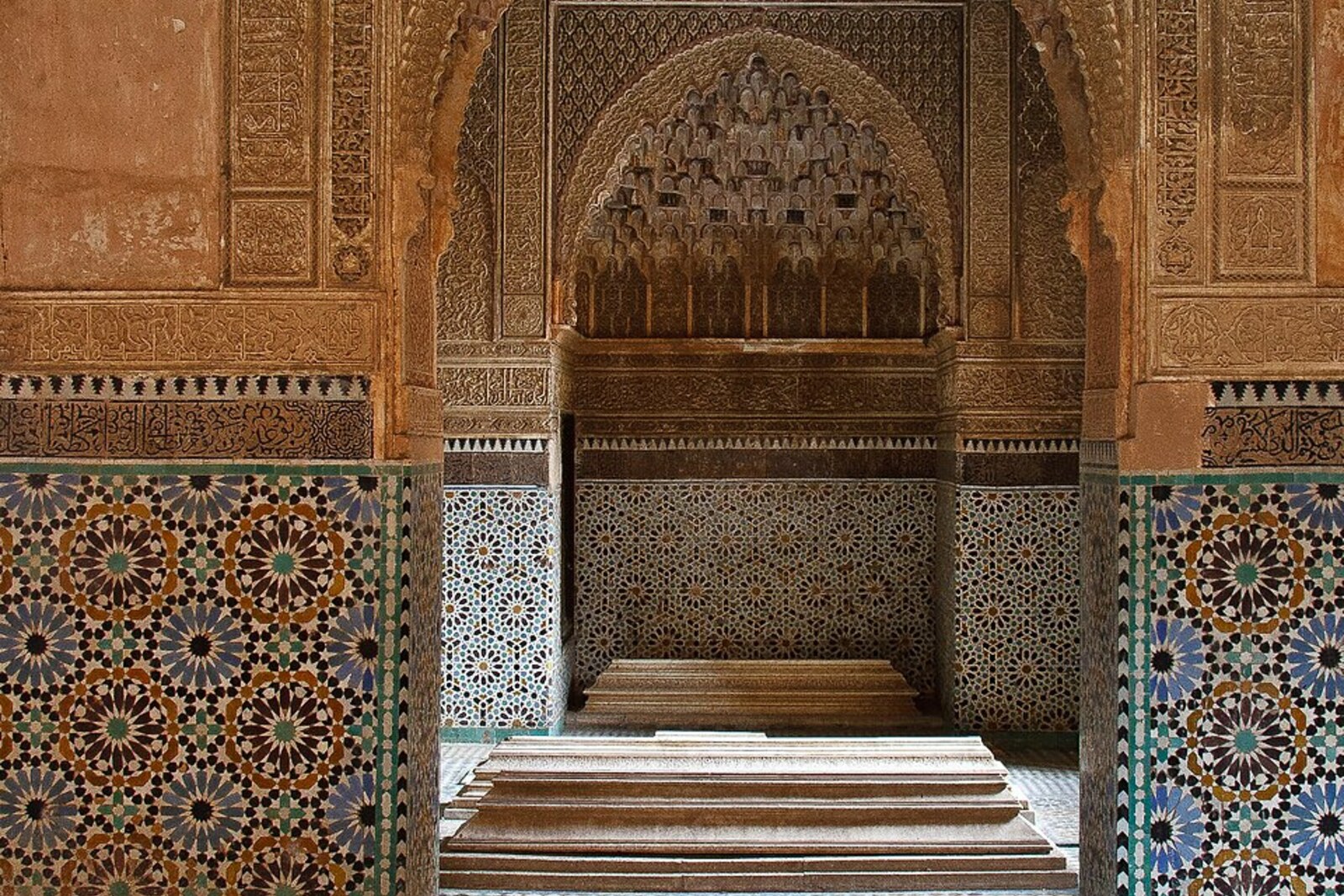
Look around first
What to notice
- Chamber of Twelve Columns
- Marble tombstones
- Eastern Mausoleum
- Garden
The story of the place
Beside the kasbah mosque stands the Saadian dynasty's family mausoleum, where rulers, their wives, and children were brought for burial. Its garden contains two mausoleums, and one of them includes a chamber with twelve columns, where a sultan, his wife, son, and grandchildren were laid. The old Eastern Mausoleum holds the grave of the dynasty's founder, although the marble slab dedicated to him was later moved to the Chamber of Twelve Columns.
In the autumn of fifteen fifty-seven, Muhammad al-Shaykh, the first Saadian sultan of unified Morocco, took several Turkish warriors into his personal guard. They claimed to be deserters from the Ottoman army. The sultan needed such men: for decades he had been fighting, retaking coastal fortresses from the Portuguese, capturing Fez from the previous dynasty, and especially valuing soldiers trained in the use of firearms.
A few years earlier, Ottoman forces had already entered Fez. Now Sultan Suleiman the Magnificent was pressing Muhammad al-Shaykh to acknowledge his supremacy. Suleiman's name was to be spoken during Friday prayer and placed on coins. In the sixteenth century, these two actions meant that a local ruler recognized another sovereign above himself. Muhammad refused and began negotiating joint action against Ottoman Algiers with the Spanish governor of Oran. He was defending a crown he had won himself, but he was confronting a power that had subjugated almost the entire North African coast east of Morocco.
Hasan Pasha, the Ottoman governor of Algiers, who had been tasked with eliminating the Moroccan sultan, sent men to him disguised as deserters. According to the chroniclers, they waited until a campaign in the western Atlas, entered Muhammad al-Shaykh's tent, and beheaded him. His head was delivered first to Algiers and then to Constantinople. His body was taken to Marrakech and buried here, beside the kasbah mosque.
The murdered man's son, Abdallah al-Ghalib, inherited the throne and continued the resistance. As early as the following year, his army halted an Ottoman advance at Wadi al-Laban. Abdallah then ordered a mausoleum built over his father's grave. This became the oldest core of the present tombs. After his death, Abdallah was buried beside him.
Later, another son of Muhammad al-Shaykh, Sultan Ahmad al-Mansur, enlarged the family mausoleum. In fifteen ninety-one, he buried his mother, Lalla Masuda, near his father and decorated the old mausoleum. Al-Mansur built a separate Chamber of Twelve Columns for himself. When he died of plague in sixteen oh three, he was laid in the center of this chamber; over time, the tombstones of his wife, son, and grandchildren appeared beside him.
These tombs are called Saadian after the Saadian dynasty: its sultans, women, and children were buried in two mausoleums and the garden. Muhammad al-Shaykh lies in the old Eastern Mausoleum. The marble slab dedicated to him was later moved to the Chamber of Twelve Columns, where it still stands behind al-Mansur's grave. The body of the dynasty's founder remained here; the assassin's head was taken east.
Useful on site
Paid monument; the official tourist page publishes daytime sessions, but the current schedule must be checked before entering.
Checked: June 28, 2026. Check the official source before visiting.In the cramped halls, do not hold up the line for a photograph; the main details can be examined one at a time.