 Guide On Map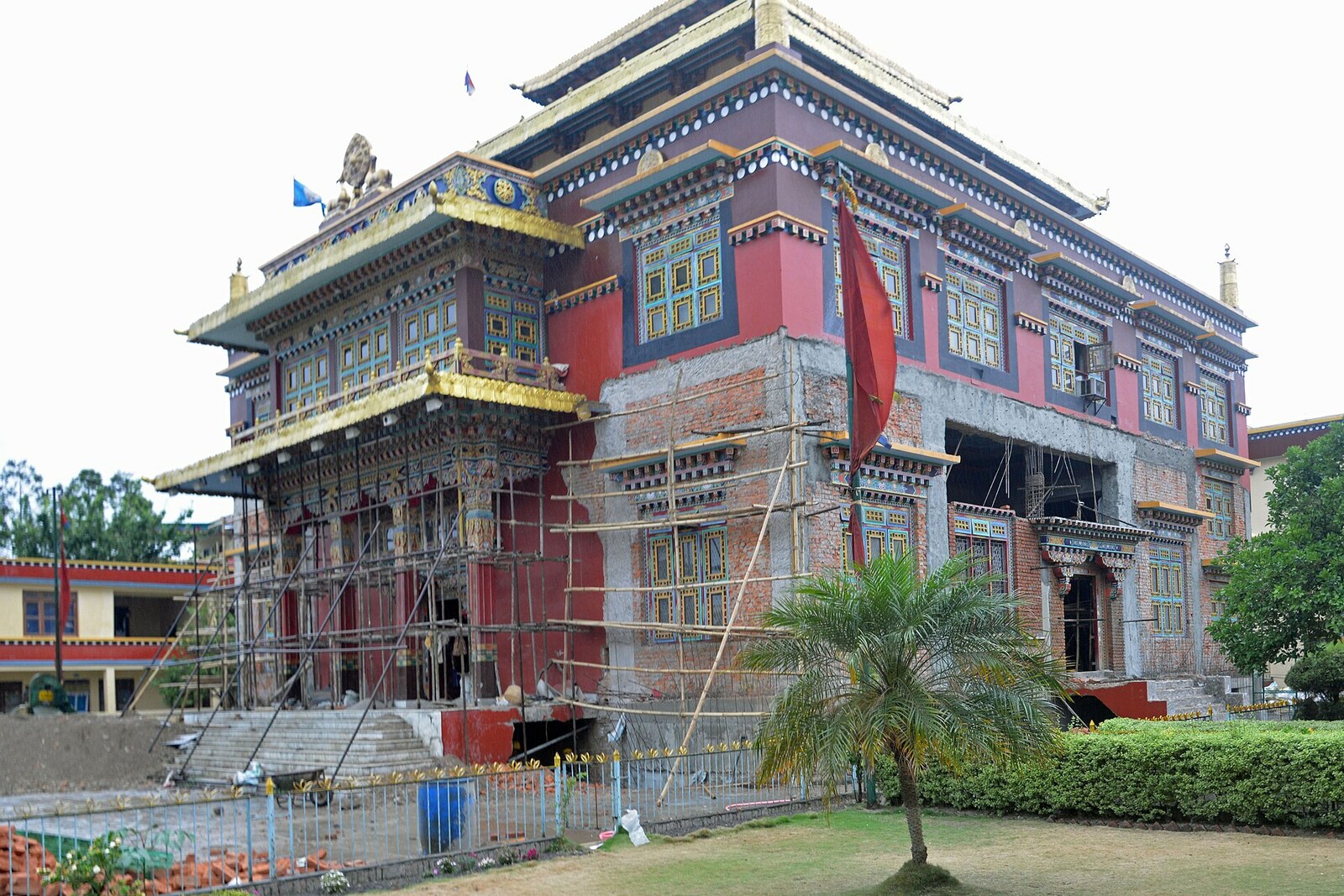
Look around first
What to notice
- Main temple
- New wall paintings
- Monastery courtyard
- Teaching buildings
The story of the place
The name Shechen was brought to Kathmandu from Kham, a region in eastern Tibet. From the end of the seventeenth century, one of the six principal monasteries of Nyingma—the oldest school of Tibetan Buddhism—stood there. It had a philosophical college, sacred-art workshops, and a network of dependent monasteries. In the late nineteen fifties, the old Shechen Monastery and its branches were destroyed.
Dilgo Khyentse Rinpoche, a Tibetan teacher who wanted to preserve Shechen's teachings in exile, lost his own school: at the age of eleven, he entered that very monastery, and later received his principal empowerments and instructions there. After leaving Tibet, he first taught in Bhutan. In nineteen eighty, Dilgo Khyentse began building a new Shechen Monastery near Boudhanath Stupa. A large Tibetan community had already formed around it, so monks, teachers, artists, and students could be brought together here again.
For almost ten years, masons, sculptors, goldsmiths, tailors, and painters from Nepal, Bhutan, India, and Tibet worked on the complex. Dilgo Khyentse even specified the expressions on the faces in the temple murals, the poses of the teachers, and the objects in their hands. He ordered teachers from several Tibetan schools to be depicted on the walls. For him, the accuracy of these figures was part of transmitting knowledge: a student was to recognize a teacher and that teacher's lineage by the same signs used to read a text.
Master Konchog Lhadrepa painted three long walls. Dilgo Khyentse had earlier sent him to study the eastern Tibetan Karma Gadri style, then personally checked the proportions and iconography. That is why Konchog's work became tied to the monastery's future more closely than an ordinary artist's commission.
Dilgo Khyentse appointed his grandson and spiritual heir, Shechen Rabjam Rinpoche, as abbot; Rabjam was to continue the system created here. In nineteen eighty-nine, Rabjam opened a philosophical institute with a nine-year program, and in nineteen ninety-six, a school of Tibetan art. Konchog Lhadrepa became its chief teacher. For years, students mastered drawing, the proportions of figures, paint composition, depictions of deities, and the construction of mandalas. In the courtyard, monks continued to perform the ritual dances of the old Shechen Monastery, while music, painting, and ordinary school subjects were added to philosophy in the teaching buildings.
During the earthquake of nineteen fifteen, the main temple was severely damaged. Rabjam Rinpoche pressed for the building to be preserved; engineers reinforced the foundation and columns, but the cracked walls had to be dismantled. The murals that Dilgo Khyentse had planned together with Konchog could not be saved.
By then, the paintings had been photographed in detail. Konchog Lhadrepa was entrusted with directing their reconstruction, and graduates and senior students of his school began painting the figures on the restored walls. The old murals are no longer in the main temple: their place has been taken by the work of artists trained here precisely so that such images could once again be made by someone living.
Useful on site
The complex is open during daylight hours (approximately 08:00–17:00). The interior halls may close during services or classes.
Checked: June 17, 2026. Check the official source before visiting.The school, services, and monks' quarters are not an ordinary tourist exhibition. Stay in accessible areas, speak quietly, and arrange photography.