 Guide On Map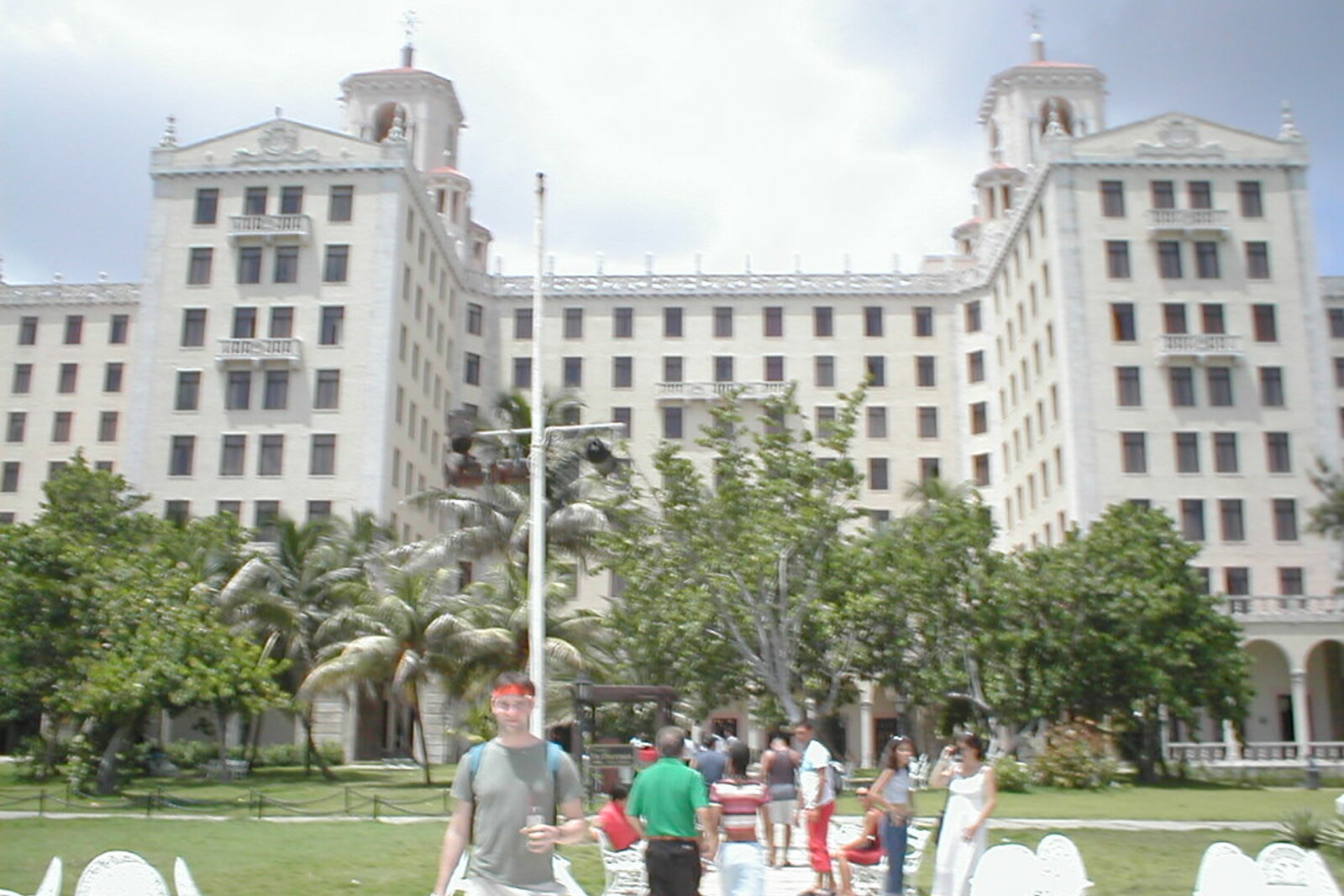
Look around first
What to notice
- Hotel facade
- Balconies of the hotel building
- Two heavy guns
- Garden above the Malecón
The story of the place
On September sixth, nineteen thirty-three, General Julio Sanguily Echarte moved into the three-year-old Hotel Nacional de Cuba. He had recently undergone surgery for a perforated ulcer, and his son served here as a doctor. Two days later, about five hundred armed officers gathered at the hotel. To them, Sanguily was the deposed army commander whom they wanted to restore to his former post.
Four days earlier, Sergeant Fulgencio Batista, who served as a stenographer at a military court, had led a mutiny by the lower ranks. The sergeants and soldiers removed their commanders and appointed Batista chief of staff. If they were defeated, they faced a military court and possibly execution by firing squad. Victory, on the other hand, opened the way to officers’ posts. The former commanders lost their units and their military careers. Both sides understood that there was no longer room for them in the same army.
The officers chose Hotel Nacional de Cuba for three reasons. Sanguily was here, the American ambassador Sumner Welles lived here, and they hoped to obtain support from him; and the building was easy to defend. The officers themselves told Welles that they had no other available refuge in Havana that was so well protected. When the staff stopped coming to work, the guests left, and the officers divided the kitchen, cleaning, and elevator management among themselves. The luxury hotel became a garrison.
Choosing the hill repeated an old military calculation. After the English captured Havana, the Spanish administration strengthened the coastal positions. In seventeen ninety-seven, the captain general of Cuba, Juan Procopio de Bassecourt y Bryas, who held the title Count of Santa Clara, gave land belonging to him for the battery. His title gave it its name: Santa Clara here is the count’s name, under whom the fortification was built. At the end of the nineteenth century, Spanish artillerymen installed long-range Krupp and Ordóñez guns on the hill. After the war, the battery was turned into barracks, then the plot was sold for a hotel. The builders removed most of the fortifications but left two heavy guns in the garden.
Sanguily and former war minister Horacio Ferrer intended to restore the government of Carlos Manuel de Céspedes y Quesada. Céspedes himself refused to head a cabinet inside the besieged hotel: he feared bloodshed. The officers tried to arrange a joint uprising with the underground organization ABC, obtain rifles, and seize the Presidential Palace. Their allies did not fulfill their promises. By the beginning of October, about four hundred people remained at the hotel, with only a few dozen rifles, several submachine guns, and personal weapons.
At dawn on October second, Batista’s soldiers began gathering around the hotel. The participants gave different accounts of who opened fire first. Batista claimed that the officers were bringing weapons through the cordon and preparing an uprising. The besieged officers stated that they had been attacked without warning. One thing is reliably known: Sanguily’s marksmen took up positions on the balconies and at the windows, while the soldiers advanced on the building with poorly sheltered machine guns. The first attack cost the attackers dozens of lives.
Batista then ordered artillery to be used. Guns fired at the facades from neighboring streets and from the direction of the University of Havana, while the Cuban ship Patria fired from the sea. Shells tore away balconies, pierced walls, and severed a water pipe. The improvised hospital had to be moved from the sixth floor.
During a daytime truce, the officers received ABC’s final answer by radio: there would be no help. They had ammunition left for about fifteen minutes of fighting. Batista promised to spare the lives of those who came out unarmed in groups of five. Sanguily and Ferrer tried to bargain for free passage with their personal pistols. The reply was not delivered in time. At three o’clock, the bombardment resumed, and at about four a white sheet was lowered from the top floor.
Sanguily surrendered to Lieutenant Belisario Hernández, who had previously served under his command. Hernández managed to get his former commander and Ferrer to a car and send them to La Cabaña Fortress. The other unarmed officers were lined up in the garden. Shooting began there again; some were killed at the hotel, others on the way to prison. Fourteen officers died in all; losses among the soldiers and the civilians supporting them were considerably higher. The surviving commanders were taken into custody, the former officer corps could no longer assemble as a united force, and Batista consolidated control over the army.
The Krupp and Ordóñez guns preserved in the garden did not take part in that battle: other guns fired at the hotel. The white sheet, the shattered balconies, and the hospital on the sixth floor have long been gone. What remains from the hill’s first defense are the gun barrels of Santa Clara Battery; from the second, the restored building itself, which the officers chose as their last available redoubt.
Useful on site
The hotel’s official website lists a free historical tour from Monday through Saturday at 10:00. The garden, lobby, and terraces are accessible subject to the hotel’s actual rules; the guest-room floors and pools are not part of the public route. Checked 2026-06-29.
Checked: June 29, 2026. Check the official source before visiting.Viewing the facade and the hotel’s position above the shore already completes the story. Access to the garden, the guns, the tunnels, and the hotel’s interior may depend on rules in place; the tour should be arranged separately.