 Guide On Map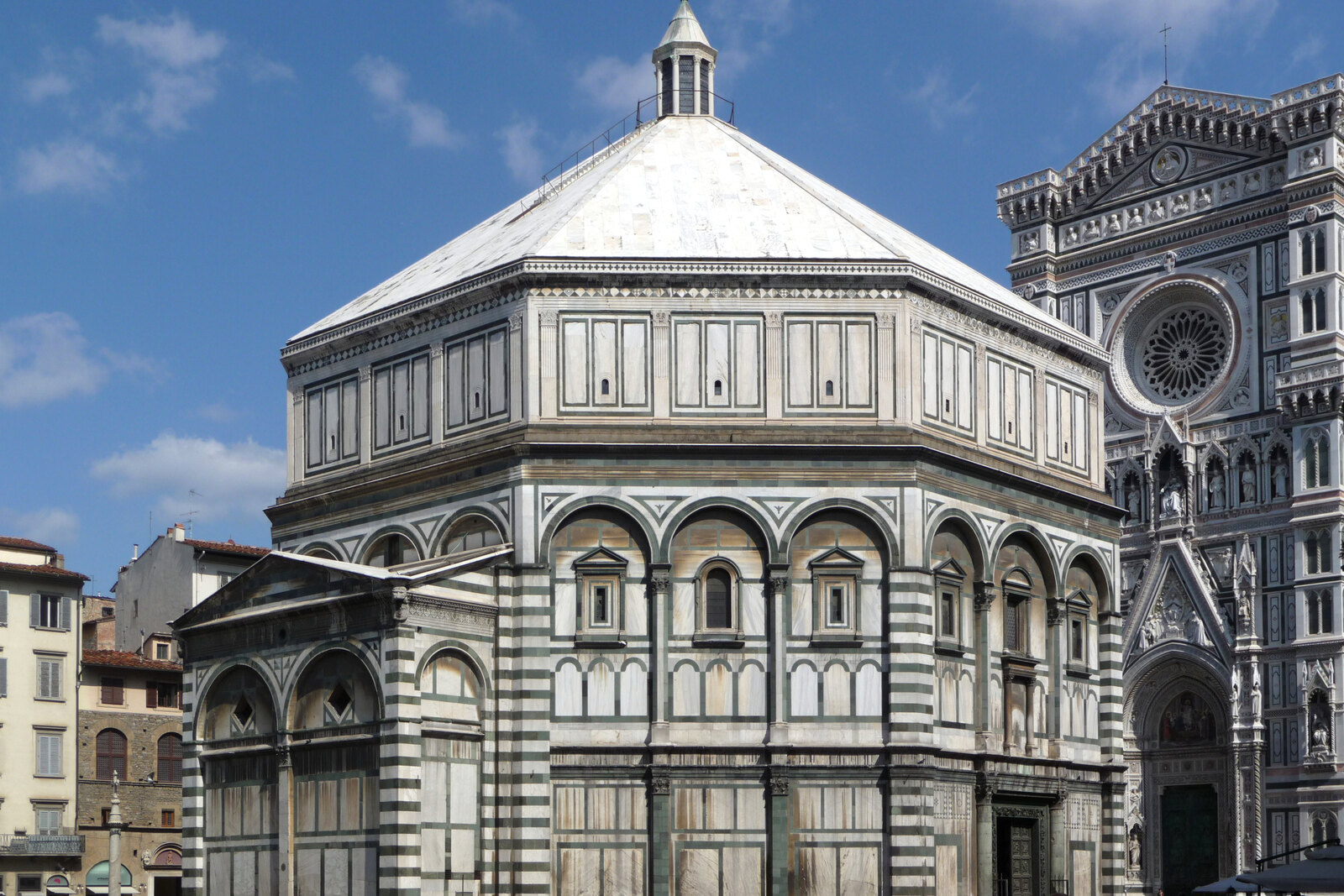
Look around first
What to notice
- Octagonal structure
- Marble cladding
- Dante’s lines at the base on the Via dei Calzaiuoli side
The story of the place
Dante Alighieri, a Florentine citizen and future author of The Divine Comedy, once broke through part of the font at the Baptistery of St. John to save a drowning child. He told this story himself. Early commentators specified that the child had been playing with other children and got stuck in one of the small recesses around the large baptismal basin. It is no longer possible to determine exactly what Dante broke—marble or the wooden lid that covered the recess. The act was remembered as damage to a sacred object, and many years later the poet had to explain in the Inferno that he had done it to save a person.
At the center of the baptistery then stood a large font for baptism by immersion. Around it were four small niches; their exact arrangement is still debated by researchers. The Baptistery was a separate baptismal church, and its font remained the only one for Florence and its suburbs for centuries. City infants were brought here, their names were recorded here, and they were received into the Christian community.
San Giovanni is John the Baptist, the preacher who, according to the Gospels, baptized Jesus in the Jordan River. The Florentines venerated John the Baptist as the city’s patron, so the baptismal church was dedicated to him. Dante himself was baptized here.
In thirteen oh two, Dante was already a former prior—one of Florence’s highest elected officials—and belonged to the White Guelphs. Their opponents, the Black Guelphs, took the city and eliminated their rivals. Dante was accused of abuses and sentenced to exile and a fine of five hundred florins. He did not appear in court and did not pay. A second sentence permitted his burning if he fell into the hands of Florentine officials.
Dante lost his home and his income from city service. In exile, he depended on the hospitality of rulers of different Italian territories, carried out their commissions, and continued writing The Divine Comedy. While working on Paradiso, he named the condition of his return: if the poem made the Florentines accept him back, he would come to the font where he had been baptized and receive here the laurel wreath of an acknowledged poet.
Dante did not receive the Florentine wreath. In thirteen twenty-one, he died in Ravenna, where his remains remain. The font he knew also disappeared. In fifteen seventy-seven, the architect Bernardo Buontalenti dismantled it by order of Grand Duke Francesco the First, clearing the center of the building for ceremonial decoration at the baptism of the duke’s son, Prince Filippo de' Medici. The surviving parts of the font are now in the lapidarium at the Opera del Duomo Museum.
At the base of the baptistery on the Via dei Calzaiuoli side, lines are carved in which Dante hopes to return to the place of his baptism. Behind this wall, his font is no longer there. Its fragments remain in the museum, along with the exile’s promise, forever addressed to John the Baptist.
Useful on site
Admission is with a valid Opera del Duomo complex pass; hours change depending on the date and work underway, and individual areas inside may be partly obscured by restoration.
Checked: June 27, 2026. Check the official source before visiting.The exterior doors are copies; the originals are in the Opera del Duomo Museum. The tomb of Baldassarre Cossa can be seen only by visiting the interior separately.