 Guide On Map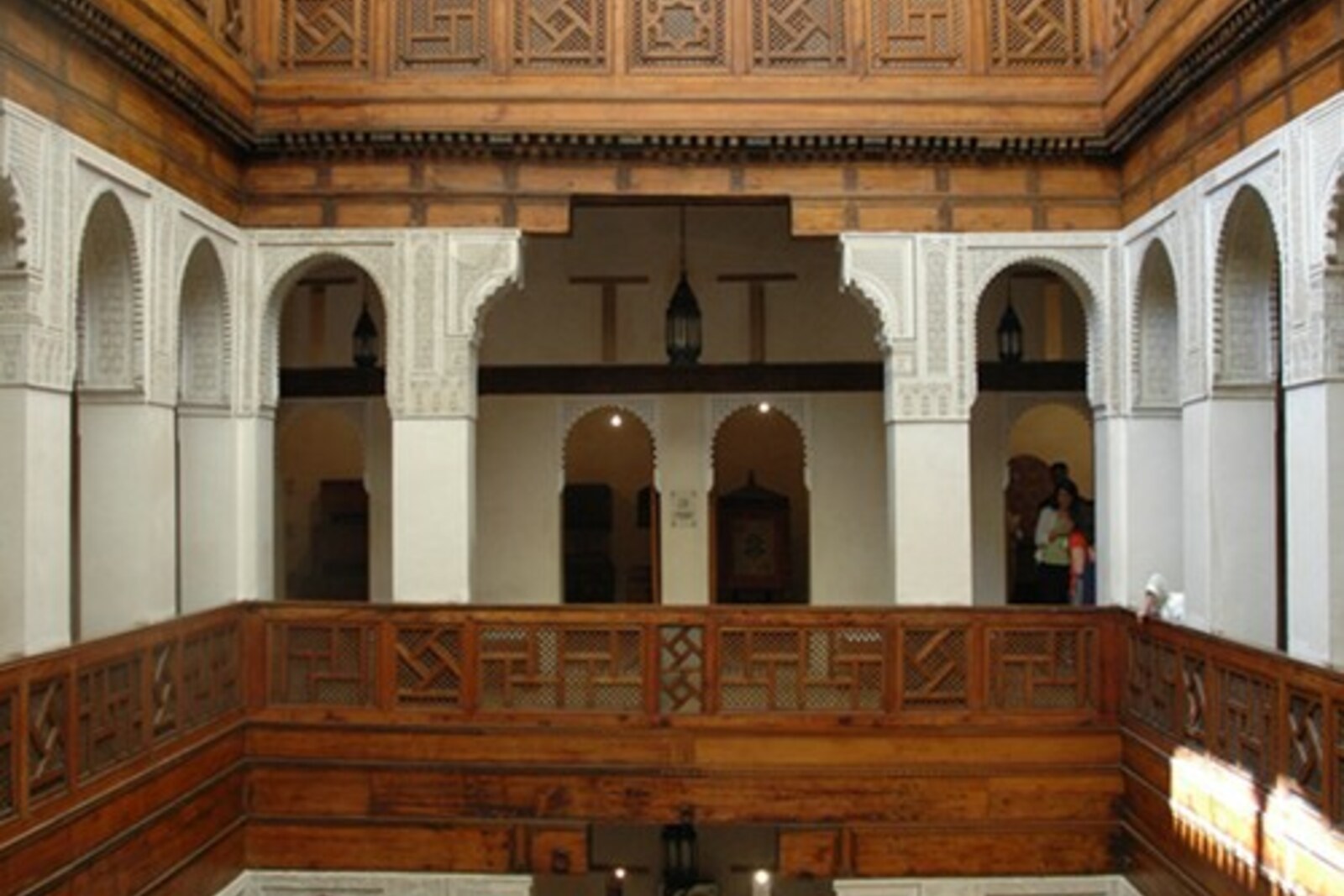
Look around first
What to notice
- High portal
- Wooden galleries
- Large metal scales
- Fountain on the square
The story of the place
Behind the high portal of Nejjarine Funduq, the routes of wholesale trade once converged: pack animals were brought here, bales were unloaded, and merchants from different places made deals. Goods remained in the lower rooms, while visitors spent the night in rooms above the wooden galleries; next door, the carpenters’ market that gave the funduq its name was at work. Now wooden objects from across the country are gathered upstairs, while the heavy metal scales left from this place’s former work can be seen downstairs.
By the nineteen seventies, the traders had long since left this funduq. After them, the building had served as a police station and then stood empty. The foundations were sinking, the ceiling structures and floors were collapsing, and the carved decoration could have disappeared with them.
Mohammed Karim Lamrani, an entrepreneur from an old Fez family, agreed to save the whole complex. He pressed for the abandoned building to be used again and took on the costs. The budget included the funduq itself, the square in front of it, the fountain, a row of carpenters’ shops, and the rooms above them. Lamrani invested eighteen million dirhams in the restoration and the establishment of the museum.
The work began in nineteen ninety and continued until October nineteen ninety-six. Restorers had to reinforce the walls and ceiling structures, and restore the wooden galleries, carved plasterwork, and mosaic. After that, a new purpose was chosen for the building, connected with its old name.
“Nejjarine” means “carpenters.” That was the name of the woodworkers’ market by the square. The funduq itself was built primarily for merchants. In seventeen eleven, it was commissioned by Abd al-Khaliq Adiyil, a wealthy merchant who became the amin of Fez—that is, an official responsible for city trade. He needed a place where a visiting wholesaler could complete a deal, leave goods, and spend the night, without having to scatter everything across different addresses in the Medina of Fez.
Pack animals were led into the funduq through the high portal. Bales were unloaded and weighed downstairs, goods were locked in rooms on the first level, and merchants stayed in rooms above the galleries. The carpenters worked nearby, in their own market, and it was they who gave their name to the square and the merchants’ funduq. Nejjarine Funduq was never a dormitory for carpenters: it was a merchants’ lodging house beside the carpenters’ market.
Lamrani and his partners collected old tools, carved doors, chests, furniture, musical instruments, and architectural details from different regions of Morocco for the future museum. On May twenty-third, nineteen ninety-eight, the Nejjarine Museum of Wooden Arts & Crafts opened in the restored Nejjarine Funduq.
The upper rooms where visiting merchants once spent the night are now occupied by the museum collection. Downstairs, the large metal scales on which the merchants’ goods were actually weighed here have been preserved.
Useful on site
Daily 10:00–19:00, fountain open around the clock
Checked: June 19, 2026. Check the official source before visiting.Do not linger in the passageway, and let visitors pass. Plan your visit to the museum rooms separately; outside, the portal, fountain, and square itself are accessible.