 Guide On Map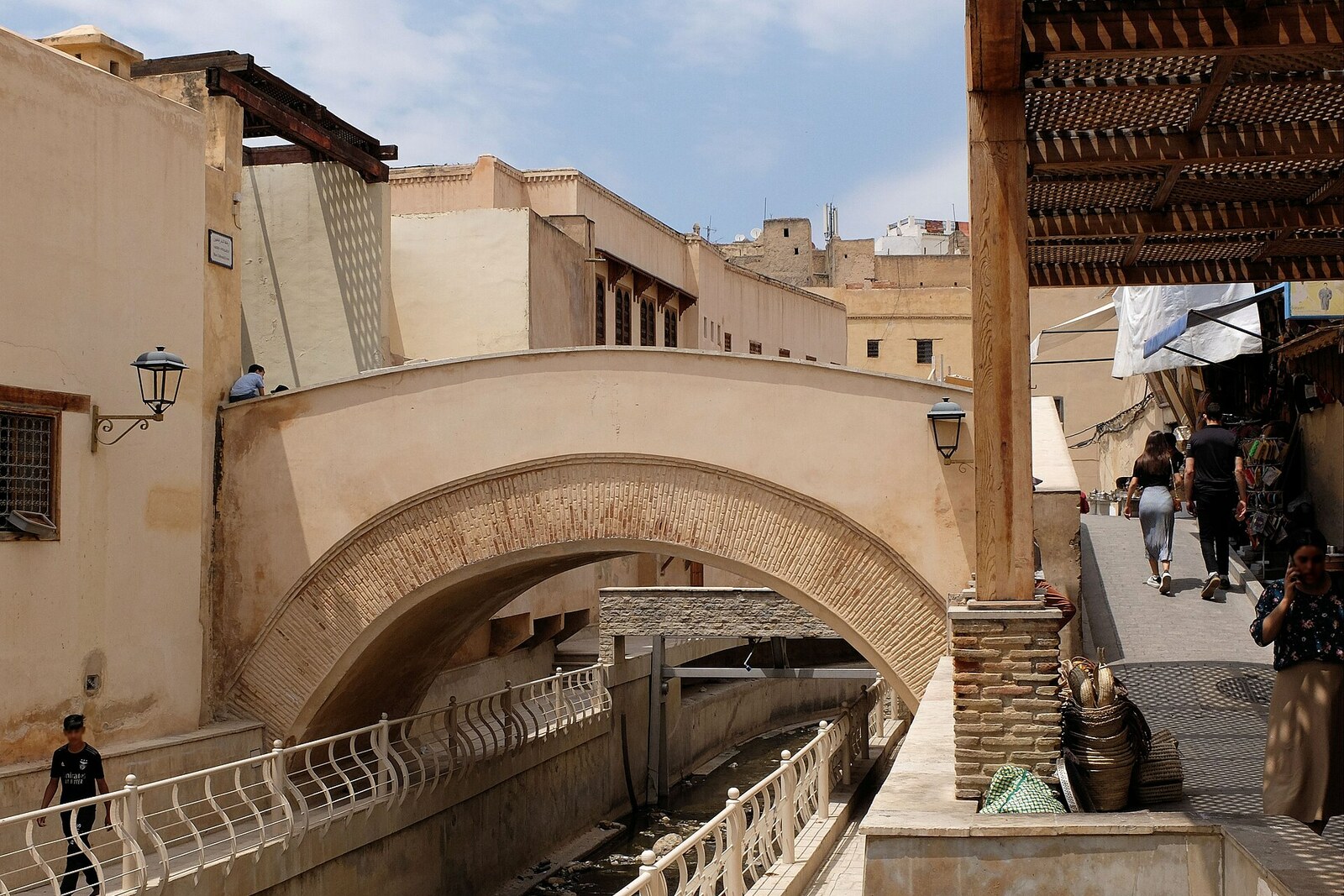
Look around first
What to notice
- The bridge’s stone arch
- The river channel
- Dyers’ workshops
The story of the place
Sebbaghine means “the bridge of the dyers.” The name has preserved an entire craft guild. These craftspeople earned their living by taking wool and cotton yarn from weavers, dyeing it in large vessels, rinsing it, and returning the finished skeins to the customer. The dyers chose their own amin—a guild representative responsible for the rules of the craft and for settling disputes. Their shops stretched toward the crossing: roads between the markets met here, and running water was needed to treat the yarn and carry away the water already used. Several such workshops still operate on the neighboring street.
The river channel beneath the bridge once divided two cities. Madinat Fas stood on one bank, inhabited in part by people from Córdoba; on the other stood al-Aliya, the city around al-Qarawiyyin Mosque. Each had its own walls, gates, markets, and rulers. For almost two centuries, the two banks alternated between trading with one another and going to war. The first bridges appeared under Emir Dunas ibn Hamama in the first half of the eleventh century, but the crossings did not end the rivalry. Soon, the brothers Ad-jisa and al-Futuh ruled the banks separately and fortified their respective halves.
The division was ended not by a treaty. In the nineteen sixties of the eleventh century, Yusuf ibn Tashfin, leader of the Almoravids, came to Fez. Resistance from the local Maghrawa, a Zenata Berber tribe, was preventing him from subjugating northern Morocco. He first took the city and left a governor here with four hundred warriors from his Lamtuna tribe. The former ruler, Muansir ibn Ziri, wanted to retake Fez: he regained the city, and the Almoravid governor was killed.
Yusuf began a new siege. Muansir died during a sortie, but the townspeople chose another leader and continued the defense. Yusuf had to spend several years capturing the surrounding fortresses and depriving Fez of support. Around ten seventy, the Almoravids finally stormed the city. Many defenders from the Zenata tribes were killed, and the rest lost their main fortress.
After the victory, Yusuf ordered the walls that stood between the two banks to be demolished, both settlements to be enclosed by a shared wall, and the crossings over the river to be built or renewed. A medieval chronicle attributes six bridges to these works, including Sebbaghine Bridge. Researchers allow that Yusuf used Dunas’s earlier crossing, but the result of his decision is beyond doubt: the two fortified cities became one Fez, and movement between their markets passed over bridges like these.
The stone arch below is younger than that crossing. In the early fourteenth century, a flood destroyed the city’s bridges, and Sebbaghine Bridge was restored under the Marinid sultan Abu Sa'id Uthman II. Yusuf’s inner walls have long since disappeared. What remain are the river channel, the crossing between the former banks, and the dyers’ name on the road from the coppersmiths of Seffarine Square to the tanneries of Chouara Tannery.
Useful on site
Open always
Checked: June 19, 2026. Check the official source before visiting.Choose a spot where you can look at the bridge without obstructing the passage. Do not try to go down to the water or seek access to the neighboring working premises.