 Guide On Map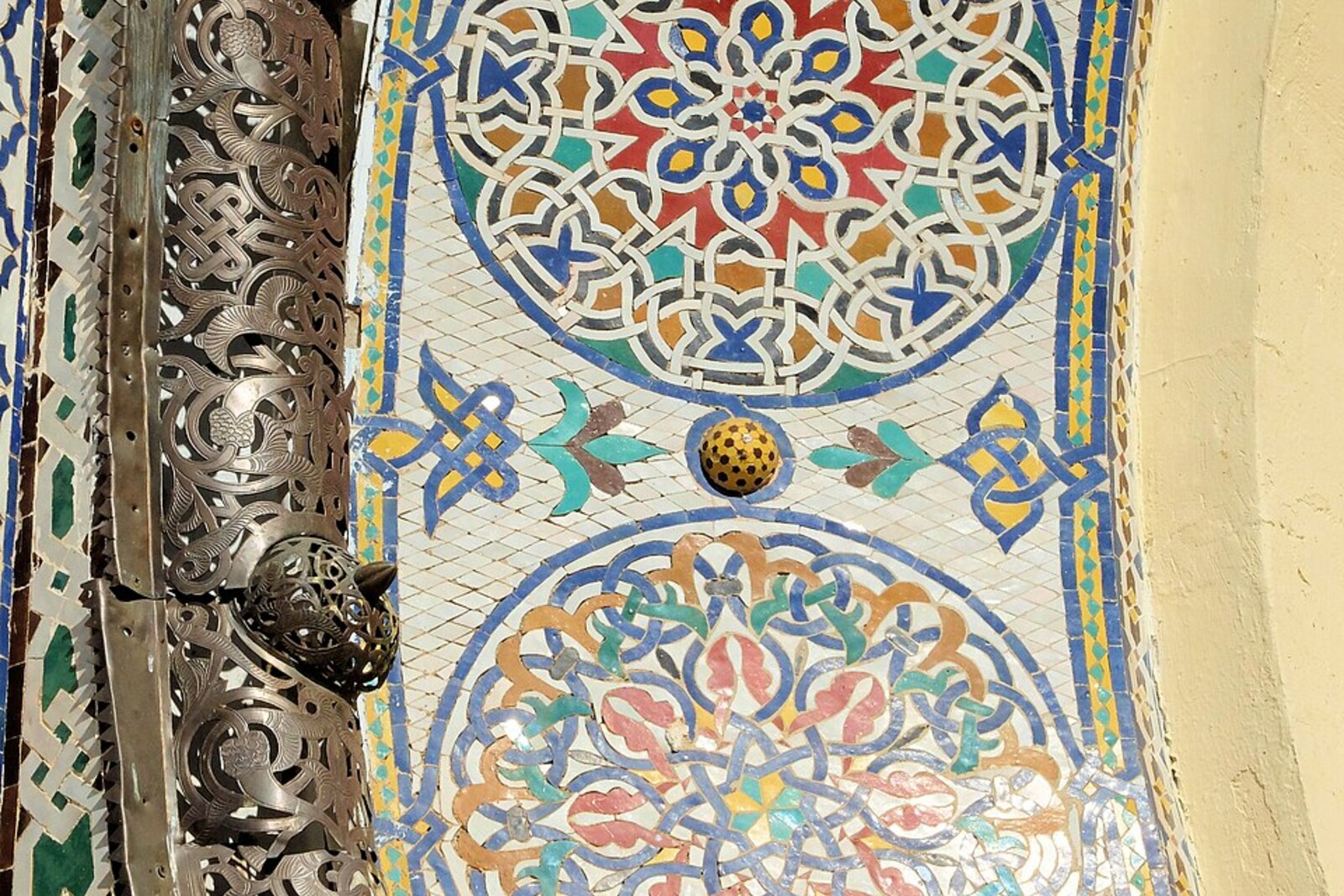
Look around first
What to notice
- Seven arched openings
- Chased metal doors
- White marble
- Green roof tiles
The story of the place
The square bears the name of the Alaouite dynasty, whose rulers settled in Fez as early as the seventeenth century. Behind the ornate facade, the closed palace quarter continues, where the monarch's residence and government institutions coexisted. The seven arches, chased doors, white marble, carved plaster, and green roof tiles belong to an entrance created in the second half of the twentieth century. Previously, the main passage into the palace was on the northeastern side, by a courtyard for receptions and petitions.
In the spring of nineteen eleven, Sultan Abd al-Hafid found himself a prisoner in his own palace. Tribes from the Middle Atlas surrounded Fez, while inside Dar al-Makhzen—the “house of the treasury,” which housed government offices and the sultan's residence—people awaited an assault.
Abd al-Hafid belonged to the Alaouite dynasty, a dynasty from Tafilalt believed to descend from the Prophet Muhammad. Its rulers established themselves in Fez in sixteen sixty-six. The square is named for them.
Abd al-Hafid came to the throne three years before the siege, overthrowing his younger brother Abd al-Aziz. The scholars of Fez agreed to recognize the new sultan on certain conditions: abolish the hated taxes, limit foreigners' privileges, and return the cities occupied by French forces. Their support decided the outcome of the struggle for the throne.
The promises collided with an empty treasury. The court, officials, and army had to be maintained, and Abd al-Hafid reinstated a cash tax on property and livestock, sold offices, confiscated property, and negotiated a new foreign loan. For the inhabitants of the Middle Atlas, this meant another levy on what they used to feed their families. When they heard of the new large loan, the tribes moved on Fez and shut the sultan behind the palace walls.
Abd al-Hafid asked for help from the very French forces he had promised to remove from the country. On May twenty-first, nineteen eleven, an expeditionary corps entered Fez and lifted the siege. The rescue quickly came with a price. On August fifteenth, the sultan handed control of his army to the French side. The soldiers were now paid by the French, and French advisers took the places of Moroccan commanders.
On March thirtieth, nineteen twelve, Abd al-Hafid signed a treaty under pressure that turned most of Morocco into the French Protectorate in Morocco. A few months later, he was forced to abdicate. The sultan was sent to France, and the throne was given to his brother Yusuf. The man whom the French army had rescued from this palace left the country under French supervision.
The seven gates in front of the palace saw none of this. At the beginning of the twentieth century, the main entrance stood on the other, northeastern side of the complex, by the old mechouar—a courtyard for receptions and petitions. The present square was laid out later, and the ornate entrance was built on the orders of another member of the Alaouite dynasty, Hassan II, between nineteen sixty-nine and nineteen seventy-one. Hence the seven openings, chased doors, mosaic, white marble, carved plaster, and green roof tiles.
Behind them lies the same closed palace complex where Abd al-Hafid waited for the outcome of the siege. The doors have changed, the main entrance has moved, and the square has received the name of his dynasty.
Useful on site
The square is open as an urban public space; the palace itself is closed to ordinary visits. Checked against open sources 2026-06-29.
Checked: June 29, 2026. Check the official source before visiting.The palace remains in operation and is closed to visitors; stay in the square, follow the guards' instructions, and do not try to approach service passageways.