 Guide On Map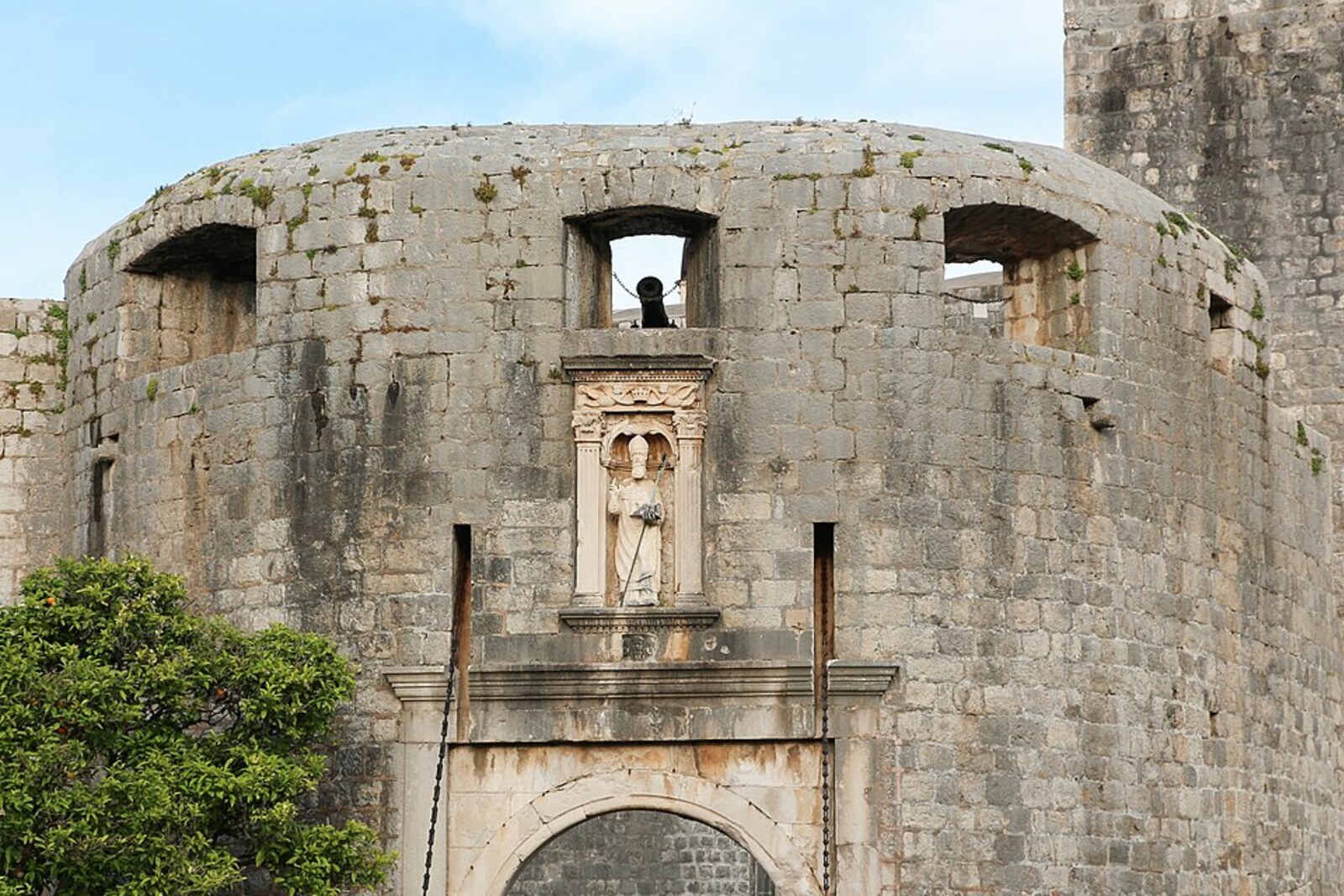
Look around first
What to notice
- Stone bridge
- Wooden section of the drawbridge span
- Outer gate
- Inner Gothic arch
The story of the place
At Pile, the defenses were arranged in several successive lines. The stone bridge leads to the surviving wooden fragment of the drawbridge crossing; beyond the outer gate, the passage turns and descends toward a Gothic-style arch. Anyone arriving was delayed at each section and could not immediately proceed into the city. After the middle of the fifteenth century, no enemy army entered Dubrovnik through this entrance.
Every evening, the captains of the night watch locked the city gates, raised the short wooden span in front of the outer arch, and took the keys to the rector. This was the title given to the head of the independent Republic of Ragusa, which European documents called Ragusa. The rector was elected for only one month. He kept the state seals and the keys, and in the morning the gates were unlocked again for people, carts, and goods.
On May twenty-seventh, eighteen oh six, General Jacques Lauriston appeared at Pile. He commanded a French detachment traveling through Dalmatia toward the Bay of Kotor. He demanded that the soldiers be allowed into the city: supposedly, the men needed food and a short rest before continuing their march.
The decision was made by the Senate, a council of noble families that governed the republic. French troops were approaching from the west, while the Russians had already occupied the Bay of Kotor in the east. Dubrovnik had no standing army capable of stopping either side. The owners of hundreds of merchant ships and sailors earned their living carrying goods across the Mediterranean Sea, while for many centuries the republic's security had rested on neutrality, treaties, and cautious negotiations. The senators feared a Russian advance and agreed to accept the protection promised by the French. The watch opened Pile.
Lauriston's soldiers entered as guests and remained as a garrison. The next day, the general announced that the French presence was temporary and that the old order would remain. The Dubrovnik government had already handed him the keys to the fortresses. The city was turned into a military camp, and the republic was drawn into a war it had tried to avoid.
On January thirty-first, eighteen oh eight, Auguste Marmont, the French commander in Dalmatia, dissolved the Senate and abolished the republic, annexing its lands to a state dependent on the French Empire. The owners of merchant ships also paid the price for the occupation of the city. Ships outside the Adriatic Sea were confiscated by France's opponents; others were stranded in foreign ports without work, and their owners had to sell them for next to nothing.
The entrance at Pile still consists of several barriers. Beyond the stone bridge lies the wooden section of the former drawbridge span, followed by the outer gate, a turn, and a descent to the inner Gothic arch. This route delayed anyone who entered and did not allow them to emerge directly onto Stradun.
After the middle of the fifteenth century, no enemy army managed to enter the city through these fortifications. The French did not storm Pile either. On May twenty-seventh, eighteen oh six, the bridge was lowered and the doors were thrown open on the orders of the people entrusted with the keys.
Useful on site
The official City Walls Dubrovnik website showed 08:00-19:30 on 2026-06-25; check seasonal hours and ticket rules before your visit.
Checked: June 25, 2026. Check the official source before visiting.View the portal from the side, away from the main flow of people, and do not linger in the narrow passage. Before climbing up, find the marked entrance to the walls and have your proof of access ready.