 Guide On Map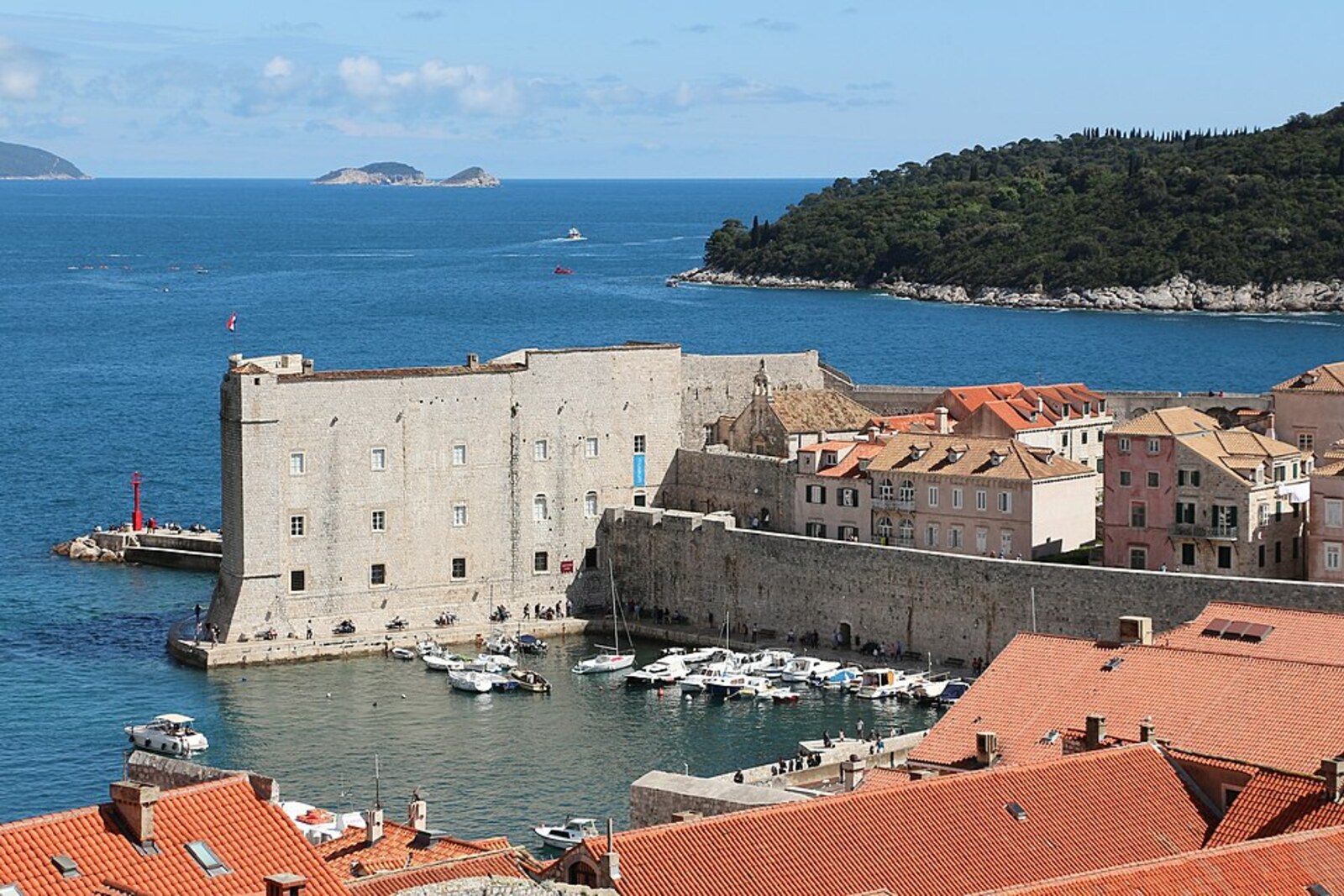
Look around first
What to notice
- Western wall with two vertical lines
- Lower-level passageways
- Massive fortress structure
- Entrance to the Old Harbor
The story of the place
The aquarium now occupies the fortress's lower floor, with the Maritime Museum operating above it; the passageways by the water have survived from the time when a special guard held their keys. From outside, the fortress looks like a single massive structure, but two vertical lines on the western wall reveal the boundaries of the earlier building, which was later enclosed by neighboring fortifications. The name of St. John remained from the early medieval Church of St. John the Evangelist, which stood nearby. In the seventeenth century, it was replaced by the Church of Our Lady of Carmel, and beneath its floor, walls and tiles from the old church were found about one and a half meters below the present level.
On March twenty-second, thirteen forty-six, the Great Council—an assembly of Dubrovnik patricians that passed the laws of the Republic of Ragusa—ordered a tower of stone and lime to be built at the edge of the harbor. The same record included another decision: to stretch a chain from here to St. Luke's Tower on the opposite side of the entrance.
The patricians followed the successes of the Genoese fleet and hurried to strengthen their sea defenses. Yet Dubrovnik made its money through merchant shipping: captains needed an open port, while the city needed the ability to turn it into a closed basin within minutes. This is how Mulo Tower, meaning the tower on the mole, appeared—the core of today's St. John Fortress.
An iron chain alone was not enough. Under its own weight, it would have sunk beneath the water and left a passage above it. Dubrovnik craftsmen laid it on thick wooden beams that held the barrier at the surface. Lighter iron sections were attached to the ends of the heavy chain: one was fixed to a support, while the other was wound around a windlass in the tower. When the chain was slackened, ships could pass; when it was hauled in by the windlass, the entrance was closed.
A special guard was responsible for this device. He lived directly on the mole, kept the keys to the gates here, checked the unloading of stone and lime, and watched the passage of vessels. By the middle of the fifteenth century, a thick-walled house had been built for him beside the tower. On August ninth, fourteen forty-eight, the senators ordered the windlass moved from the cramped tower into this house. The guard received a separate room for the mechanism, and the builders surrounded his house with a semicircular wall and a walkway from which the harbor could be watched.
In sixteen eleven, the rules were made even stricter. After the bell that marked the first hour of the night, captains were forbidden to enter the harbor, leave it, or even move vessels within it. For a late-arriving ship, the decision was no longer the helmsman's: between it and the pier lay the chain raised by the guard.
Later, engineers joined Mulo Tower to the neighboring fortifications and enclosed it within a massive structure. On the fortress's western wall, two vertical lines still mark the boundaries of that first quadrangular tower. The chain and the windlass for raising it are gone, but the passageways whose keys the guard kept have survived on the lower level, where the aquarium is now located. The Maritime Museum operates above.
The fortress received the name of St. John from the early medieval Church of St. John the Evangelist that once stood nearby—an apostle to whom tradition attributes one of the Gospels. In the seventeenth century, the Church of Our Lady of Carmel was built on its site. During investigations beneath the floor, the old walls and tiles of St. John's church were found; its level lies about one and a half meters below the present one. The church changed its dedication, the chain disappeared, but the fortress of the old harbor retained the name of its buried neighbor.
Useful on site
The official City Walls Dubrovnik website showed 08:00-19:30 on 2026-06-25; check the museums inside the fort separately.
Checked: June 25, 2026. Check the official source before visiting.The history of the fortification can be understood from outside; the Maritime Museum and other rooms are visited separately. Near the water, watch for people and service vehicles moving about.