 Guide On Map
Charleston Museum Mile: Meeting Street and Historic Houses
From a former railroad warehouse to the Nathaniel Russell House
Guide On Map on your phone
Open the walk like a regular app
It takes about 10 seconds to install. No app store needed.
The whole path
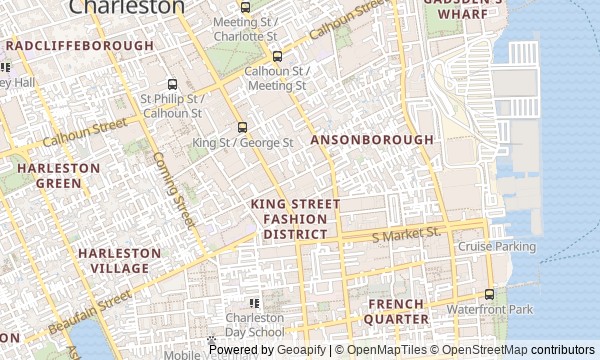
Route map
About the walk
You will begin at a former railroad warehouse and head south along Meeting Street. First, you will pass through the museum district, make a short detour to the service yard of a historic estate, then return to Marion Square and continue into the colonial part of the city, toward the art museum and its grand houses.
You will encounter gates with nothing left to lock, a museum box that crossed a border before visitors could enter, a garden pavilion among car tires, and a scrap of primer from inside a wall. Each object will raise a question, while the answer remains inside the story.
You will hear a calm, documentary-minded account: one that does not sidestep slavery or segregation, but does not hand down a ready-made verdict either. By the end, you will read Charleston through backyards, old whitewash, and the names on museum signs.
Why this order
At the former warehouse, you will see how the city shaped its own entrance, while the neighboring museum building explains who was long denied recognition as a full visitor. Then you will move to the house that this very museum helped save, and trace the cost of that rescue. The Aiken-Rhett House continues the conversation about preservation, shifting attention from formal rooms to the service yard and to life after emancipation. After the private estate, Marion Square presents emancipation as a public event in the city. From the square, the route heads south into the colonial city: The Powder Magazine recalls what was once defended here, while the Gibbes Museum of Art shows how the city later defended its right to its own art. The Nathaniel Russell House brings both threads together: the formal facade, hidden labor, and museum research into rooms that long remained behind a wall.
Those who want to understand historic houses through the lives of the people who lived and worked in them Museum lovers, architecture enthusiasts, and anyone interested in the city's preservation history Those who value an honest conversation about slavery, segregation, and emancipation
Those looking only for an easy walk among beautiful facades Those unwilling to enter several museum buildings and courtyards Those who want an overview of Charleston's postcard sights without detailed stories
Before you go
Decide in advance which interiors you truly want to enter: a full visit to every museum and house will noticeably lengthen the walk, and access is arranged separately by different institutions. Exhibits in art and history museums can change, so a particular work mentioned in the story may not be on view on the day of your visit. Bring water and leave time for a pause at Marion Square: it helps you shift between the two groups of sites and quietly take in what you have heard.
When to go
Start in the first half of the day, and do not try to cover every interior at the same pace: choose two or three main visits and view the remaining stops from outside.
Backup plan
If a particular museum or house is unavailable, do not skip the stop altogether. Take in the warehouse-like volume of the Charleston Visitor Center, the facades and service layouts of the houses, the open space of Marion Square, and the massive walls of The Powder Magazine. Save the audio story for the courtyard or another quiet nearby spot, and leave the interior for a separate return visit: the route's meaning rests not on the number of tickets bought, but on the connections between buildings and stories.
Route conditions
Surface. Paved — 3.4 km; unpaved — 207 m
Access. Wheelchair — limited; stroller — limited
Facilities. Toilets — 6; drinking water — 2
Elevation. Ascent — 20 m; descent — 18 m
OpenStreetMap extract of June 18, 2026: database data, not a check on the ground. Data © OpenStreetMap contributors, ODbL licence
Walk plan
Open in maps ↗- 1
Charleston Visitor Center
Here, the city walk begins with the transformation of a freight warehouse into Charleston's public gateway. - 2
The Charleston Museum
This stop shows how access to the collections changed before the boundaries imposed by the city disappeared. - 3
Joseph Manigault House
Here, preserving a landmark becomes a story of debts, a lost garden, and persistent attempts to reclaim it. - 4
Aiken-Rhett House
The surviving service buildings make it possible to continue the story of the family that documents initially recorded as property. - 5
Marion Square
On the former parade ground, private stories of emancipation become a large public procession through the city center. - 6
The Powder Magazine
The thick walls will be needed for the story of a supply that was hidden beside an enemy guard. - 7
Gibbes Museum of Art
Here, a civic bequest, a court dispute, and one exhibition link Charleston to a future New York museum. - 8
Nathaniel Russell House
The final stop will compare the restored formal interior with a room found beneath later paneling.
Route features
Everything you need stays in the browser
Progress, saves and your trip plan are stored on this device.
Add Guide On Map to your home screen so the walk opens outside the browser.
How we handle sources, maps and corrections: our editorial standards