 Guide On Map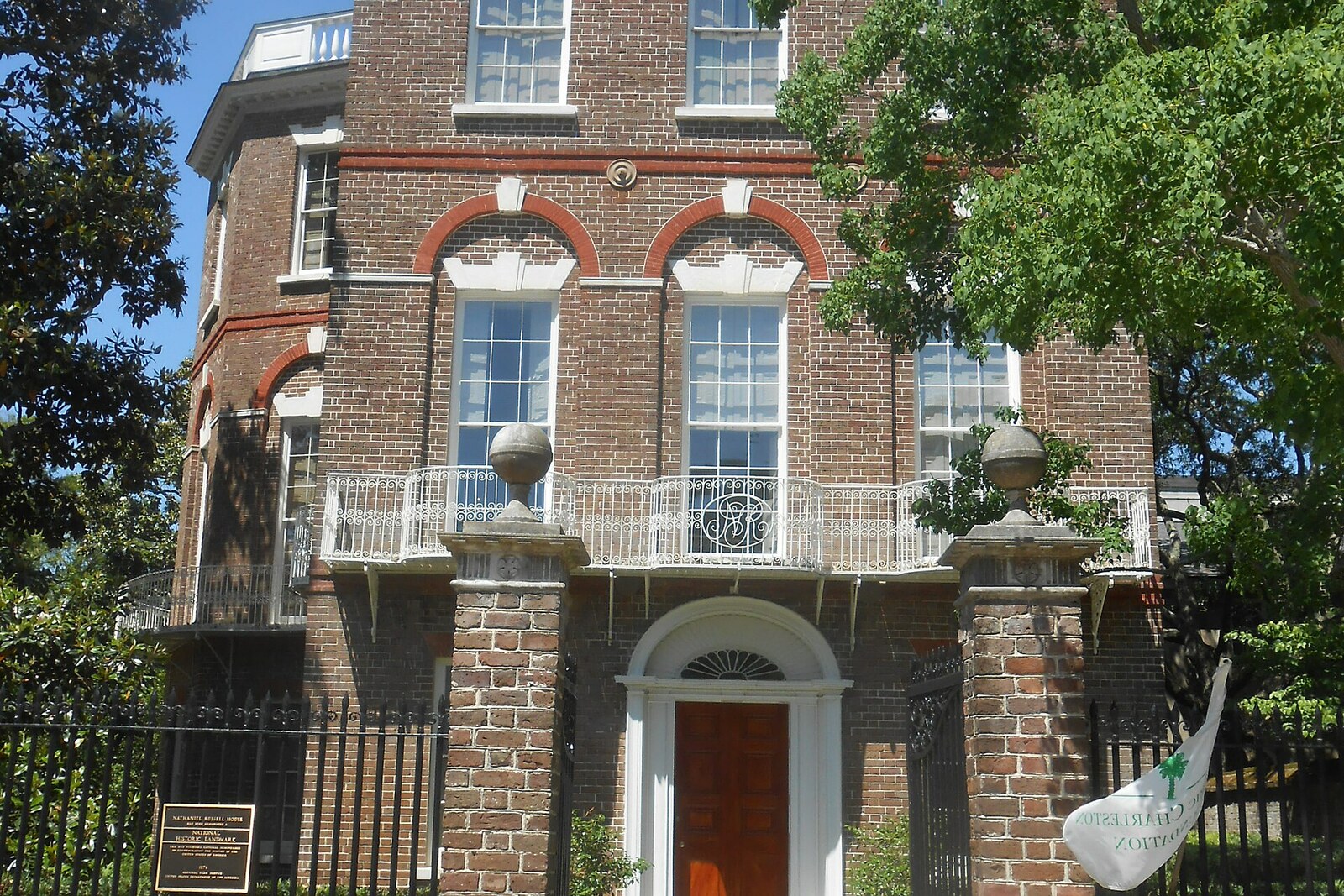
Look around first
What to notice
- Monogram on the balcony railing
- Three-story cantilevered staircase
- Brick kitchen building
- Original whitewash of the rooms
The story of the place
In the spring of eighteen oh eight, the seventy-year-old merchant Nathaniel Russell moved here with his wife, two daughters, and eighteen enslaved men and women. The house bears Russell's name because he commissioned this mansion and made it a testament to his status in Charleston: his monogram is woven into the balcony railing, and inside rises a three-story cantilevered staircase without the usual supports.
Russell traded in rice, indigo, tobacco, and cotton, imported expensive goods, and acted as an intermediary in the sale of captives brought from Africa. Enslaved day laborers, masons, and carpenters carried out most of the construction work. After the housewarming, other enslaved people prepared food, did laundry, tended the garden and horses, and served the family and its guests.
These activities were divided between two buildings. The formal rooms were in the mansion, and a brick kitchen building stood behind it. The kitchen and laundry were separated from the residence because of heat, humidity, and fire danger; rooms for enslaved people were arranged above the workspaces. A visitor saw oval halls, gilding, and the broad staircase. Much of the labor remained in the yard and behind the walls of the rear building.
In the twentieth century, the rooms above the kitchen were covered with drywall and adapted for offices and storage. In twenty seventeen, architectural historian Ed Chappell, historic-paint specialist Susan Buck, and conservator David Hoffman began looking for the original finishes. Hoffman made a small opening in the later paneling. Beneath it, early nineteenth-century plaster and lime whitewash had survived. When the paneling was removed further, old doors, window frames, wooden details, and painted surfaces came to light—almost an entire room from the era of slavery.
Undisturbed rat nests lay in the voids. The researchers took them apart layer by layer and found buttons, pins, scraps of clothing, a small box containing a cosmetic product, and two scraps of paper. One could be matched to a newspaper from November eighteen thirty-three. The other turned out to be a fragment of a primer.
It is impossible to establish who owned the primer: rats may have dragged the paper in from a neighboring room. The find therefore does not prove that any of the room's residents learned to read, although that possibility is especially significant where the education of enslaved people was restricted by law. It proves something else: a learning sheet ended up beside their dwelling and lay in the wall together with everyday belongings.
After this discovery, the museum added the uncovered spaces to the tour and began a separate study of the kitchen building. Now, in the formal section, the Russell house is being restored as it was shown to guests in eighteen oh eight, while behind it the original whitewash is being studied in the rooms where the people who built and served this mansion lived.
Useful on site
Mon 13:00-16:00, Tue-Sun 10:00-16:00; guests may remain until 17:00.
Checked: June 28, 2026. Check the official source before visiting.A separate visit is needed for the interior. Inside, do not limit yourself to the formal rooms: the service section is necessary for understanding the whole house.