 Guide On Map
Skadarlija and Dorćol: From the Market to the Danube River
From Bajloni Market through Skadarska Street and Upper Dorćol to the Danube River quay
Guide On Map on your phone
Open the walk like a regular app
It takes about 10 seconds to install. No app store needed.
The whole path
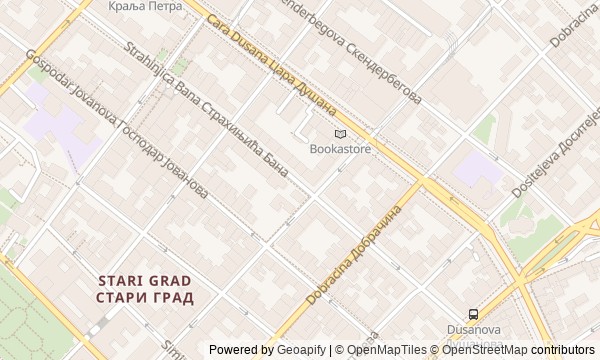
Route map
About the walk
You will begin at the market stalls, then step into a factory yard, cross old Skadarlija and the residential streets of Upper Dorćol, and finish by the Danube River. Along the way, the evening neighborhood will change its shape several times: market, brewery, working church, kafanas, school building, mosque, waterfront.
Why is the market called something other than what appears in official documents? What does a factory yard have in common with a cultural venue? How could a parish exist for decades without a building of its own, while a street acquired its “old-time” look through a modern project?
The story will stay close to civic decisions, students’ notebooks, signs, and a disputed account of the final attack. It will separate what is documented from later legend and will not cover up a defeat with heroic rhetoric. By the water, you will be able to tell apart an old building, a reconstructed image, and a name that outlived the place that disappeared.
Why this order
The market introduces a family name that leads straight into the neighboring yard of Bajloni Brewery: first you will see the enterprise’s trace in the city’s language, then the space of production itself. From the factory yard, the road continues into Dorćol, to a parish that grew out of a field church. After the story of a building that did not exist for a long time, Skadarska Street offers the opposite case: old houses were preserved, but the familiar image of the neighborhood was assembled anew. From the kafanas, the route follows Gospodar Jevremova Street to the building of the Great School, where the city learned to train civil servants. The next stop stands on the same street: beside the school building, you will see the place of worship the authorities chose for the remaining Muslim community. From the mosque, the descent to Lower Dorćol completes another change of urban setting: residential blocks give way to the waterfront, where the quay’s name returns the route from preserved buildings to a lost battlefield.
Those who want to see Skadarlija beyond its restaurant street Those interested in civic decisions and the fates of ordinary buildings Those who prefer documented history without ceremonial rhetoric
Those looking only for an evening bar route Those who do not want to end the walk with military history Those uncomfortable with uneven cobblestones and a descent to the river
Before you go
Start a few hours before dark: the market will still feel like a working place, while the waterfront, memorial, and river edge can be seen in the remaining light. Wear shoes suited to uneven cobblestones, and do not expect to cover the whole route at a brisk pace—details along Gospodar Jevremova Street are spread across both sides of the street. Access to the museum, the Cetinjska Street yard, and individual venues may depend on their current hours; if the interior matters to you, check separately before setting out. At Bajrakli Mosque and the Church of St Alexander Nevsky, follow the rules of an active religious space, do not disturb prayer, and do not photograph people without permission.
When to go
Allow 2.5–3.5 hours. The lower end works for exterior viewing and short pauses; the upper end is needed if you visit the museum, linger in the brewery yard, or want to sit quietly by the Danube River.
Backup plan
If market trading has already wound down, take in its boundaries and head straight to the lower part of Skadarska Street: the story of the Bajloni name still continues in the yard of the former brewery. If the Cetinjska Street yard is closed or overcrowded, read it through its exterior brick buildings without changing the order that follows. If the Museum of Vuk and Dositej is unavailable, pause at its Ottoman facade and compare it with the neighboring Bajrakli Mosque—the architectural connection remains visible. In bad weather or if you are tired, it makes sense to finish at the Church of St Alexander Nevsky; it is better to postpone the Danube River section than to rush through it without time for the memorial.
Route conditions
Surface. Paved — 1.6 km (data covers 78% of the route)
Elevation. Ascent — 34 m; descent — 38 m
OpenStreetMap extract of August 2, 2026: database data, not a check on the ground. Data © OpenStreetMap contributors, ODbL licence
Walk plan
Open in maps ↗- 1
Bajloni Market
Here, the first city name will appear—one that will prove more enduring than the official decision. - 2
Cetinjska Street fifteen—the courtyard of the old brewery
The nearby market makes it possible to trace a family enterprise from industrial growth to the new occupation of its buildings. - 3
Church of St Alexander Nevsky
The history of the parish shows how the church’s name was preserved even when there was no church building of its own. - 4
Skadarska Street
This stop will explain why the street’s old appearance required a modern project and functioning kafanas. - 5
Museum of Vuk and Dositej
A residential house will become the starting point for a conversation about the first students, who were trained not for a trade but for civil service. - 6
Gospodar Jevremova Street
Here, a specific decision about the building, the staff, and their upkeep will explain the fate of the city’s only functioning mosque. - 7
Dorćol Danube River Quay
The finale returns the heroic legend to the place where the confirmed counterattack ended in failure.
Route features
Everything you need stays in the browser
Progress, saves and your trip plan are stored on this device.
Add Guide On Map to your home screen so the walk opens outside the browser.
How we handle sources, maps and corrections: our editorial standards