 Guide On Map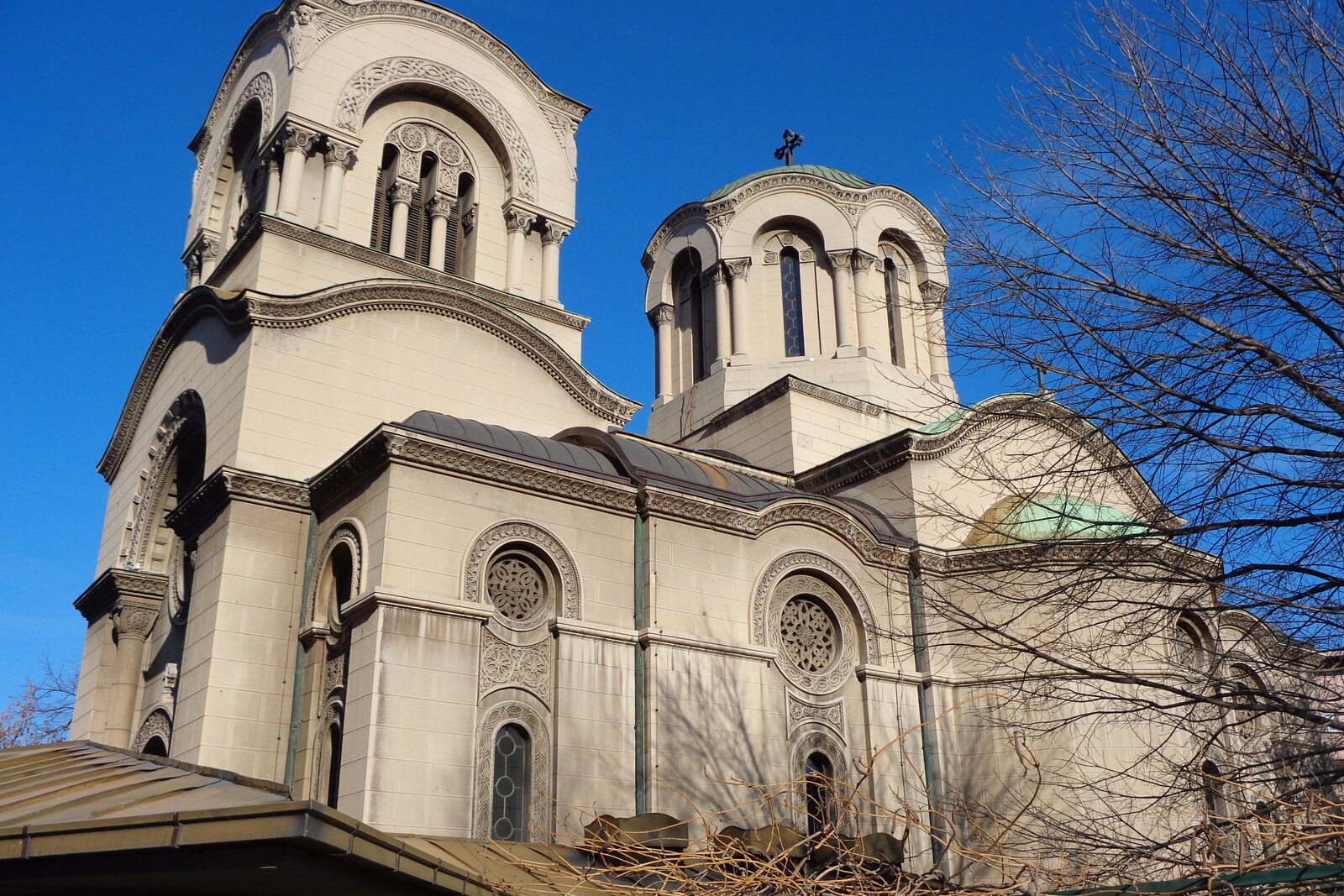
Look around first
What to notice
- Church facade
- Dome
- Marble iconostasis
- Bell tower
The story of the place
Behind the facade with its bell tower and dome stands the active church of the Dorćol parish. Construction of the present building began before the Balkan Wars, but work was suspended for a long time and was completed only after the First World War. Inside, the marble iconostasis transferred here by King Alexander I from Oplenac has been preserved.
In eighteen seventy-six, the retired Russian general Mikhail Chernyayev entered Serbian service to command troops in the war against the Ottoman Empire. Along with Russian volunteers, a portable church was brought to Serbia: a frame of metal rods, a canvas covering, a wooden iconostasis, icons, and two small bells. It could be dismantled, loaded onto carts, and set up beside an army camp. It accompanied the volunteers to the Deligrad Front.
Many of those who arrived were career officers. To take part in this war, they had to temporarily resign from service. Emperor Alexander II allowed those who returned to keep their rank and place in the regiment: their pay and further careers depended on this promise. The guarantee applied only if they returned. The volunteers suffered heavy losses, the Serbian army was defeated at Đunis, and after the armistice most Russians went home. The church furnishings remained in Belgrade.
The portable church was dedicated to Alexander Nevsky. This was the name given to the Novgorod prince Alexander Yaroslavich after his victory over the Swedish army on the Neva River in twelve forty. The Russian Church canonized the prince, and the army revered him as its patron. In eighteen seventy-six, this name also referred to Emperor Alexander II, who allowed the officers to leave for Serbia.
The residents of Dorćol were seeking a parish of their own at that time. They received the furnishings of the military chapel and in eighteen seventy-seven built a small church with a wooden frame and brick infill. It stood east of here, at the intersection of Cara Dušana Street and Dubrovačka Street. The people of Dorćol preserved the dedication to Alexander Nevsky in memory of the people who brought the portable altar here.
Fourteen years later, the city council decided to build a modern elementary school on this site. The church extended beyond the new line of the block by about half a meter. Metropolitan Mihailo of Belgrade demanded that a replacement be built first; the municipality promised to do so within three years, but in eighteen ninety-one workers dismantled the old church.
For three years, the parish held services in the Cathedral Church, then moved to the House of Saint Sava, and from nineteen oh-two to a room in Dorćol School. The result was literal: the school took the church’s place, and the church community moved inside the school. On its official seal, throughout this time, it was called the Danube Chapel of St Alexander Nevsky.
The foundation of the present building was laid in nineteen twelve. The Balkan Wars and the First World War halted the work; builders returned here only in nineteen twenty-seven. In nineteen thirty, the church was consecrated, and after thirty-nine years in other premises, the parish once again had a building of its own.
Today it is an active church of the Serbian Orthodox Church. The portable canvas and metal frame are not here, while King Alexander I transferred the present marble iconostasis from Oplenac. The military chapel left its name on the facade: Alexander Nevsky. It remained on the church seal even when the people of Dorćol had no church itself.
Useful on site
An active Orthodox church; opening hours, services, and photography depend on the parish schedule. Unrestricted tourist visits are not guaranteed.
Checked: July 1, 2026. Check the official source before visiting.Enter quietly if there is no service or restriction; view the interior as the space of an active parish, not a museum display.