 Guide On Map
Amsterdam's Old Port and Medieval Center
From Amsterdam Centraal along Damrak and the old canals to Zuiderkerk
Guide On Map on your phone
Open the walk like a regular app
It takes about 10 seconds to install. No app store needed.
The whole path
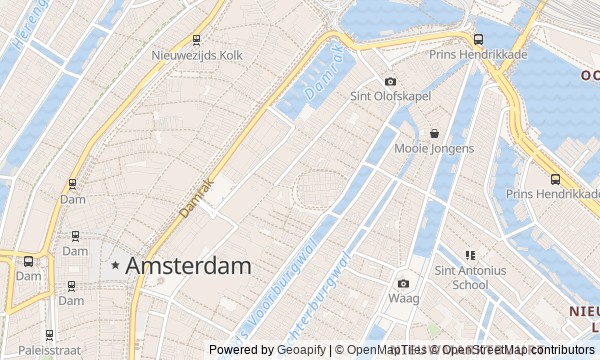
Route map
About the walk
You will begin at Amsterdam Centraal, on the former edge of the harbor, then follow Damrak into the medieval half of the city. Water, a filled-in channel, narrow canals, and old church squares will succeed one another without taking you far from the center.
Behind familiar facades lie spaces whose purpose you would never guess from the street: an exchange whose future merchants found inconvenient, a church in the attics of three houses, a weigh house with a separate door for surgeons. You will spot a clock face that does not tell time and learn why a famous painting acquired a hand that should not have been there.
The story moves through contracts, debts, bans, and city decisions. Calmly, without mercantile glitter or museum solemnity. By the end, you will connect Amsterdam's canals not with a postcard, but with a port, a house church, an exchange hall, and an office from which a ship would set out in search of Asia.
Why this order
First, you will stand on the line of the former harbor and follow Damrak, the old entrance route for ships, to the exchange built directly over a filled-in channel. From the merchants' building, the route turns into De Oude Zijde, to a house with a hidden church: a private response to a religious ban sets up the story of Oude Kerk, where that same ban changed the work of the city organist. Next, former defensive canals lead to De Waag (Saint Anthony's Gate), a gateway adapted for trade and guilds after Amsterdam expanded. After the local control of goods at the weigh house, you will reach the office from which directors sent ships across the ocean. The final stretch to Zuiderkerk changes the scale: from global trade to a single church nave, which city officials used for the hardest work of wartime.
Those visiting Amsterdam's oldest quarters for the first time Lovers of urban history, trade, and religious conflict Those who prefer human stories to a list of architectural styles
Those expecting a walk only among grand canals and wealthy mansions Those who find it difficult to listen to stories of execution, religious bans, and wartime hunger Those looking for an easy route centered on famous people's biographies
Before you go
Check access to Oude Kerk and the conditions for visiting its tower: the church and the climb may require separate tickets, and tower walks do not run continuously. Oost-Indisch Huis is used by a university, so its courtyard cannot be considered a guaranteed open attraction. Zuiderkerk serves as an event venue, and it is not always possible to get inside. Bring headphones, comfortable shoes, and rainwear: much of the route remains worthwhile even without entering the buildings.
When to go
It is best to set out in the first half of the day, when it is easier to stop and examine details along Damrak and around Oude Kerk. On weekends and market days, Nieuwmarkt is especially lively, but it is harder to listen to a long story there.
Backup plan
If Oude Kerk is closed, take in its form, tower, and close relationship with the surrounding houses, then listen to the story from the square. At Oost-Indisch Huis, it is enough to see the entrance and the exterior facades; do not try to enter through closed university doors. If Zuiderkerk is inaccessible, view it from Groenburgwal, where the tower and the church's place in the quarter's skyline are clearly visible. In rain, make brief stops beneath awnings without blocking entrances or narrow sidewalks.
Route conditions
Surface. Paved — 1.7 km (data covers 88% of the route)
Stairs. Flights: 1, 13 m in total
Access. Wheelchair — no; stroller — limited (stairs)
Facilities. Toilets — 9; drinking water — 7
Elevation. Ascent — 21 m; descent — 21 m
OpenStreetMap extract of August 12, 2026: database data, not a check on the ground. Data © OpenStreetMap contributors, ODbL licence
Walk plan
Open in maps ↗- 1
Amsterdam Centraal
It will show how the railway took over the edge of the harbor and changed the main entrance to the old city. - 2
Damrak and the Beurs van Berlage
Here, the merchants’ commission will collide with the architect’s vision of a world in which the former exchange trade will disappear. - 3
Oudezijds Voorburgwal
It shows how a wealthy merchant set up a church hall behind an ordinary facade and lost his houses because of debts. - 4
Oude Kerk
It will show how the ban on the organ during services turned church music into an open public performance in the city. - 5
Nieuwmarkt and De Waag (Saint Anthony's Gate)
Links the former city gates, goods scales, and a public lesson whose commissioned image changed the career of a young artist. - 6
Oost-Indisch Huis
It shows how a single contract for a northern expedition carried the history of an Amsterdam office far beyond Asia. - 7
Zuiderkerk
It will show how city officials used an empty church hall when the regular burial service could no longer cope.
Route features
Everything you need stays in the browser
Progress, saves and your trip plan are stored on this device.
Add Guide On Map to your home screen so the walk opens outside the browser.
How we handle sources, maps and corrections: our editorial standards