 Guide On Map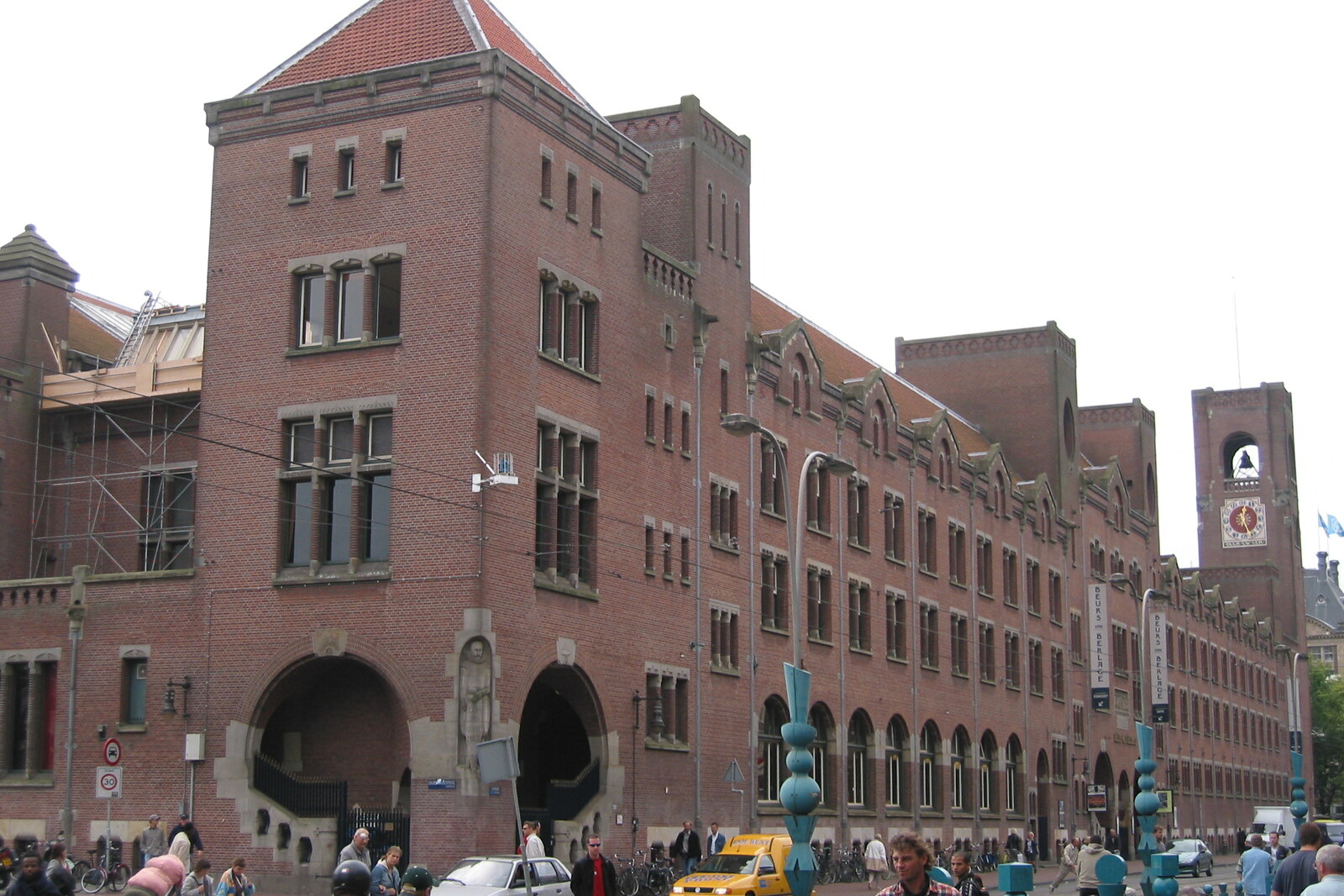
Look around first
What to notice
- Three ceramic panels in the vestibule
- The sawtooth roof of the former grain hall
- The north-facing windows of the grain hall
- The open water of Damrak
The story of the place
In the Beurs van Berlage building, merchants concluded deals in goods, securities, currency, and ship cargoes within a few hours. Different kinds of trade had their own halls; the sawtooth roof of the former grain hall and its north-facing windows provided even light for comparing grain samples. Trade has left this place, and concerts, exhibitions, congresses, and receptions now take place in these rooms.
The name Damrak comes from the water. The Dutch word “rak” means a straight stretch of a watercourse: here, the Amstel ran from the dam to IJ Bay. In the Middle Ages, this was a harbor. Seagoing vessels unloaded by the IJ, smaller ships went closer to the dam, and merchants kept warehouses, offices, and inns nearby. In the nineteenth century, the city council filled in the southern part of the riverbed. The Beurs stands on the former riverbed; open water survives only to the north.
The merchants themselves demanded that a new building be erected here. The previous exchange stood by Dam Square, roughly on the site of today’s department store. It was dark, cramped, and drafty. In eighteen eighty-four, the city held an international competition. Hendrik Petrus Berlage, an architect seeking his first major public commission, came only fourth. The city built neither the winning design nor any of the others.
Twelve years later, the commission did go to Berlage. It was a professional breakthrough for him: until then, he had designed mainly private homes and offices, but now he was given an entire city block on the main route between the station and Dam Square. Construction began in eighteen ninety-eight.
The merchants needed a place where, within a few hours, they could conclude deals in goods, securities, currency, and ship cargoes. Their income depended on such meetings. Berlage provided separate halls for different kinds of trade. In the grain hall, buyers rubbed samples between their fingers and assessed them in the even northern light; the windows in the sawtooth roof were oriented specifically for this inspection.
But Berlage himself was a socialist and considered exchange trading a temporary activity. He expected that, in the future, the building would become a people’s palace—a shared home for gatherings, art, and education. The architect built this future destiny into the decoration before the merchants entered.
Berlage commissioned the artist Jan Toorop, who was assigned to depict the history of trade, to create three large ceramic panels: “The Past,” “The Present,” and “The Future.” In them, trade appeared as a stage of human history that was to be followed by a society without the former division into classes. People came to earn money at the exchange, while the walls told them that the world on which their income rested would disappear.
After the building opened in nineteen oh three, the merchants regarded Berlage’s idea with suspicion. Three years later, they tried to remove Toorop’s panels from the vestibule. The attempt failed: all three images remained in place.
Trade left the building piece by piece. The securities market quickly outgrew the hall allotted to it and moved to a separate exchange in nineteen thirteen. Last to leave, in nineteen ninety-eight, was the agricultural futures trading floor. Congresses, concerts, exhibitions, and receptions now take place inside, and the former Merchants’ Exchange bears the architect’s name—the Beurs van Berlage. The panels the merchants wanted to remove are still in the former vestibule.
Useful on site
I amsterdam lists the building’s hours as Mon–Fri 08:30–17:30, but public access to the halls depends on events, tenants, and the Beurs van Berlage event schedule.
Checked: June 28, 2026. Check the official source before visiting.The street is crowded with pedestrians, trams, and bicycles; choose a wide spot by the water or the facade for listening. Visiting the exchange’s rooms depends on events taking place inside.