 Guide On Map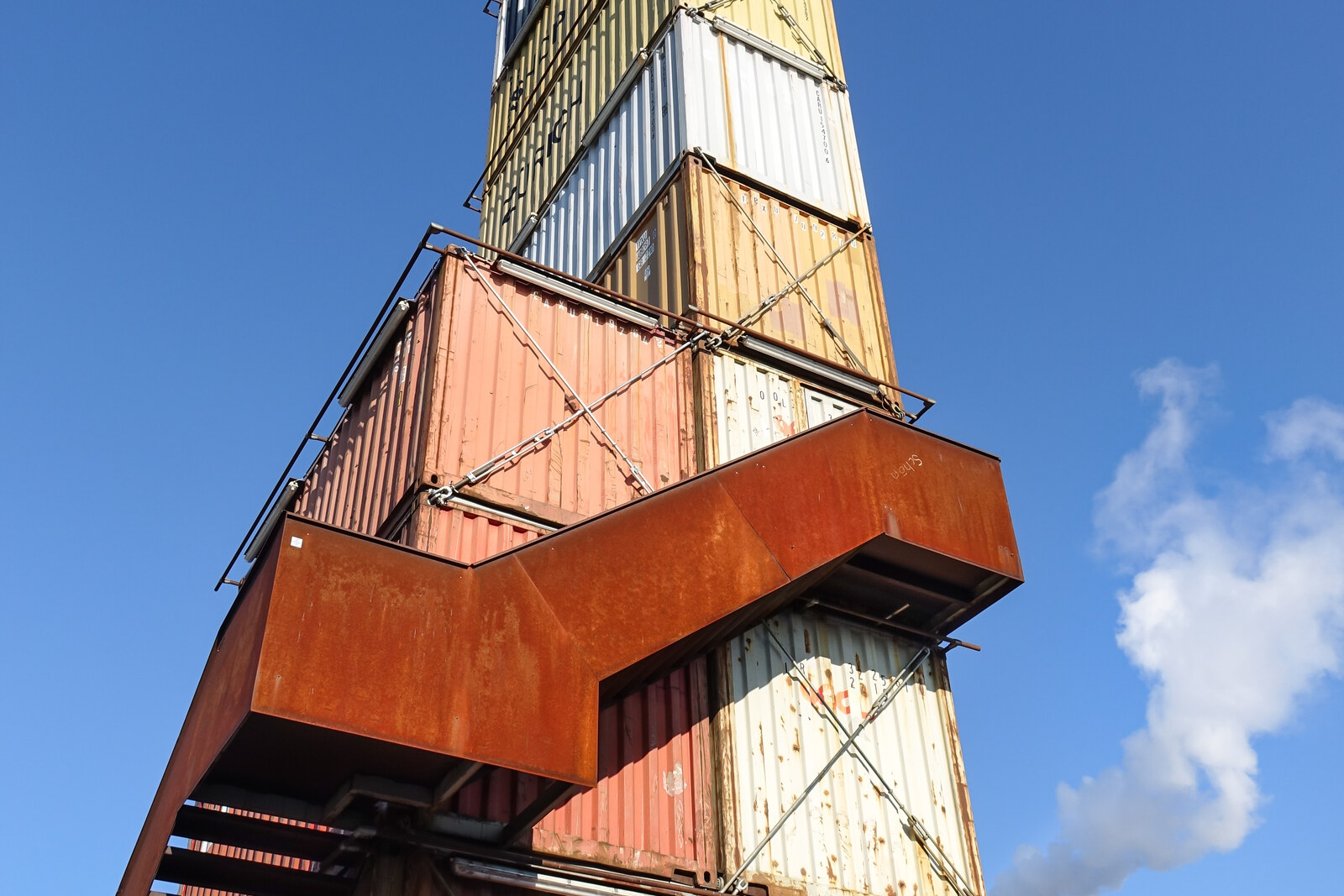
Look around first
What to notice
- Container tower
- Steel braces
- Side modules
- Viewing platform
The story of the place
The four lower levels here are given over to sales rooms, and above them a staircase rises to the viewing platform. A heavy foundation slab and steel braces hold up the nearly twenty-five-meter structure: without them, a strong wind could have toppled it. There are now nineteen modules on the façade—two side modules were added later, and the structure, originally intended to be short-lived, has outlasted its expected term.
This tower of shipping containers is the store of FREITAG. Freitag is the surname of brothers Daniel and Markus Freitag, graphic designers from Zurich. In nineteen ninety-three, they sewed themselves a sturdy bicycle bag from an old truck tarp, car seat belts, and an inner tube from a bicycle tire. Over time, this became their craft and their company. By two thousand six, the brothers were selling more than one hundred twenty thousand bags a year and were looking for a site in Zurich for their own large store.
One morning, Markus was walking to the workshop when he saw a notice here: a parking area for rent. The site was well located, but too small for a conventional retail building. That evening, the team was stacking building blocks and came to the decision to place rooms one on top of another. For the brothers, this was their first major investment: they built the tower with a loan obtained from the bank on the other side of the street.
The architects Annette Spillmann and Harald Echsle turned this idea into a store. In Hamburg, seventeen decommissioned shipping containers were selected and delivered to Zurich by train. They were joined using the fittings employed in sea transport: the structure was intended to be easy to dismantle. This mattered on a leased site, where the owners expected to remain for only five to ten years.
But stacking ready-made boxes was not enough. To create sales rooms, the builders cut out the longitudinal walls and floor slabs, then welded in steel braces. Engineers added a heavy foundation slab; otherwise, a nearly twenty-five-meter stack could have been toppled by a strong wind. The store occupied the four lower levels, while nine container tiers formed a stair tower leading to the viewing platform.
The store opened in two thousand six. Later, two more side modules were added, so there are now nineteen containers here. In two thousand nineteen, the building was renovated, although the original ten-year term had long since expired.
Down below, they still sell bags made from worn-out truck tarps. Above, a panoramic information panel shows, among the city landmarks, the house on the other side of the tracks where the brothers sewed their first prototype. The tower has remained in place longer than its creators expected, and the number of containers on its façade preserves the trace of its expansion: the original seventeen and the two attached later.
Useful on site
Mon–Fri 11:00–19:00, Sat 10:00–18:00, Sun closed; the terrace is open during store hours.
Checked: June 26, 2026. Check the official source before visiting.The container structure is visible from the street; go inside and climb up only when the store is open and access is not restricted.