 Guide On Map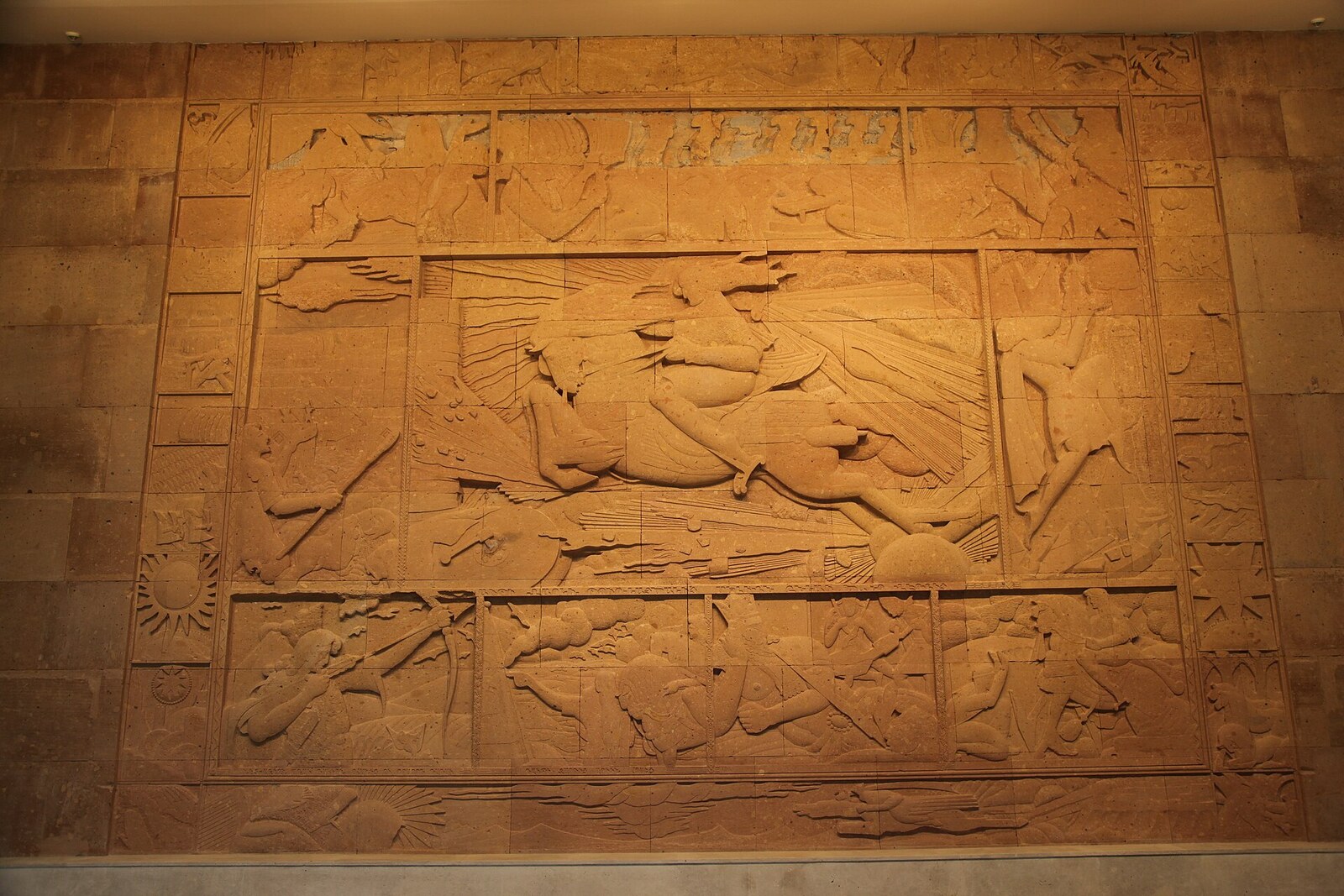
Look around first
What to notice
- Multi-figure tuff relief
- David on horseback
- Carved lines from the epic
- Fortress walls along the edges of the composition
The story of the place
Inside the Cafesjian Center for the Arts, one of the Yerevan Cascade’s halls is devoted to a stone telling of the Armenian epic. An entire wall here is carved from tuff: deep in the relief, David rides on horseback with a sword, while more than thirty scenes are arranged around him. On either side rise fortress walls, mountains, and a monastery; lines from the epic run beneath individual figures. In this museum space, created from a collection of contemporary art, the wall was left as an independent permanent display.
For four years, the sculptor Artashes Hovsepyan and four stonemasons carved this multi-figure wall from tuff. They were supposed to be paid after the entire work was completed. It proved impossible to complete it—and, according to Hovsepyan, neither he nor the craftsmen ever received payment for those four years.
In the mid-eighties, Yerevan Cascade architect Jim Torosyan was assembling themed exhibition halls inside the complex. He wanted to devote one wall to the Armenian epic and asked Hovsepyan to enlarge Hakob Kojoyan’s graphic composition David of Sassoun, created in nineteen twenty-two. Hovsepyan agreed: the small sheet was to be turned into an image about fifteen times larger than the original.
Sassoun is a mountainous region of historical Armenia. David is the main character of the third part of the folk epic Daredevils of Sassoun, that is, Daredevils of Sassoun. The ruler of Egypt, Msra Melik, demands tribute from the people of Sassoun and sends his men to collect it. David stands against him and defeats him in a duel. That is why, at the center of the composition, he rides the horse Kurkik Jalali, raising a lightning sword. More than thirty episodes are arranged around him: David’s birth, his first hunt, and encounters with Msra Melik’s people. Lines from the epic are carved beneath individual scenes; along the edges run fortress walls, mountains, and Maruta Monastery.
Hovsepyan had to turn Kojoyan’s lines into volume directly on the wall. A figure that fit among ornament on paper projected from the stone in the hall almost in full. The four craftsmen transferred the drawing to the tuff and cut away the background around the bodies, horses, and inscriptions. When the work neared its end, the Spitak earthquake of nineteen eighty-eight halted construction of the Yerevan Cascade. Then Soviet funding disappeared. Torosyan tried to find money to continue, but Hovsepyan refused to work further without payment.
Later, the wall was covered, and works of glass were displayed in the hall. This was the state in which the relief was encountered by Gerard Cafesjian—an American businessman and collector of Armenian descent—whose foundation undertook the restoration of the complex in two thousand two. Cafesjian gave the future museum his collection of contemporary art; when the center opened here in two thousand nine, it was named after its founder.
The relief remained behind a partition for several more years. In May two thousand sixteen, the Cafesjian Center for the Arts opened it to the public for Hovsepyan’s eighty-fifth birthday. After a break of many years, the sculptor saw his wall in its entirety; he died the following summer. They did not have another master complete the relief.
Today it is still unfinished and forms the permanent display of the David of Sassoun hall. At the center’s classes, schoolchildren choose an episode from the same epic, redraw it as a comic, and put together a new illustrated book.
Useful on site
Exhibition galleries and visitor center: Friday–Sunday 10:00–20:00; Escalator Gallery: daily 08:00–20:00; sculpture garden open continuously. Closed on public holidays.
Checked: June 24, 2026. Check the official source before visiting.The relief and triptych are indoors, so seeing them depends on access to the halls; the outdoor sculptures can be viewed separately.